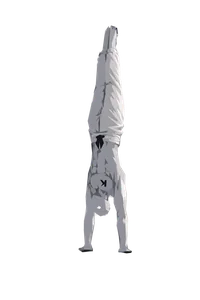
Element preview
The wall plank is an entry-level isometric hold that loads the shoulders more than a standard floor plank by resting the feet against a wall, without any of the balance demands of being upside down. This is the feet-on-wall incline variant — hands stay on the floor and only the shins or feet rest on the wall — distinct from a hands-on-wall vertical plank against a wall. It is the first rung on the vertical-pushing ladder, building the shoulder and core bracing needed before progressing to the wall handstand, with wall walks available as an optional intermediate drill.
Technique
- Stand facing away from a wall, then bend down and place your hands on the floor shoulder-width apart, roughly a leg-length away from the wall.
- Rest your shins or feet against the wall so your body forms a long incline, with the hips slightly higher than in a flat floor plank.
- Stack your shoulders directly over your wrists and push the floor away, spreading the shoulder blades to keep the upper back flat rather than sunken.
- Brace the core, squeeze the glutes, and keep a straight line from shoulders to heels — no sagging or piking at the hips.
- Hold the position while breathing normally, then step down with control to exit.
Preparation
Equipment and conditions
A flat, sturdy wall and enough clear floor space in front of it to place the hands a leg-length away. No other equipment is required.
Set up close enough to the wall that the incline feels challenging but the hips do not sag. As the hold gets easier, walk the feet slightly higher up the wall to increase shoulder loading before progressing to the more upright wall handstand.
Risks
The exercise carries little inherent risk, but a sagging lower back or flared elbows can still irritate the shoulders or lumbar spine over repeated holds. Keep the ribcage down and the hips in line with the shoulders, and stop the hold once form breaks down rather than fighting for extra seconds.
Muscles


The shoulders take the bulk of the load as the prime movers stabilizing the incline, with the core working hard to resist the hips sagging or piking. Triceps, trapezius, and forearms assist in locking out the arms and gripping the floor, the glutes squeeze to help keep the hips in line with the shoulders, and the chest, hands, and lower back play smaller supporting roles.
Stats
- Strength
- 0.00
- Endurance
- 0.00
- Control
- 0.00
- Balance
- 0.00
- Mobility
- 0.00
- Power
- 0.00
This is primarily a strength exercise with a strong endurance component: the shoulders and core must produce steady isometric tension for the full length of the hold. Control plays a smaller supporting role in keeping the body line from sagging or twisting, while balance and mobility demands stay low thanks to the wall support taking over the balance task.
Completion criteria
Hold a strict wall plank with a straight body line and stable shoulders for 45–60 seconds before progressing to the wall handstand, the next step on the vertical-push tree (wall walks are an optional intermediate drill).
Progression thresholds
- Lower threshold
- 15 s
- Upper threshold
- 45 s
Once a strict hold is comfortable well past the 45-second mark, move on to the wall handstand hold, the direct next node on this vertical-push tree; wall walks can serve as an optional stepping drill along the way. If the line breaks down before 15 seconds, regress to a standard floor plank until basic shoulder and core bracing improve.