Element preview
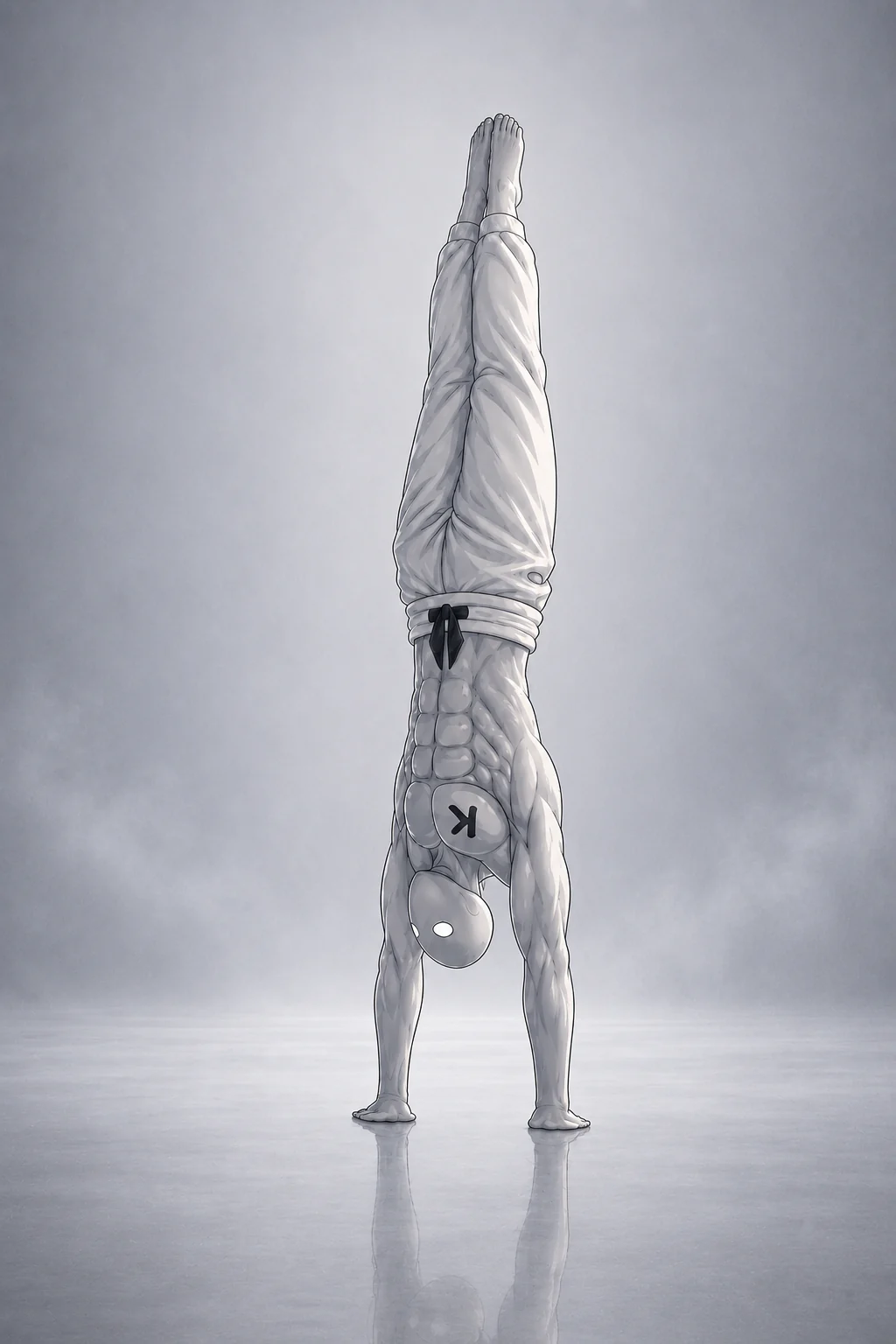
Preview · 0:06
A short look at the whole element in motion.
This is an overview clip, not a technique reference — the form in it may be imperfect. Follow the steps in Technique.
The handstand is one of the most fundamental elements in calisthenics and gymnastics. It is an inverted static position where the body is held vertically on both hands. The movement demands a well-developed sense of balance, proprioceptive control, and core stability — all of which are counterintuitive relative to the body's natural upright orientation.
In the gymnastics Code of Points the handstand is classified as an A-level skill and serves as one of the key indicators of an athlete's overall ability. Those who possess a confident freestanding handstand tend to perform better across the board: flips, turns, and any inverted movements become significantly easier.
Mastering the freestanding handstand opens the path to more advanced skills — handstand on parallettes, on rings, and ultimately the one arm handstand.
Technique
- Kick up to a freestanding handstand, driving for full-body vertical alignment without touching a wall.
- Stack shoulders over hands, hips over shoulders, heels over hips, with scapulas elevated and slightly retracted at the top.
- Balance through the fingertips with small wrist corrections; minimize both kick-up wobble and static swaying.
Preparation
Before working on the freestanding handstand, make sure you can confidently perform:
- Wall Handstand — at least a 20-second hold against the wall with proper alignment (full scapular elevation, straight body, eyes directed at the hands)
In addition, it is recommended to have:
- Good shoulder mobility — shoulders should fully open into an overhead position (180° flexion)
- Kick-up and bail technique skills — the ability to safely enter and exit the handstand
- Strong grip control — the ability to manage balance through the fingers and wrists
Start practicing on the floor. Transition to parallettes and rings only after you can confidently hold a freestanding handstand. Although parallettes technically make gripping easier, the floor is safer for practicing entries and bails.
Risks
- Falling out of the handstand — always practice a safe bail (pirouette or roll out) before training freestanding holds.
- Excessive lumbar arch ("banana handstand") shifts load onto the lower back instead of the shoulders and core.
- The wrists bear the full bodyweight in an extended position; build up wrist tolerance gradually and warm up thoroughly to avoid overuse strain.
Muscles


The primary load falls on the shoulders (deltoids), which bear the entire body weight in the overhead position. The trapezius muscles work to elevate and stabilize the scapulae. The forearms and hands provide balance control through constant micro-corrections at the wrists — they are responsible for the "fine-tuning" of the position. The core muscles (rectus abdominis, obliques, transverse abdominis) work in a stabilizing mode to maintain a straight body line. The triceps keep the elbows locked in extension.
Stats
- Balance
- 0.00
- Control
- 0.00
- Strength
- 0.00
- Endurance
- 0.00
- Mobility
- 0.00
- Power
- 0.00
The movement is predominantly balance-oriented. Although holding the body upside down requires a certain level of shoulder strength, the key factor is balance and proprioceptive control. The strength component is minimal compared to strength-based elements like the planche.
Completion criteria
Hold a freestanding handstand for 20 seconds with only minor wrist corrections.
Progression thresholds
- Lower threshold
- 15 s
- Upper threshold
- 20 s
Once you can consistently hold a freestanding handstand for 20 seconds with minimal corrections, the movement is considered mastered. For further progress, build up to 30 seconds and then aim for a 60-second hold. After that, you can transition to handstands on parallettes and gradually work toward ring handstands or begin training the one arm handstand.
Practice the handstand daily — it is a skill that develops primarily through training frequency. Strive to minimize swinging both during the kick-up (dynamically) and during the hold itself (statically). The ideal handstand is one where corrections happen only at the wrists while the body remains a motionless straight line.