Element preview
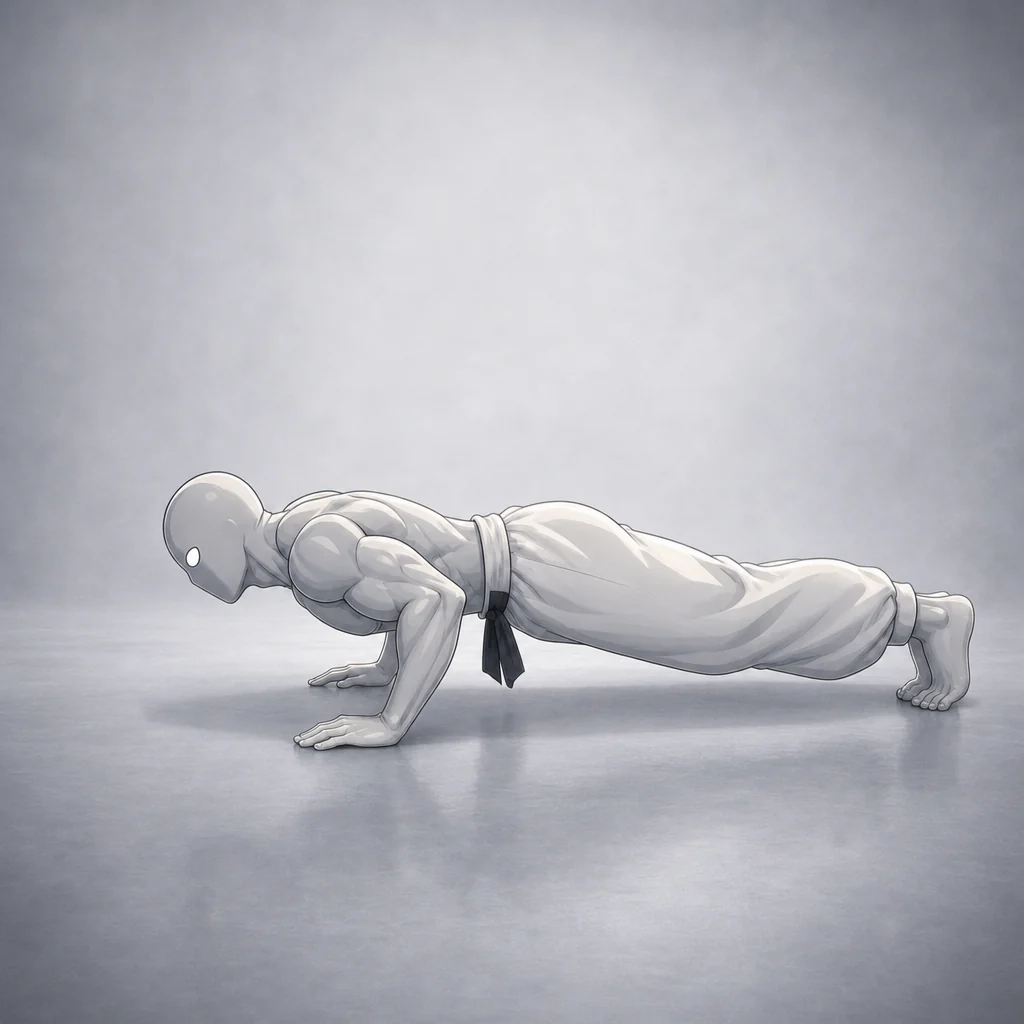
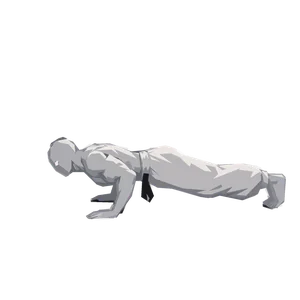
The push-up is the foundational bodyweight pressing movement: a plank held rigid from head to heels while the arms bend and straighten to lower and raise the whole body. It asks for very little in the way of equipment or space, which is why it usually sits at the base of every horizontal pushing progression — pike, pseudo-planche, archer, and eventually one-arm push-up variations all build on the same straight-body pressing pattern and the same core-bracing habits learned here. It is also one of the few calisthenics staples with a body of applied research behind it: a large longitudinal study of active-duty firefighters found that men able to complete more than 40 push-ups had a substantially lower rate of cardiovascular events over a 10-year follow-up than men who could do fewer than 10, though that finding is specific to that occupational population and describes an association with general fitness rather than a direct effect of the exercise itself.
Technique
- Start in a plank position with hands roughly shoulder-width apart (or slightly wider), directly under or just outside the shoulders, feet together or hip-width apart.
- Brace the core and squeeze the legs so the body forms one straight line from head to heels — this is the position to maintain throughout, not just at the top.
- Bend the elbows and lower the whole body as one unit, keeping the elbows tracking back at roughly a 45° angle from the torso rather than flaring straight out to the sides.
- Descend until the chest is close to the floor (or the elbows reach roughly 90°), then press back up by extending the elbows, stopping just short of locking them out to keep tension on the working muscles.
Preparation
Because the push-up has almost no prerequisites in this tree, "preparation" mostly means getting the plank line right before adding reps: practice holding a strict, braced plank for time, and if full reps break down before a reasonable rep count, use an easier regression such as an incline or knee-supported push-up while keeping the same shoulder and elbow mechanics. Warming up the wrists with some light extension/flexion work before higher-volume sessions is a cheap way to reduce discomfort, since the wrists stay under load in an extended position for the whole set.
Risks
The most common fault is letting the hips sag or pike, which collapses the plank line and shifts load onto the lower back instead of the core and shoulders — bracing the core and glutes/legs throughout the rep prevents this. Letting the elbows flare out wide toward 90° from the torso, rather than back at roughly 45°, narrows the space under the shoulder and can aggravate the front of the shoulder joint over repeated reps; this is a widely repeated coaching cue rather than a measured injury statistic, so treat it as a form guideline. Because the wrists carry a large share of bodyweight in an extended position, beginners with wrist discomfort can regress to fists, push-up handles, or a slight incline while wrist tolerance builds.
Muscles


Electromyography on the standard push-up consistently finds the triceps brachii more active than the pectoralis major through the pressing range, so the triceps are treated here as the leading prime mover, with the chest as a strong secondary contributor to elbow and shoulder-horizontal-adduction force. The anterior/medial shoulder shares meaningfully in driving the press and stabilizing the shoulder blade against the ribcage. The core braces isometrically to resist the hips sagging or piking, and the lower back, glutes, and legs help hold the plank line in extension rather than acting as prime movers. The trapezius, forearms, and hands round out the picture as scapular and grip stabilizers.
Stats
- Strength
- 0.00
- Endurance
- 0.00
- Control
- 0.00
- Mobility
- 0.00
- Balance
- 0.00
- Power
- 0.00
This is a strength movement first, but with a real endurance component: push-ups are traditionally trained and tested for reps rather than a single maximal effort, and holding good form across a set draws on repeated, moderate-intensity muscular endurance more than it does on a single peak strength expression. Control matters throughout for keeping the plank braced and the shoulder blades stable, while mobility, balance, and power play comparatively small roles at this foundational level compared with more advanced pushing variations later in the tree.
Completion criteria
Perform 15-20 consecutive strict reps with a rigid head-to-heel line, full range of motion (chest near the floor each rep), and no hip sag, as a baseline before moving on to harder pressing variations.
Progression thresholds
- Lower threshold
- 5 reps
- Upper threshold
- 25 reps
Comfortably clearing the upper rep threshold with strict form — full range of motion, no hip sag, controlled tempo — is a reasonable signal to start layering on the next pushing challenge, such as a pike push-up or a feet-elevated variation. Falling below the lower threshold, or losing the plank line well before that, suggests spending more time on incline or knee push-ups and core-bracing drills before adding load back onto the wrists and shoulders.