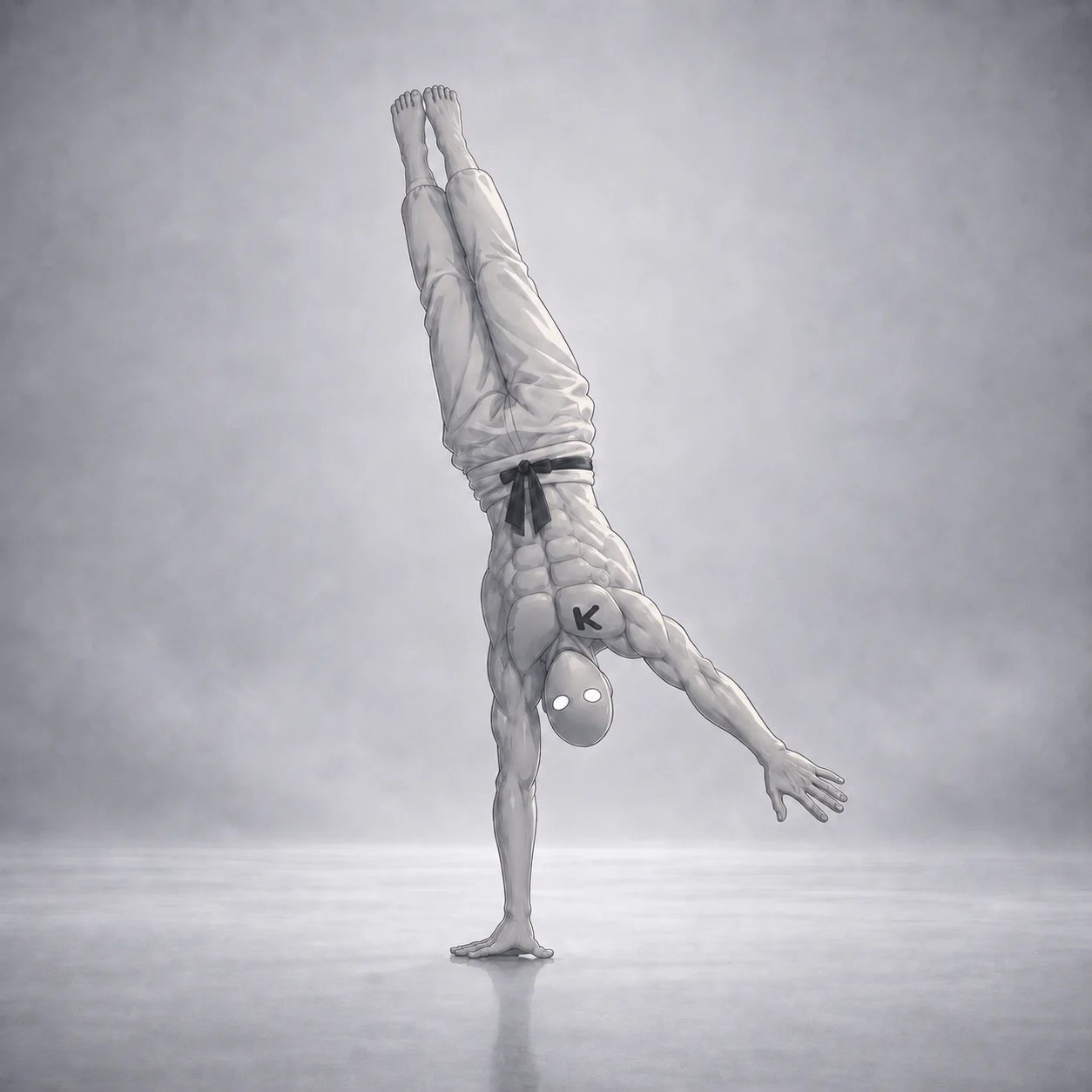
The straight-body one-arm handstand is the far end of the vertical-push line: the same single point of contact as the straddle version, but with the legs closed and stacked directly over the hips instead of spread wide for stability. Closing the straddle removes the extra leverage that made small corrections easier to catch, so the balance has to be held with more precision even though the strength and flexibility demands barely change from the straddle version. It is a milestone skill in its own right rather than a small step past its prerequisite — most people who reach a controlled straddle hold still spend a long stretch closing the legs before the straight-body line feels stable.
Technique
- Start from a solid freestanding straddle one-arm handstand — a controlled fingertip weight shift, shoulder locked in the active "earmuffed" position, and the free hand able to leave the floor for several seconds with only occasional taps back down.
- Bring the legs together and stack them in a straight line above the hips before attempting the shift to one arm; closing the straddle removes the wide leg leverage that made the earlier skill more forgiving, so the whole body now has to hold one rigid line while it balances.
- Shift the hips over the supporting hand exactly as in the straddle version — either by elevating the supporting shoulder and moving the head toward it, or by letting the head move away from the supporting arm to counterbalance the hips — while keeping the supporting arm vertical throughout and moving everything else as one piece rather than piece by piece.
- Let the free hand progressively lighten and come up onto fewer fingers (ring and pinky last) as weight transfers fully onto the supporting hand; do not lift the free hand until it is genuinely weightless, or the lift itself will pull the body back off balance.
- Lift the free arm off the floor in segments — elbow first, then forearm, then hand, similar to a ballet développé — while keeping it bent and close to the floor at first so it can tap straight back down if the hold starts to break; only extend the free arm further from the body, and eventually alongside it, once the hold is consistently controlled.
Preparation
The straddle one-arm handstand — a fingertip weight shift held for around 30 seconds and the free hand able to leave the floor briefly — is the direct prerequisite for this skill, alongside the freestanding two-arm handstand, ring handstand, and handstand push-ups behind it. From there, the build-up is mostly about closing the legs without losing the balance patterns already learned: practice the weight shift and fingertip stage again with the legs together, starting from a chest-to-wall handstand and a pushup position before returning to freestanding. Straight-body handstand walking and freestanding handstand shoulder taps both help build the dynamic control needed to hold this narrower, less forgiving line.
Risks
With the legs closed, the body loses the wide two-sided leverage that the straddle position provided, so it can fall in any direction around the supporting hand with less warning and less time to correct than in the straddle one-arm handstand or a two-arm handstand. All corrections still have to happen through the wrist and fingers of the supporting hand rather than through wobbling of the core or legs — trying to "save" the position by bending at the hips or twisting the legs apart is a common fault that makes the fall worse instead of catching it. The center of balance sits close to the ring-finger joint of the supporting hand, and that joint takes a concentrated, sustained load; noticeable soreness while building tolerance is expected, but soreness that does not settle between sessions calls for rest rather than continuing to train through it. Because the margin for error is smaller than in the straddle version, always keep the free arm bent and close to the floor as a safety tap until the hold is reliable, and never attempt this skill without the straddle one-arm handstand and a long, controlled fingertip hold already solid.
Muscles
- Shoulders0%— show exercises
- Core0%— show exercises
- Forearms0%— show exercises
- Hands0%— show exercises
- Trapezius0%— show exercises
- Triceps0%— show exercises
- Glutes0%— show exercises
- Latissimus Dorsi0%— show exercises
- Lower Back0%— show exercises
- Quadriceps0%— show exercises
- Chest0%— show exercises
- Biceps0%— show exercises
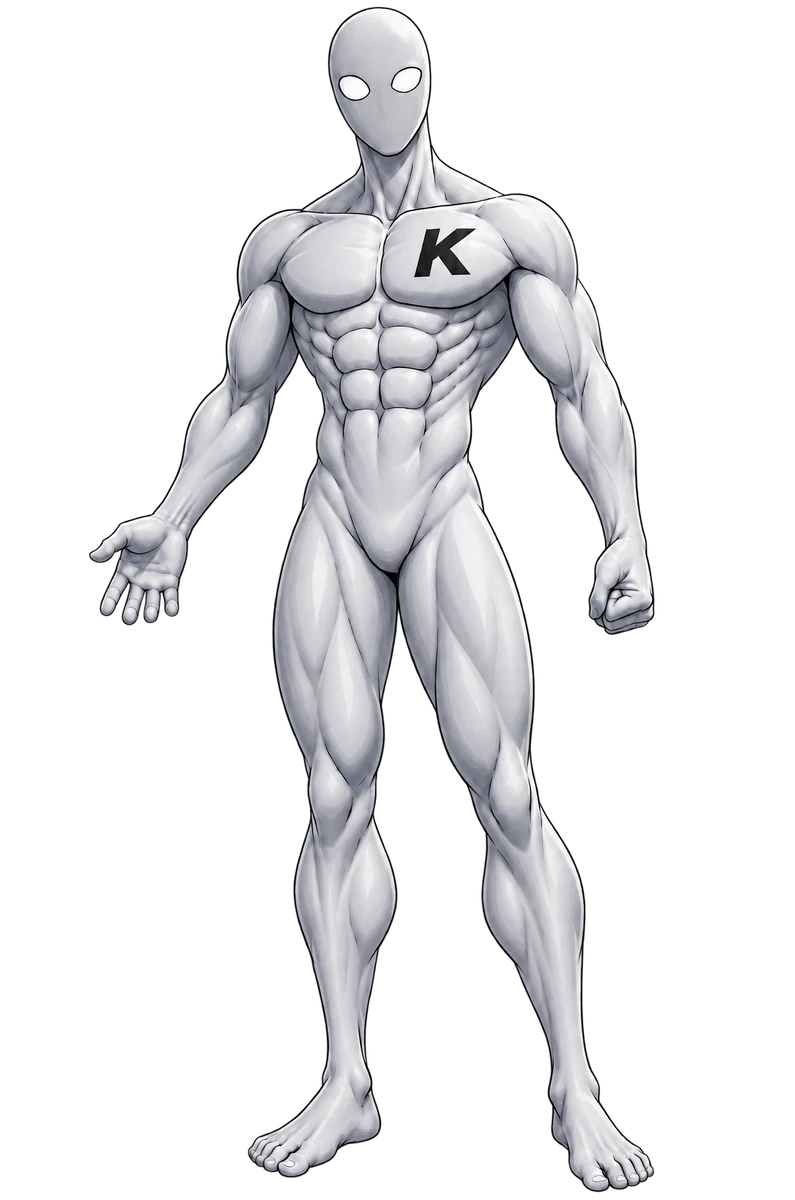
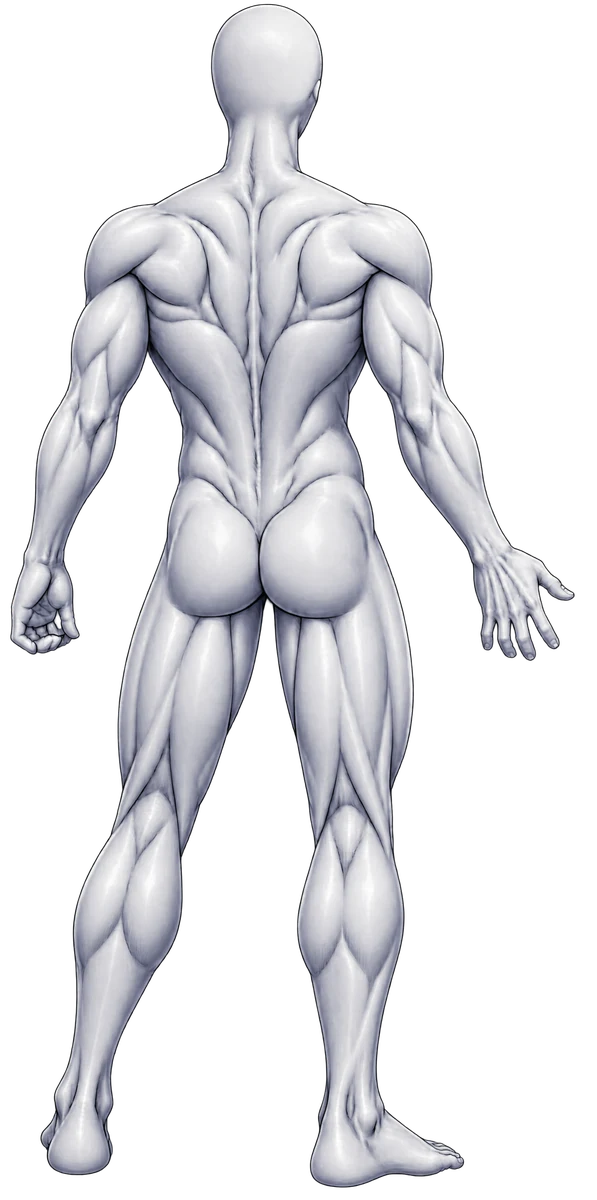
Closing the legs removes the wide two-sided base the straddle position gave the hips and torso, so the core now works harder isometrically to resist rotation around the single supporting hand — this is the main reason the straight-body hold is harder to control even though the raw strength demand is similar. The supporting shoulder, trapezius, forearms, and hands carry essentially the same load as in the straddle version, but with less margin for error, since every correction still has to happen through the wrist and fingers of one hand. The glutes and quadriceps now do more active work than in the straddle version, keeping the legs locked straight and pressed together against the tendency to drift apart, while the latissimus and lower back keep the whole line from head to feet rigid.
Stats
- Balance
- 0.00
- Control
- 0.00
- Strength
- 0.00
- Endurance
- 0.00
- Mobility
- 0.00
- Power
- 0.00
This remains a balance- and control-dominant skill rather than a strength one — supporting bodyweight on a single locked arm is not the limiting factor once the straddle one-arm handstand is solid. What makes the straight-body version harder is the reduced margin for error: with the legs together there is less leverage to resist a fall in any direction, so the balance has to be held with more precision and the same weight-shift skill has to be repeated at a finer tolerance. Strength, endurance, and mobility play the same modest supporting roles as in the straddle version.
Completion criteria
Lift the free arm fully off the floor and hold a straight-body one-arm handstand for 3 seconds on each arm with minimal wobble, then return the hand to the floor under control rather than falling out of the position.
Progression thresholds
- Lower threshold
- 3 s
- Upper threshold
- 10 s
A reasonable point to consider this skill consolidated is a controlled straight-body one-arm handstand held for around 10 seconds with the free arm extended away from the body. If the free arm needs to tap back down before 3 seconds, spend more time on the straddle one-arm handstand's fingertip stage and on closing the legs gradually during the weight shift rather than forcing the full straight-body lift.