Element preview
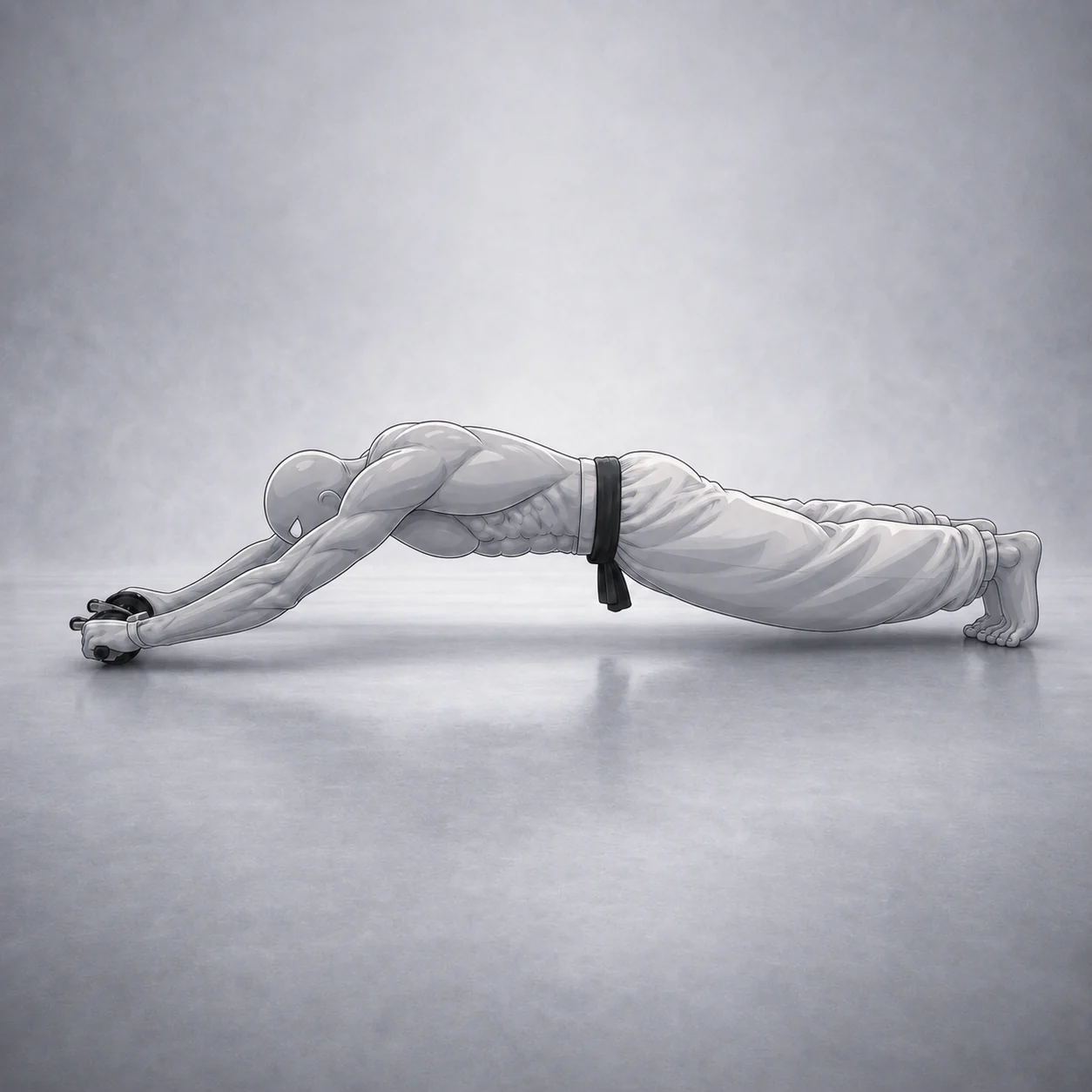
Preview · 0:06
A short look at the whole element in motion.
This is an overview clip, not a technique reference — the form in it may be imperfect. Follow the steps in Technique.
The straight-leg ab wheel rollout is a two-handed, kneeling anti-extension exercise: instead of letting the knees bend to shorten the lever as the wheel rolls out, the legs stay straight so the hips, trunk, and legs extend together as one line. That single change lengthens the lever the abdominal wall has to control and adds a real isometric demand on the glutes and hamstrings to keep the hips from sagging, which is why it sits above the one-arm plank and a bent-knee or ring rollout on this branch of the tree, and below the single-arm version of the same movement.
Technique
- Kneel on a padded surface with a two-handed ab wheel set on the floor in front of you. Grip the handles just outside shoulder width and set the wheel so your arms start roughly under your shoulders.
- Brace the abdomen hard, pull the ribs down toward the pelvis, and squeeze the glutes before the wheel moves. This brace is what will keep the lumbar spine from arching once load comes on.
- Roll the wheel forward under strict control. Instead of letting the knees bend to shorten the lever as the hips extend, keep the legs straight throughout — the hips, torso, and straight legs should move together as one line, with the glutes and hamstrings working isometrically to hold that line.
- Extend only as far as the braced, flat-spine position can be held. Stop the descent the moment the lower back wants to arch or the hips want to drop toward the floor; that point is the working range for the day, not necessarily a long extension.
- Reverse the motion by pulling the wheel back toward the knees, driving through the abs and lats rather than yanking with the arms or using a hip "kip" to start the return.
- Reset the brace between reps instead of relaxing the core at either end of the movement.
Preparation
Equipment and conditions
- A two-handed ab wheel (or ab roller) with a stable, non-slip grip.
- A padded surface or a mat/kneepad under the knees.
- A well-controlled bent-knee (or ring) ab rollout and a solid plank/one-arm plank base before extending the lever with straight legs.
Build a controlled bent-knee (or ring) rollout first: kneeling, knees bent enough to shorten the lever, rolling out only as far as a flat, braced spine allows. Once that range is fully controlled with no lumbar arch, extend the legs and repeat the same brace-first approach at the longer, straight-leg lever — reducing range again if needed rather than keeping the same distance with worse form.
Risks
- The core failure mode is lumbar hyperextension: once the brace gives out, the lower back arches and takes over from the abdominal wall as the wheel keeps rolling out. Cap the range at the point a flat, braced spine can still be held, and add range gradually rather than chasing a longer rollout early.
- Keeping the legs straight (instead of letting the knees bend to shorten the lever) increases the length of the lever arm the core must control, and adds sustained isometric demand on the glutes and hamstrings to keep the hips from sagging. If straight legs cause the lower back to arch before a bent-knee rollout would, shorten the range or return to a bent-knee rollout until the brace is reliable at the longer lever.
- Keep wrists stacked under the handles and use a wheel with a stable, non-slip grip on a firm surface. Stop the set if the exercise causes sharp or increasing pain in the low back, wrists, or shoulders; persistent pain warrants assessment by a qualified healthcare professional.
Muscles


The core (rectus abdominis, obliques, and deep stabilizers together) is the primary target, resisting spinal extension as the wheel moves the load away from the body. The shoulders and latissimus dorsi drive and control the wheel through the reach and the pull back, while the triceps hold the elbows extended and the forearms and hands grip the handles. Because the legs stay straight instead of bending to shorten the lever, the glutes work harder than in a bent-knee rollout to keep the hips extended and prevent sag, with the hamstrings, quadriceps, lower back, trapezius, and chest acting as secondary stabilizers holding the kneeling line rigid.
Stats
- Strength
- 0.00
- Control
- 0.00
- Endurance
- 0.00
- Balance
- 0.00
- Mobility
- 0.00
- Power
- 0.00
Strength is the dominant demand — the straight-leg lever is long, and the abdominal wall has to resist it through a controlled range. Control is the clear secondary quality, since the entire skill is stopping the lumbar spine from arching rather than simply producing force, and endurance matters as the set of reps continues. Balance rises modestly above a bent-knee rollout because the straight-leg line is harder to keep rigid, while power and mobility play a minor role.
Completion criteria
Product completion estimate: 10 controlled kneeling rollouts with straight legs, each reaching a challenging but well-braced range with no visible lumbar arch or hip sag, and with the wheel tracking straight rather than drifting side to side.
Progression thresholds
- Lower threshold
- 5 reps
- Upper threshold
- 10 reps
Add reps within the controlled range before extending the reach further; if lumbar arch or hip sag creeps in before this rep count, shorten the range or return to a bent-knee rollout to rebuild the brace before adding straight-leg reps again. A clean set of 10 is enough to start working toward the single-arm version of this movement.