Element preview
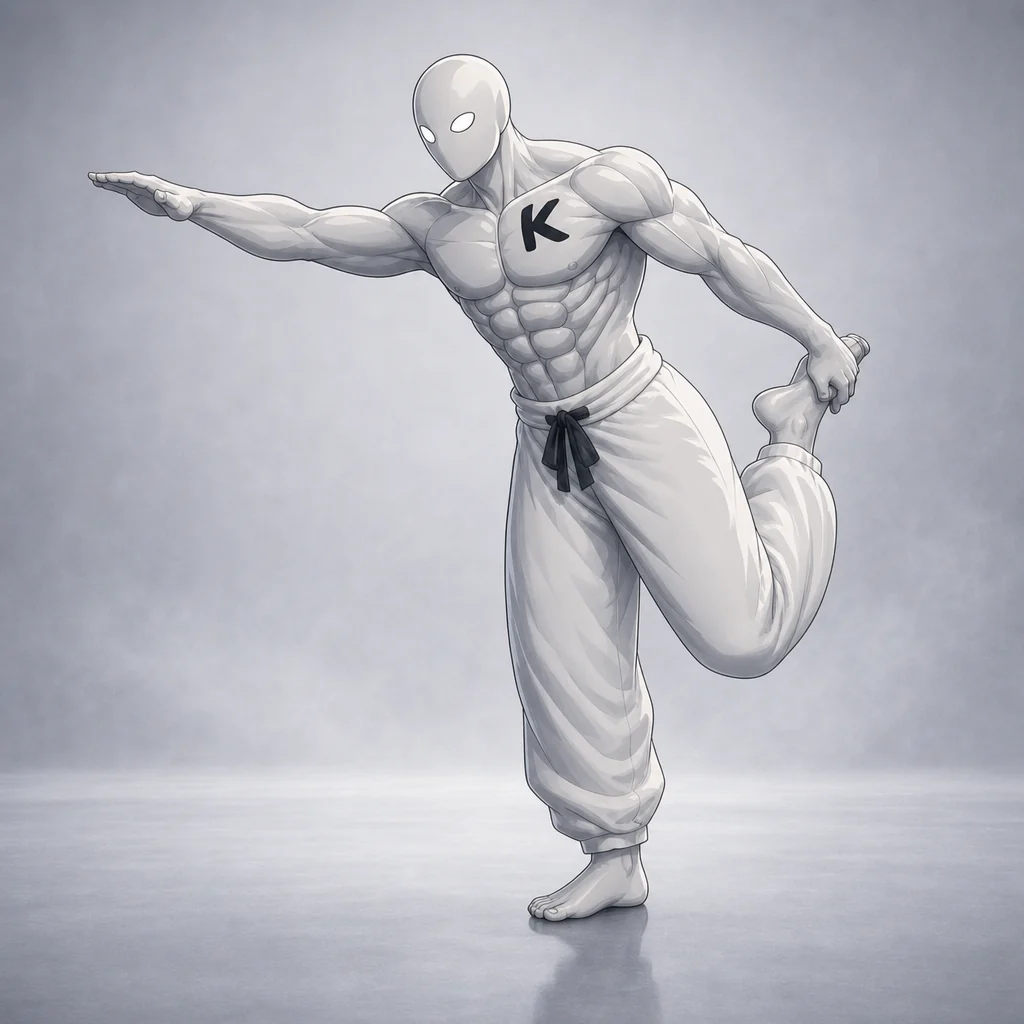
Preview · 0:06
A short look at the whole element in motion.
This is an overview clip, not a technique reference — the form in it may be imperfect. Follow the steps in Technique.
The srimp squat is a single-leg squat in which the rear leg stays bent and is held by the hand at the foot or ankle instead of resting free. Holding the rear leg keeps it out of the way but adds a real quadriceps and hip-flexor stretch on that side, on top of the strength and balance already needed to lower and raise the body on one leg.
Compared with the beginner version, which lets the free knee trail behind without a hand hold, gripping the rear foot removes the option to swing or reposition it for balance, which raises the coordination and mobility demand. The working-leg strength requirement is broadly comparable to a full-depth pistol squat, though the two variations stress mobility differently: the pistol squat asks more of the working ankle and rear hamstring as the free leg extends forward, while the srimp squat asks more of the held leg's quadriceps and hip flexors.
Technique
- Stand tall on one leg. Bend the other knee and reach back with the same-side hand to hold the top of the rear foot or ankle, keeping the rear thigh roughly vertical.
- Extend the free arm forward for a counterbalance and brace the trunk before you start to lower.
- Bend the working hip and knee and descend under control, keeping the working heel and midfoot pressed into the floor and the knee tracking over the toes.
- Lower until the rear knee makes a light, controlled contact with the floor, or as close to it as your current range allows without losing tension in the held rear leg.
- Drive back up through the working foot, keeping the rear leg held throughout, until the hip and knee reach full extension. Regain balance before the next repetition or before switching sides.
Preparation
Equipment and conditions
- A flat, non-slip floor with enough space behind the body for the rear knee.
- No equipment is required; a folded mat or towel under the rear knee is optional while building tolerance.
Build this movement on a controlled beginner srimp squat with a light, hands-free rear-knee touch. Once that pattern is reliable on both sides, add the hand hold on the rear foot and rebuild the same depth and tempo before removing any support. A parallel pistol squat practice can also transfer working-leg strength and single-leg balance, even though its mobility demands sit on a different part of the body.
Risks
The held rear leg adds a quadriceps and hip-flexor stretch on top of the single-leg squat demand, so build range gradually rather than forcing depth on day one. Watch for the working knee caving inward or the heel lifting; both signal that the depth or tempo has outrun current strength and control.
Lower slowly and land the rear knee lightly rather than dropping into it; padding under the knee is a reasonable accommodation while building tolerance. Reduce range, add hand support, or return to the beginner srimp squat if balance breaks down or the descent becomes uncontrolled. Stop for sharp or worsening joint pain and have persistent pain assessed by a qualified clinician.
Muscles


The quadriceps carry most of the knee-extension work on the standing leg, with the glutes extending and stabilizing the working hip through the full range. The hamstrings and calves help control the descent and contribute to standing back up, and the abductors and adductors resist side-to-side knee drift on the narrow base of support. The core and lower back keep the trunk organized while the rear leg's own quadriceps and hip flexors are held under a passive stretch.
Stats
- Strength
- 0.00
- Balance
- 0.00
- Mobility
- 0.00
- Control
- 0.00
- Endurance
- 0.00
- Power
- 0.00
Strength remains the dominant quality, since one leg still lowers and raises the full bodyweight through a deep range. Mobility and balance are close secondary demands: mobility from the held rear leg's hip-flexor and quadriceps stretch and from the working ankle's dorsiflexion, balance from controlling the body over one foot without the free leg available to swing for correction. Control matters through the slow direction change at the bottom; power contributes little to a strict repetition.
Completion criteria
Project calibration, not a universal standard: perform 5 controlled repetitions per side, holding the rear foot throughout, with a light rear-knee contact at a consistent depth and full hip/knee extension at the top of each repetition.
Progression thresholds
- Lower threshold
- 2 reps
- Upper threshold
- 8 reps
The 8-repetition up and 2-repetition down values are project calibration estimates, matched to the working-leg strength standard used for the pistol squat. At 8 clean repetitions per side, progress to a deeper range, a slower eccentric, or the next single-leg squat variation. Below 2 controlled repetitions, return to the beginner srimp squat until the hand-held rear-leg pattern is reliable again.