Element preview
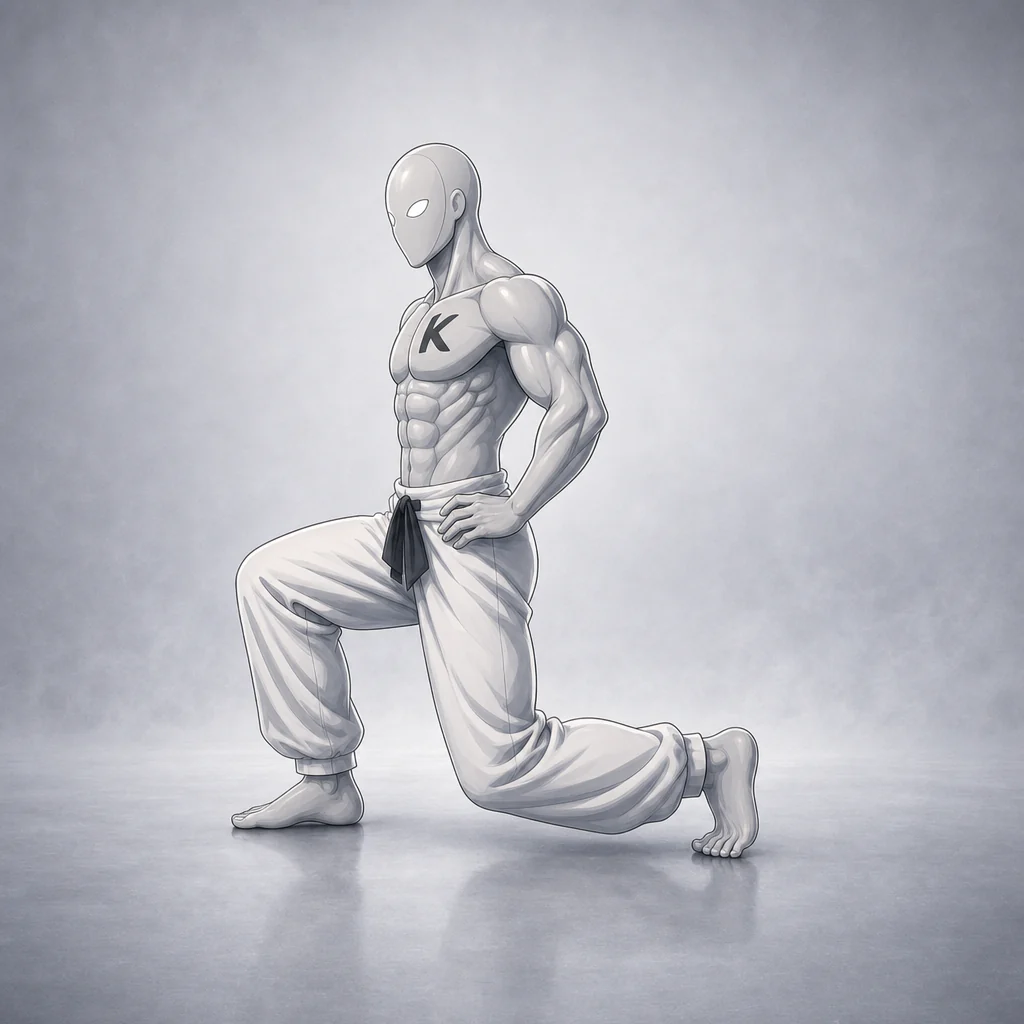
Preview · 0:05
A short look at the whole element in motion.
This is an overview clip, not a technique reference — the form in it may be imperfect. Follow the steps in Technique.
The split squat takes the bilateral squat pattern and loads it asymmetrically: one foot stays forward and one back, so most of the bodyweight sits on the front leg while the rear leg mainly provides balance. Because both feet stay planted throughout, it is a bridge between the full squat and true single-leg work such as the pistol squat — it asks the front leg to do most of the strength work of a single-leg squat while still keeping a wider, more stable base of support.
Technique
- Split the stance front-to-back, roughly hip-width apart laterally, with the feet far enough apart that both knees can reach close to 90° at the bottom.
- Keep the torso tall and braced, ribcage stacked over the pelvis, and let most of the bodyweight load the front leg.
- Lower straight down by bending both knees together — the front shin moves slightly forward while the back knee drops toward the floor without touching it.
- Keep the front heel grounded throughout; if it lifts, the stance is too short or the ankle is restricted.
- Track the front knee in the same direction as the front toes and avoid letting it collapse inward.
- Drive through the front foot to return to the top, using the back leg mainly for balance rather than to push the body up.
Preparation
The split squat builds directly on the full squat: it needs the same knee- and hip-bending pattern and comfort with depth, but now applied through a front-biased stance. Before loading it, a lifter should already own a controlled bodyweight full squat with grounded heels and a neutral spine — without that base, the added front-leg demand and balance challenge of the split stance tend to expose the same faults (heel lift, rounding) in a harder position.
Risks
Most split squat issues come from stance geometry rather than the movement itself: a stance that is too narrow front-to-back forces the front knee far past the toes and limits depth, while a stance that is too narrow side-to-side makes balance unnecessarily hard. Inward collapse of the front knee (valgus) under fatigue is the main technique fault to watch, since research on single-leg squatting links dynamic knee valgus and excessive forward knee travel to patellofemoral joint stress; keeping the knee tracking over the foot and building hip-abductor and quadriceps control addresses this. The back leg is a stabilizer, not a load-bearer, so avoid pushing off it to compensate for a weak front leg.
Muscles


The front-leg quadriceps and glutes drive the movement, extending the knee and hip out of the bottom position much as in a bilateral squat, but now carrying a larger share of bodyweight on one limb. Research comparing split squats with back squats and good mornings found the front leg's glutes and hamstrings working harder than in a bilateral squat, reflecting the more hip-dominant, longer-lever position of the front leg; the calves and core add extra stabilization for the single-leg-biased base, and the lower back braces isometrically as in the full squat.
Stats
- Strength
- 0.00
- Balance
- 0.00
- Control
- 0.00
- Mobility
- 0.00
- Endurance
- 0.00
- Power
- 0.00
Strength remains the primary demand, driven mainly by the front leg, but the split stance shifts some of the load profile away from raw depth-driven mobility (as in the full squat) and toward balance and control, since the narrower base and independent leg positioning require more active stabilization than a bilateral stance. Endurance and power stay secondary, similar to the full squat.
Completion criteria
Perform 12-15 controlled bodyweight split squats per leg to a depth where the front thigh is close to parallel, with the front heel grounded, the front knee tracking over the toes, and no loss of balance or trunk lean.
Progression thresholds
- Lower threshold
- 8 reps
- Upper threshold
- 15 reps
Once bodyweight split squats feel controlled and balanced for 15 reps per leg at a comfortable depth, a lifter is ready to progress toward more single-leg-biased work such as the step-up or, eventually, the beginner shrimp squat and pistol squat. If fewer than 8 reps per leg is achievable with good knee tracking and a grounded front heel, keep training at this level and revisit full squat mechanics before adding difficulty.