Element preview
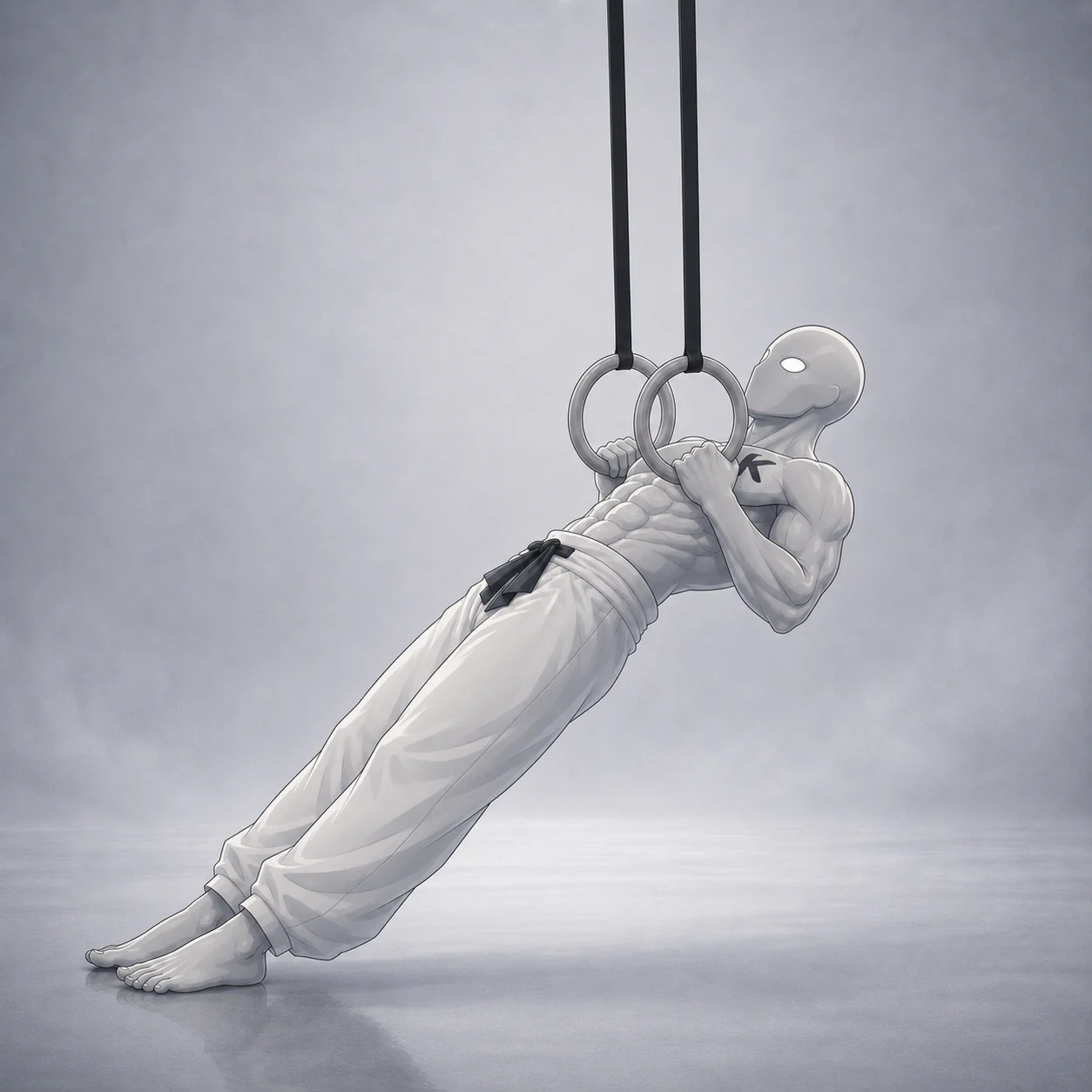
The row (commonly performed as a ring row or inverted row) is the foundational horizontal-pulling exercise in this progression. You hang from a pair of rings, straps, or a fixed bar, walk your feet out until your body is close to horizontal, and pull your chest toward your hands. It grooves the same scapular-retraction pattern used by every heavier horizontal pull that follows — the archer row and the one-arm row — without the added leverage or single-arm demand of those variations.
Technique
- Hang from a pair of rings, a suspension strap, or a fixed bar set roughly waist-to-chest height, with your feet on the floor (or on a low support) out in front of you.
- Start each rep with your shoulders relaxed and protracted, arms extended, before you begin the pull.
- Initiate the movement by retracting and depressing both shoulder blades together, then bend your elbows and keep them close to your sides as you pull.
- Hold your body straight or slightly hollow by squeezing your glutes and core, and pull until the rings or bar reach roughly chest level.
- Lower back down under control, letting your shoulder blades protract again at the bottom before the next rep.
Preparation
Equipment and conditions
A pair of gymnastic rings, suspension straps, or a fixed bar set at roughly waist-to-chest height, with enough floor space to walk your feet out and set your body at the desired incline. No block is required for the base row, but one can raise your feet closer to shoulder height to increase difficulty.
Before this position, you should be comfortable with the vertical row: an easier, more upright regression done with your feet on the ground and your body closer to vertical, so most of your bodyweight is still taken by your legs. As you get stronger you gradually lower the rings or raise your feet, tilting your body closer to horizontal until you can perform full reps with a straight body line. If you struggle to hold a stable top position, hold the fully retracted top of a rep for a few seconds between reps to build scapular-retraction strength directly.
Risks
The most common technical fault is letting the body sag from a straight line into a hollow, saggy C-shape, which shifts load off the back and onto the lower back and shoulders in an unintended way — keep the glutes and core braced throughout the set. Because this is a foundational horizontal pull, it carries comparatively low risk, but it still plays an important role in shoulder health: balancing pulling volume against pushing work (bench press, dips, push-ups) helps prevent the anterior-dominant strength imbalance that can irritate the front of the shoulder over time. If you have an existing posterior shoulder weakness or imbalance, bias your sets toward the top portion of the row and hold it briefly to bias the posterior deltoid, rhomboids, external rotators, and trapezius.
Muscles


The latissimus and biceps drive the concentric pull, while the trapezius and shoulders work to retract and depress the shoulder blades and keep them stable through the range. The core, lower back, and glutes contract isometrically to hold the body in a straight or slightly hollow line, and the forearms and hands maintain grip on the rings or bar throughout the set.
Stats
- Strength
- 0.00
- Endurance
- 0.00
- Control
- 0.00
- Balance
- 0.00
- Mobility
- 0.00
- Power
- 0.00
Strength leads since the movement is a bodyweight pull against a fixed load, but as an early, higher-rep progression step it also leans on muscular endurance more than the harder unilateral rows that follow. Control plays a modest role in keeping the shoulder blades set and the body line stable, while balance, mobility, and power stay in the background since the movement is symmetric and performed at a controlled tempo.
Completion criteria
As a project-calibrated estimate (the source material treats this as an early progression step without a numeric standard): controlling roughly 12-15 strict reps with a straight body line, full scapular retraction at the top, and no hip sag before moving toward a wide or archer ring row.
Progression thresholds
- Lower threshold
- 8 reps
- Upper threshold
- 15 reps
These rep numbers are a conservative, book-informed estimate rather than a published standard. Once you can control roughly 15 strict reps with a straight body line and no hip sag, you have outgrown the basic row and are ready to add width (wide ring row) or move toward the archer row. If you cannot yet manage about 8 controlled reps, spend more time on the vertical row, or raise your feet less / stand more upright, before returning to the full row.