Element preview
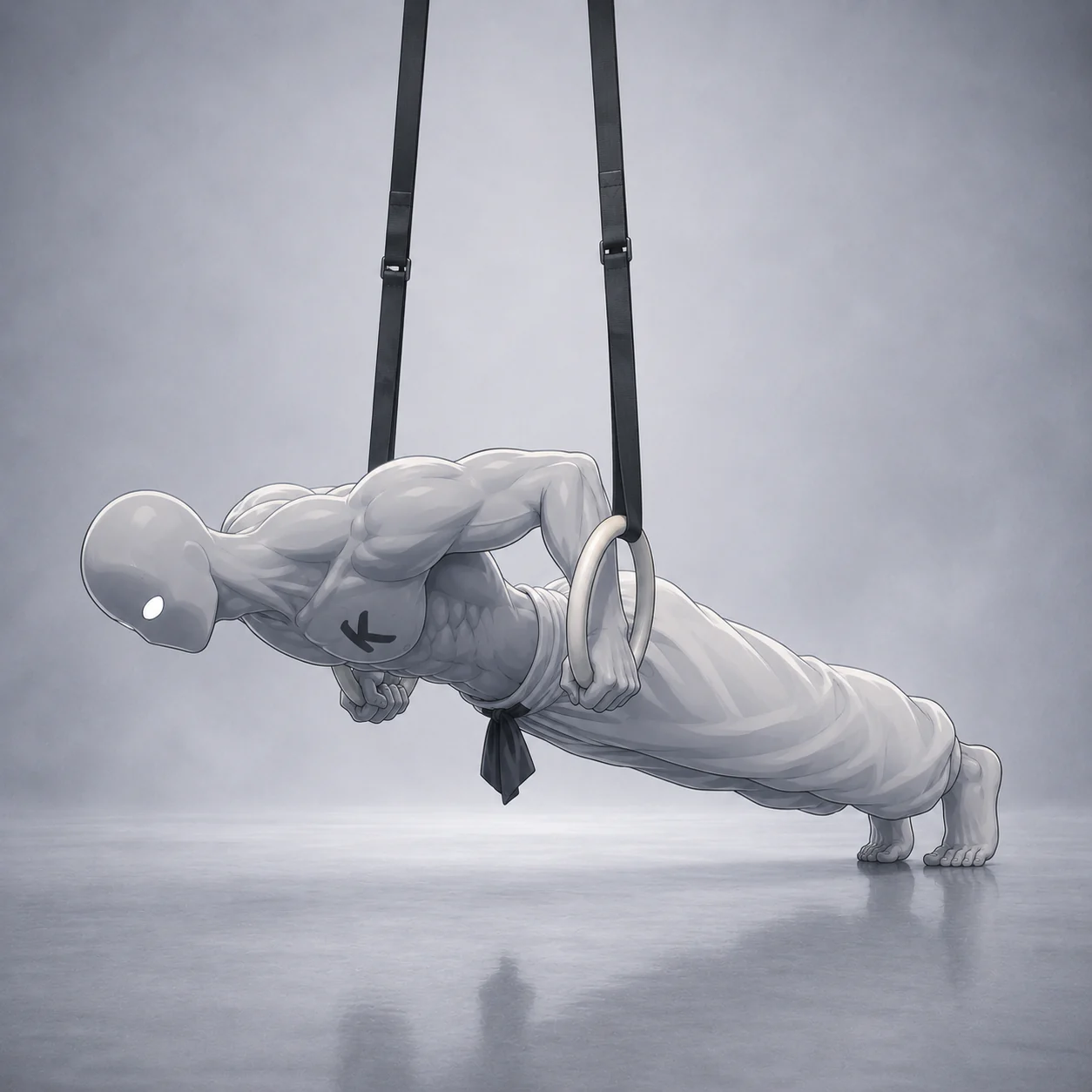
Turning the rings out during a ring push up adds a rotational demand on top of the ordinary horizontal push. Instead of keeping the palms facing each other for the whole repetition, the hands and rings rotate outward through the bottom portion of the movement, asking the shoulders to stabilize through a wider range of motion while the trunk still holds a rigid plank. This turned-out (RTO) position is a common bridge exercise in ring calisthenics toward holds like support scale or planche, where the arms are habitually turned out.
Technique
- Set both rings at equal height, roughly at or slightly above foot level for a full-range set; raise them if the turned-out position is not yet controlled at a lower height.
- Grip the rings with a neutral hand position (palms facing each other) and extend to a straight-arm support. Build a rigid line from shoulders through hips to heels before moving.
- Lower under control with the elbows tracking close to the torso, the same way as a standard ring push-up.
- Near the bottom of the descent, rotate the hands and rings outward (external rotation) so the palms turn away from the body. Keep the rotation smooth and driven from the shoulder, not forced through the wrist.
- Hold the turned-out position briefly, then press back up while keeping the rings turned out through most of the ascent, rotating them back to neutral only near lockout.
- Reset the shoulder blades and confirm the rings are level and still before starting the next repetition. Stop the set if the rings begin to swing or the rotation is being muscled through the wrist rather than the shoulder.
Preparation and scaling
Equipment and conditions
- A matched pair of gymnastics rings suspended from a secure anchor, with both straps set to equal length.
- Comfortable, pain-free shoulder external rotation under load; build this gradually rather than starting with a full turn-out.
- A clear, nonslip area beneath the rings with room for a full plank and controlled hand rotation.
The locked prerequisite is the ring push up. Before adding the outward rotation, be comfortable performing strict neutral-grip ring push ups for a full set without the rings drifting or the hips sagging — the rotation is easiest to control once the base pushing pattern is already automatic.
Introduce the turn-out gradually. Many lifters cannot rotate the rings to a full turned-out position on the first attempts; starting with a partial rotation (for example, turning the rings only 30–45 degrees rather than fully outward) and increasing the range over several sessions is a reasonable way to respect shoulder tolerance. Raising the rings above foot level also reduces body weight through the arms while the rotation is being learned, similar to scaling a standard ring push up.
Muscles
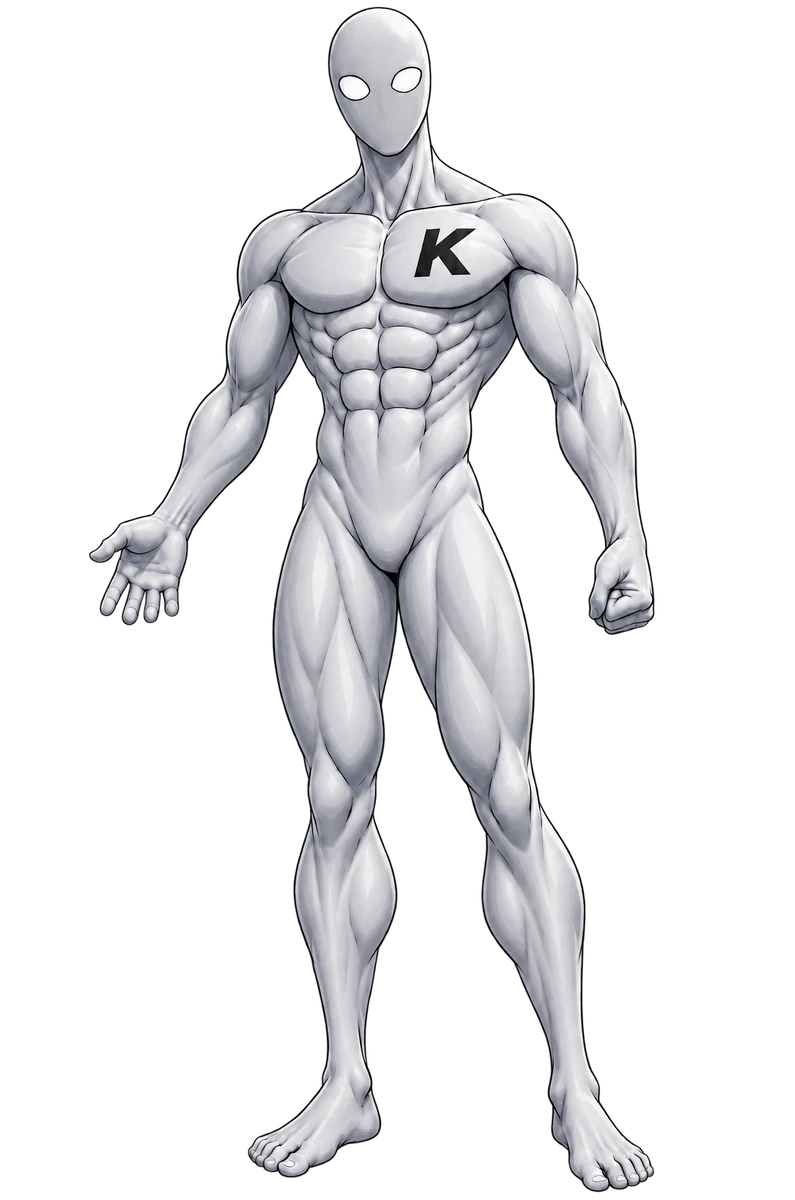
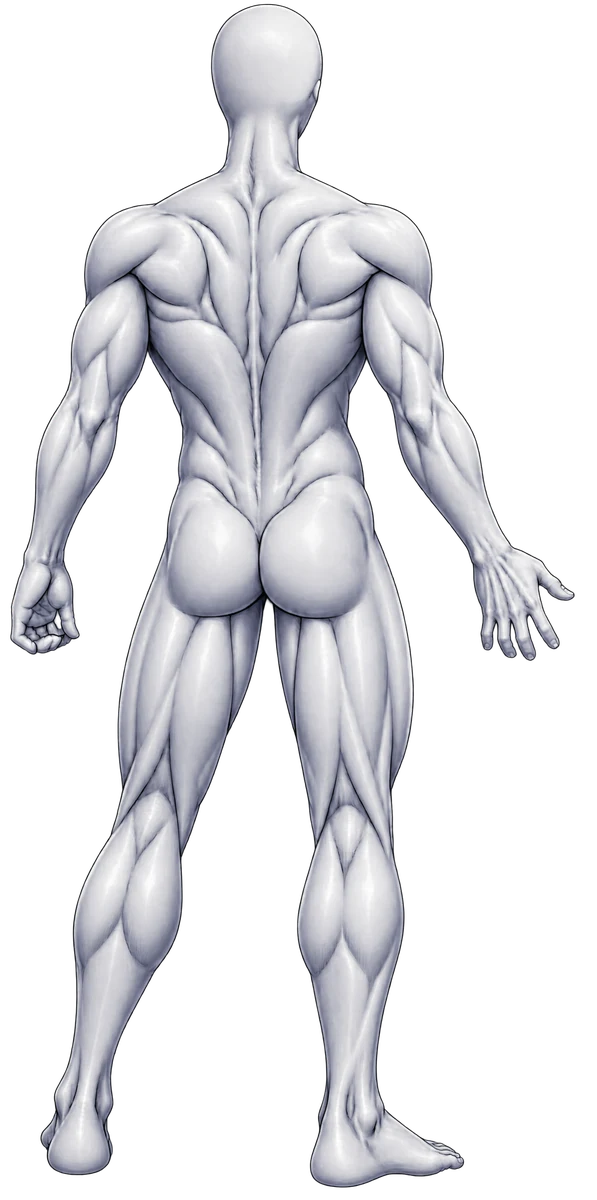
The chest, triceps, and anterior shoulder still produce most of the press, as in a neutral ring push up, but the turned-out position asks the shoulder and scapular stabilizers to control a larger range of motion and a less symmetrical load path, which is why shoulder and trapezius involvement is rated higher here than in the neutral version. The core continues resisting trunk extension and rotation while the rings move independently, and the forearms and hands work harder to actively rotate the rings rather than simply holding them still. As with all product muscle ratings, these percentages are estimates that reflect relative role, not measured EMG values for this specific variation — a broader systematic review of still-rings elements confirms that ring support work generally imposes high shoulder training loads, but it does not isolate the turned-out hand position specifically.
Stats
- Strength
- 0.00
- Control
- 0.00
- Balance
- 0.00
- Endurance
- 0.00
- Mobility
- 0.00
- Power
- 0.00
Strength remains the primary quality, rated slightly above the neutral ring push up because the turned-out position is executed later in the same strength-dependent pressing pattern. Control is the main secondary quality and is rated higher than the neutral version: the hands must actively rotate the rings while keeping them from swinging, on top of the stabilization already required in a ring push up. Balance is also rated higher for the same reason — small ring movements are harder to correct mid-rotation. Mobility is rated higher than the neutral variant because comfortable shoulder external rotation under load is a limiting factor, while endurance and power play smaller, supporting roles.
Completion criteria
Perform 8 controlled repetitions with the rings at or near foot level, rotating the rings outward through the bottom half of each repetition, keeping a straight shoulder-to-heel line throughout, and finishing with straight arms and quiet, non-swinging rings.
Progression thresholds
- Lower threshold
- 3 reps
- Upper threshold
- 8 reps
Roughly 12 clean neutral-grip ring push ups is a reasonable readiness marker before spending focused practice on the turn-out, matching the ring push up's own product threshold for moving toward this variation. If turned-out repetitions are inconsistent — for example if you can complete fewer than about 3 with full rotation and controlled rings — spend more time on partial-rotation reps or return to strict neutral ring push ups. These figures are product calibration guides rather than fixed physiological cutoffs.