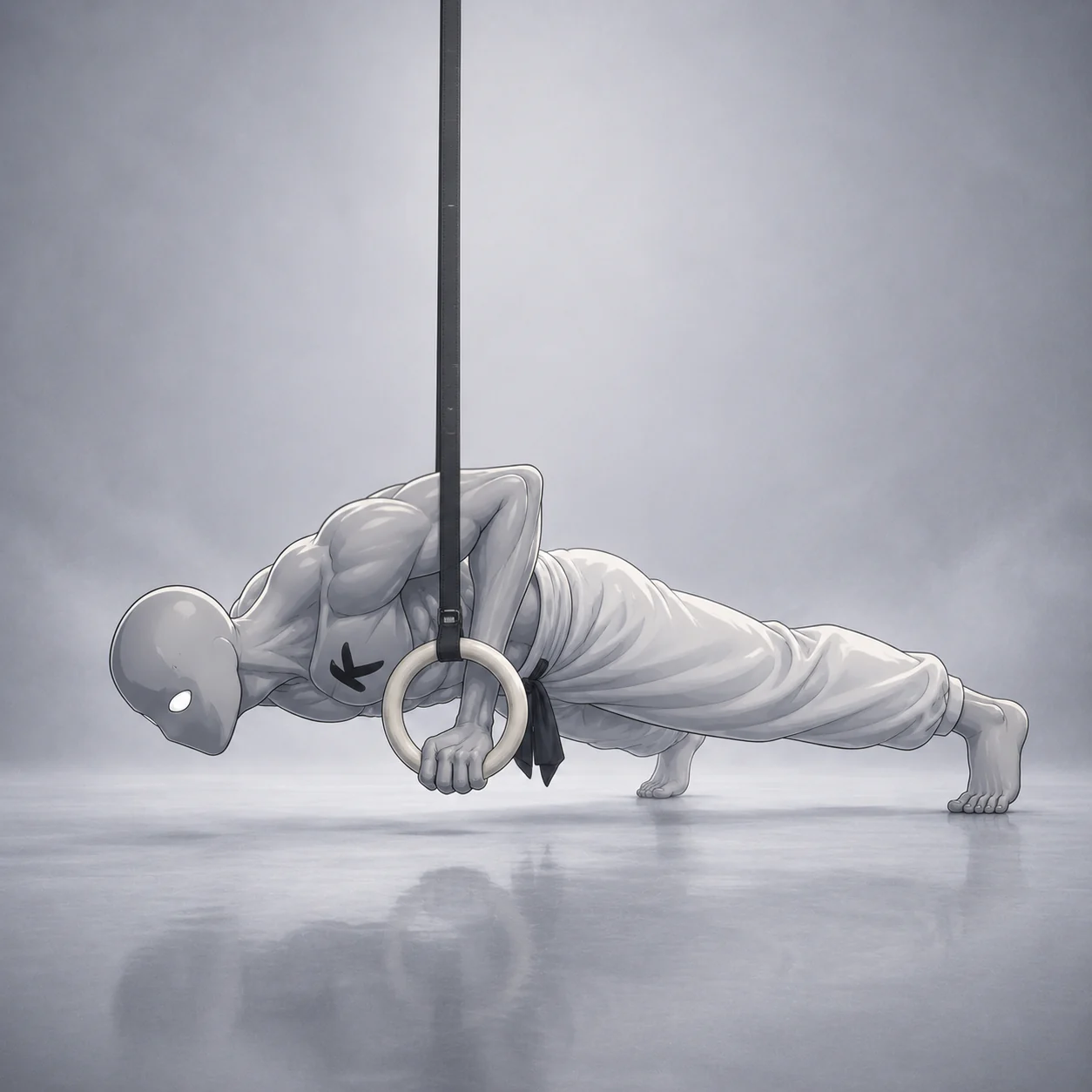
The ring one-arm push-up combines two separate hard problems into one movement: a single arm must supply the entire pressing force, and that arm's only contact point is a ring free to swing, rotate, and drift in any direction. Where the floor one-arm push-up asks the working arm to resist a fairly predictable rotational torque, the ring version adds a support surface that actively fights back against every small error, so timing and tension have to be nearly continuous rather than corrected mid-repetition.
This article treats it as the ring-based extension of the straddled floor one-arm push-up, keeping the same wide leg base and one-arm mechanics while replacing the floor with a single unstable ring.
Technique
- Suspend a single ring at roughly chest height and set the second ring out of the way (raised clear, or removed) so it cannot be brushed or grabbed for assistance.
- Take the same wide straddle base used in the floor one-arm push-up: one hand gripping the ring, legs spread well apart for a stable platform, the free arm resting lightly against the back.
- Before descending, actively press the ring down and back so the strap runs vertically. Brace the abdominals, lower back, glutes, and quads so the trunk stays rigid and does not sag, pike, or rotate toward the ring.
- Lower under control, keeping the elbow close to the torso, until the chest approaches the hand. Resist the ring drifting inward, outward, or forward at every point in the range — the ring can move in any direction, unlike a fixed floor surface.
- Press back to full elbow lockout while keeping the strap quiet. Treat any swinging or spinning of the ring as a sign to reduce range or reset rather than push through it.
- Narrow the straddle only in small increments, and only once the ring stays still through a full, controlled repetition at the current stance.
Preparation and scaling
Equipment and conditions
- A single gymnastics ring on a secure, checked anchor, with the second ring raised clear or removed so it cannot be used for assistance.
- A firm, non-slip floor beneath the ring with room for a wide leg straddle.
- Both the floor one-arm push-up (straddled) and the two-hand ring push-up should already be controlled and pain-free before attempting this combination.
The locked prerequisite is the one-arm push-up. Do not begin ring work until the floor version is controlled and symmetric on both sides, and until the standard two-hand ring push-up is solid — that movement already teaches the hands to keep a ring from drifting under a lighter, bilateral load.
- Keep the straddle as wide as the floor progression required; this is the same balance strategy, now applied to a moving support.
- Start with the ring set slightly higher than for the two-hand ring push-up to shorten the range while the extra instability is new.
- Treat any ring swing or spin as a technical fault to fix immediately, not a load to push through.
- Narrow the stance only in small steps, and only after a full range is consistently controlled at the current width.
Risks
This movement stacks two separate injury-relevant demands: the asymmetric shoulder and elbow torque already present in a one-arm push-up, and the multi-directional instability of a single, freely rotating ring. A systematic review of still-rings gymnastics elements notes that shoulder-joint injuries on rings are often linked to fatigue and technique breakdown during high-load hold and strength elements (Malíř et al., 2023, PMC10059656); that evidence comes from competition ring skills such as the cross and support scale rather than this specific pressing variant, so treat it as a general caution about ring loading rather than a direct measurement of this exercise's risk. Broader calisthenics injury surveys have not identified one-arm or ring pressing specifically as a leading injury mechanism, and the shoulder/wrist are not the most commonly injured regions in that population overall (Attia et al., 2023, PMC10225133) — the evidence here is sparse and non-causal, not a documented injury pattern for this exact skill.
Practically, keep the elbow tucked rather than flared to limit rotational torque on the shoulder and elbow, and stop the set the moment the ring swings, spins, or the pelvis twists hard toward the working side. Only attempt this on a secure, checked anchor, and only once the floor one-arm push-up and the ring push-up are both controlled and pain-free.
Muscles


Triceps, chest, and anterior shoulder produce the unilateral press, at an intensity at or above the floor one-arm push-up because the ring offers no fixed reaction point to push against. The core, lower back, and glutes work hard isometrically to resist both the rotation created by a single working arm and the extra directional instability of the ring itself. Trapezius and other scapular stabilizers, along with a smaller latissimus contribution, help keep the shoulder blade organized against a moving support, while the forearms and hand take on a larger role than in either single-hand variant, since they must continuously correct the ring's position rather than just bear weight. These intensities are product estimates built by combining the floor one-arm push-up and ring push-up baselines; they are not direct measurements of this specific combination.
Stats
- Strength
- 0.00
- Control
- 0.00
- Balance
- 0.00
- Mobility
- 0.00
- Endurance
- 0.00
- Power
- 0.00
Strength remains the dominant demand and sits above both parent movements, since a single arm must still complete the full press while receiving no help from a fixed surface. Balance and control both increase relative to the floor one-arm push-up: the athlete must manage pelvic rotation exactly as before, plus continuous multi-directional ring correction that a stable floor does not require. Endurance and mobility remain modest supporting qualities, and power is not the focus of this strict, controlled press.
Completion criteria
Perform 2 to 3 controlled repetitions per arm on a single ring from a straddled base, reaching a full range without the pelvis twisting excessively, and finishing each repetition at full elbow lockout with the strap essentially still. This is a conservative, estimated calibration target rather than a fixed physiological standard — expect far fewer clean repetitions here than on the floor one-arm push-up.
Progression thresholds
- Lower threshold
- 1 reps
- Upper threshold
- 3 reps
Because this movement sits at the intersection of two already-advanced skills, use a small number of clean, full-range repetitions per arm — well below the floor one-arm push-up target — as the signal that the pattern is under control rather than being muscled through instability. If the ring swings, the pelvis twists heavily, or full range disappears, widen the straddle, raise the ring, or return to the two-hand ring push-up until control is restored. These thresholds are conservative calibration guides, not fixed physiological cutoffs.