Element preview
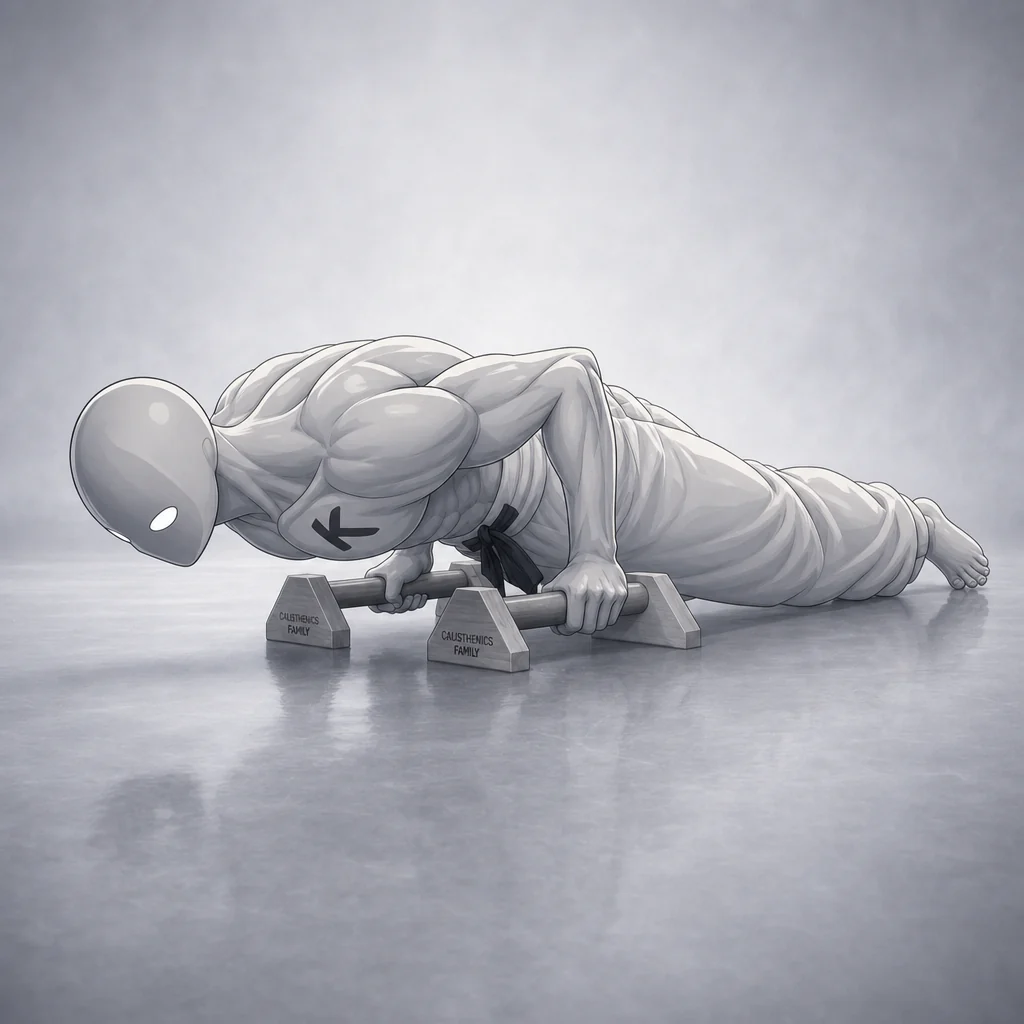
The pseudo planche push-up takes a standard push-up and slides the hands back toward the hips while leaning the shoulders forward past the wrists — the same weight-shift used in the planche lean, but performed dynamically for reps instead of held for time. It works as a bridge between a basic push-up and the more vertical pressing angle of the pike push-up: it keeps the elbows tucked and the body in a horizontal line, but asks the shoulders and triceps to control real load in a forward-leaned, straight-arm-biased position, which is exactly the tolerance the later planche progressions depend on.
Technique
- Start in a push-up position, but slide the hands down and slightly outward so they sit beside the lower ribs or hips rather than under the shoulders; fingers can point forward, out to the sides, or back toward the feet, whichever keeps the wrists comfortable.
- Protract and depress the shoulder blades and brace a hollow, straight-body line from shoulders to heels, squeezing the glutes and quads so the hips cannot sag or pike.
- Shift your weight forward by leaning the shoulders ahead of the wrists — the more the shoulders travel past the hands, the closer the position sits to an actual planche lean.
- Bend the elbows and lower under control, keeping the elbows tracking backward close to the torso rather than flaring out to the sides.
- Press back up along the same forward-leaned path, keeping the shoulders in front of the wrists throughout the rep rather than letting the hips drift back over the hands as fatigue sets in.
Preparation
A comfortable set of standard push-ups is enough of a base to start; the added demand here comes from the forward lean and the hand position, not from a fundamentally different pressing pattern. Because the wrists sit under a larger share of body weight in extension than in a normal push-up, a short wrist warm-up before the set is worth doing, and beginners can start with only a small forward lean before working the hands progressively closer to the hips over sessions. Familiarity with the planche lean's scapular protraction and full-body-tension cues transfers directly into this movement.
Risks
Sliding the hands back toward the hips and adding a forward lean concentrates more load through the wrists in extension than a standard push-up, so build the lean distance up gradually across sessions and warm up the wrists beforehand; back off or use a shallower lean if wrist pain appears. Letting the elbows flare out to the sides instead of tracking back close to the torso shifts stress toward the front of the shoulder joint, and losing the forward lean partway through a set (the hips drifting back over the hands) undermines the point of the drill even if it makes the rep easier. Hips sagging or piking under fatigue reduces core tension and can strain the lower back. As with the planche lean, this movement builds toward straight-arm planche work — persistent wrist, elbow, or shoulder pain warrants easing off the lean and, if it does not resolve, assessment by a qualified healthcare professional.
Muscles


Moving the hand position back and leaning the shoulders forward keeps this a horizontal pressing pattern, so the chest and shoulders share the prime-mover role together with the triceps, which also work harder to keep the elbows extended from a more flexed, tucked position. The core braces isometrically to hold the straight-body line under the shifted load, the trapezius helps control scapular protraction through the rep, and the glutes stay active to keep the hips from sagging. The forearms and hands manage a larger wrist-extension load than a standard push-up because of the closer, more hip-level hand placement, and the lower back assists the core in resisting any pike or sag.
Stats
- Strength
- 0.00
- Control
- 0.00
- Balance
- 0.00
- Endurance
- 0.00
- Mobility
- 0.00
- Power
- 0.00
This is still primarily a strength movement, but the forward lean pulls in more balance and control than a standard push-up or even the pike push-up: part of the skill is finding and holding a lean angle without the hips drifting back over the hands, which is a balance-and-control problem as much as a pressing one. Endurance and mobility play a smaller role than in the pike push-up, since this drill is typically trained at lower rep counts with a fairly modest range of motion at the hips, and power is minimal given the controlled tempo.
Completion criteria
Perform roughly 8-10 strict reps with the hands beside the hips, the shoulders visibly ahead of the wrists for the whole rep, elbows tracking straight back without flaring, and a rigid straight-body line from shoulders to heels throughout.
Progression thresholds
- Lower threshold
- 4 reps
- Upper threshold
- 10 reps
Once 10 clean reps are possible with the hands near the hips, the shoulders staying ahead of the wrists for the whole set, and no elbow flare or hip sag, it's a reasonable time to start working toward the pike push-up or a longer-held planche lean. If reps break down before about 4 — the lean collapsing, the hips drifting back over the hands, or the elbows flaring — build the hand position back toward a standard push-up and revisit planche-lean holds before returning to this drill.