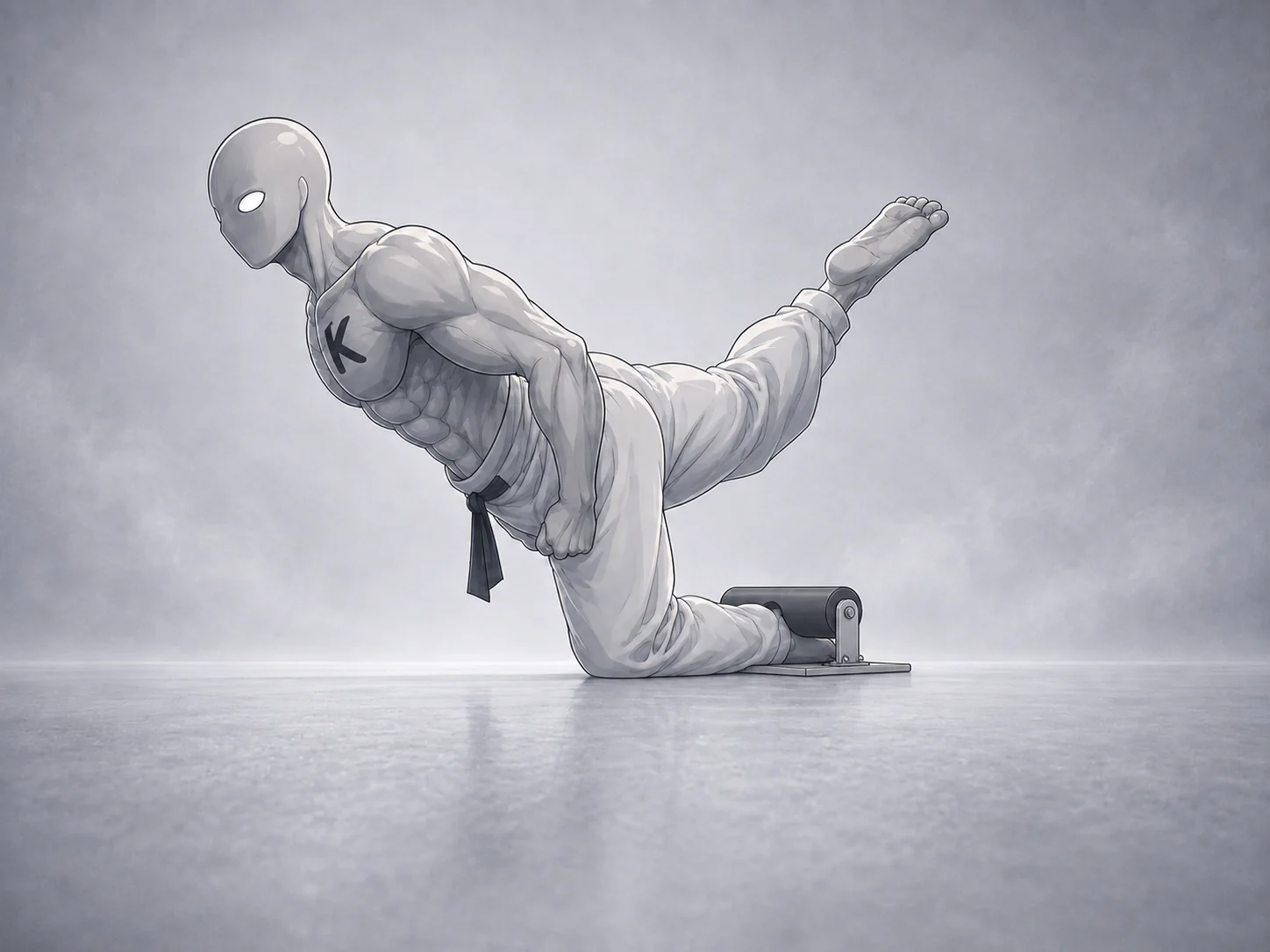
The one-leg Nordic curl takes the standard Nordic hamstring curl — a kneeling, ankle-anchored eccentric hamstring drill — and removes the second leg's support, so a single hamstring, hip, and core must resist the entire torque of the falling torso. It is one of the hardest hamstring-strength progressions in a bodyweight program: where the two-leg version is common in team-sport injury-prevention protocols, the one-leg version asks that same tissue to produce roughly double the force per limb while the hips also fight to stay square without a symmetrical base.
Technique
- Kneel on a padded surface with only one foot anchored — pinned by a partner, locked under a Nordic bench pad, or hooked under a secured bar. Cross the non-working leg behind the working calf or hold it lifted so it cannot help share the load.
- Set hips, knee, and shoulders of the working side in a straight line, hips fully extended, core braced — the same rigid starting position as the two-leg Nordic curl, now held on one leg alone.
- Lean forward as one rigid unit from the working knee, resisting the fall with that single hamstring for as long as possible. Expect a much shorter controlled range than the two-leg version before the hamstring can no longer hold the descent.
- Let your arms track the floor in front of you and catch the fall with your hands once the working hamstring can no longer control the speed; do not let the hips flex or rotate toward the anchored side to cheat range.
- Push back up with your hands and hip drive from the working leg to reset, then repeat for the target reps before switching sides.
Preparation
Equipment and conditions
- A padded surface for kneeling (mat or cushioned floor).
- A way to lock a single ankle down: a Nordic-curl bench/attachment, a partner holding the working ankle firmly, or the foot hooked under a secured heavy object.
- Enough clear floor space in front to lower toward and catch yourself with your hands if needed.
- A way to keep the non-working leg out of the way (crossed behind the working calf, or lifted and held clear) without it sharing the load.
Because only one ankle is anchored and one hamstring is doing all the work, the controlled range of motion on this variant will start out much smaller than what the same lifter can manage on two legs — that is expected, not a sign of doing it wrong. The non-working leg should stay genuinely passive (crossed behind the calf or held clear) rather than quietly assisting, or the exercise stops training the intended single-leg strength.
Risks
This concentrates the entire eccentric hamstring, glute, and hip-stabilization demand of the Nordic curl onto one limb, so the forces a strained hamstring would see are higher than in the bilateral version for the same body weight — treat this as a substantially harder progression, not a linear step up. Only attempt it once multiple sets of controlled, near-full-range two-leg Nordic curls are comfortable; the two-leg version is the prerequisite for a reason. Keep the hips square and extended — rotating or hiking the hip on the working side to "cheat" the range shifts load unpredictably onto the lower back and hip stabilizers instead of the hamstring. Because only one foot is anchored, the ankle lock must be completely secure; a slipping anchor on a single point of contact is a sharper fall risk than in the two-leg setup. Expect a much smaller controlled range of motion than the two-leg version initially, and progress that range conservatively — the single-leg eccentric load is large enough that overreaching range or speed too quickly risks a strain rather than building resilience.
Muscles
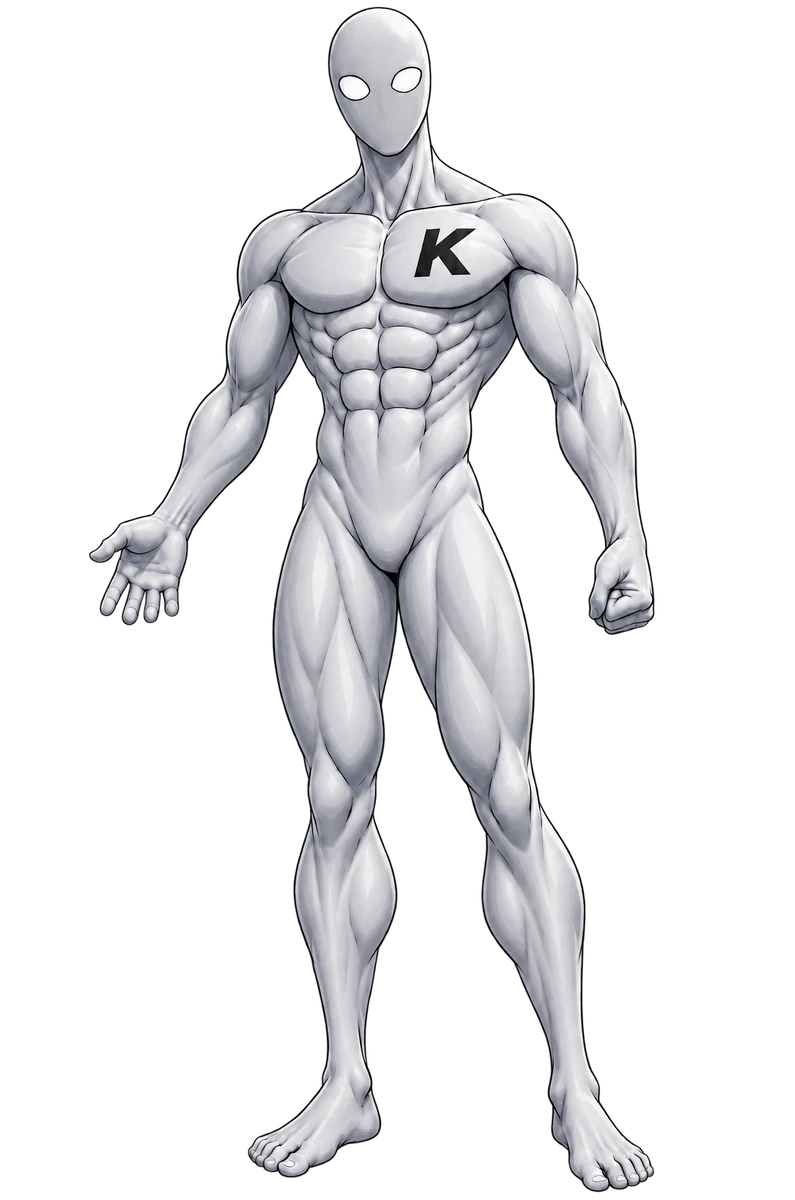
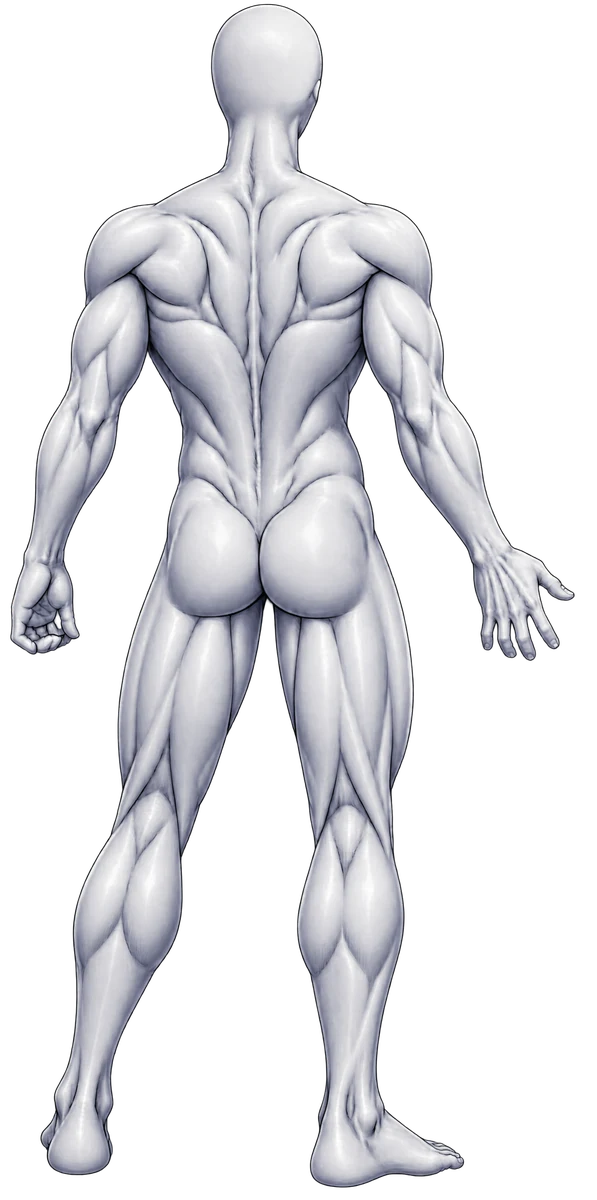
The working-side hamstrings (biceps femoris, semitendinosus, semimembranosus) are the target muscle and now absorb the full eccentric knee-extension load alone; bilateral Nordic-curl EMG work has recorded hamstring activation in the roughly 45-55% MVIC range through the exercise, and removing the second leg's contribution should push the working leg's demand higher still, though this has not been directly measured in the literature. The glutes and core work harder than in the two-leg version because they must also resist the hips rotating or hiking toward the anchored side on an asymmetrical base, the lower back braces against that same rotational tendency, and the calf of the working leg contributes extra stabilization around the single ankle anchor point.
Stats
- Strength
- 0.00
- Control
- 0.00
- Balance
- 0.00
- Endurance
- 0.00
- Mobility
- 0.00
- Power
- 0.00
Strength is weighted at the top of the primary band because a single leg must now produce the force two legs shared before, and control sits high in the secondary band since keeping the hips square without a matching leg for balance is as much a skill as the raw hamstring strength is. balance is meaningfully higher than in the two-leg version because the single point of ground contact removes the lateral stability a kneeling two-leg base provides. Endurance, mobility, and power remain minor factors, since the movement is still slow and limited by strength ceiling rather than by reps or explosiveness.
Completion criteria
Able to perform 3-5 slow, fully controlled reps per leg through a meaningful range (several seconds of resisted descent each), keeping the hips square and extended and using minimal early hand support, matched on both sides.
Progression thresholds
- Lower threshold
- 1 reps
- Upper threshold
- 5 reps
Because the working range of motion on one leg is inherently smaller than on two, progress by extending that controlled range and reducing early hand support before adding reps; the rep thresholds here are deliberately lower than the two-leg version's, reflecting how much harder each single-leg rep is. Regress toward the two-leg Nordic curl, or toward a lightly assisted one-leg version (partner support through more of the range, or a band offloading part of body weight), if reps or control fall below a comfortable working range on either side.