Element preview
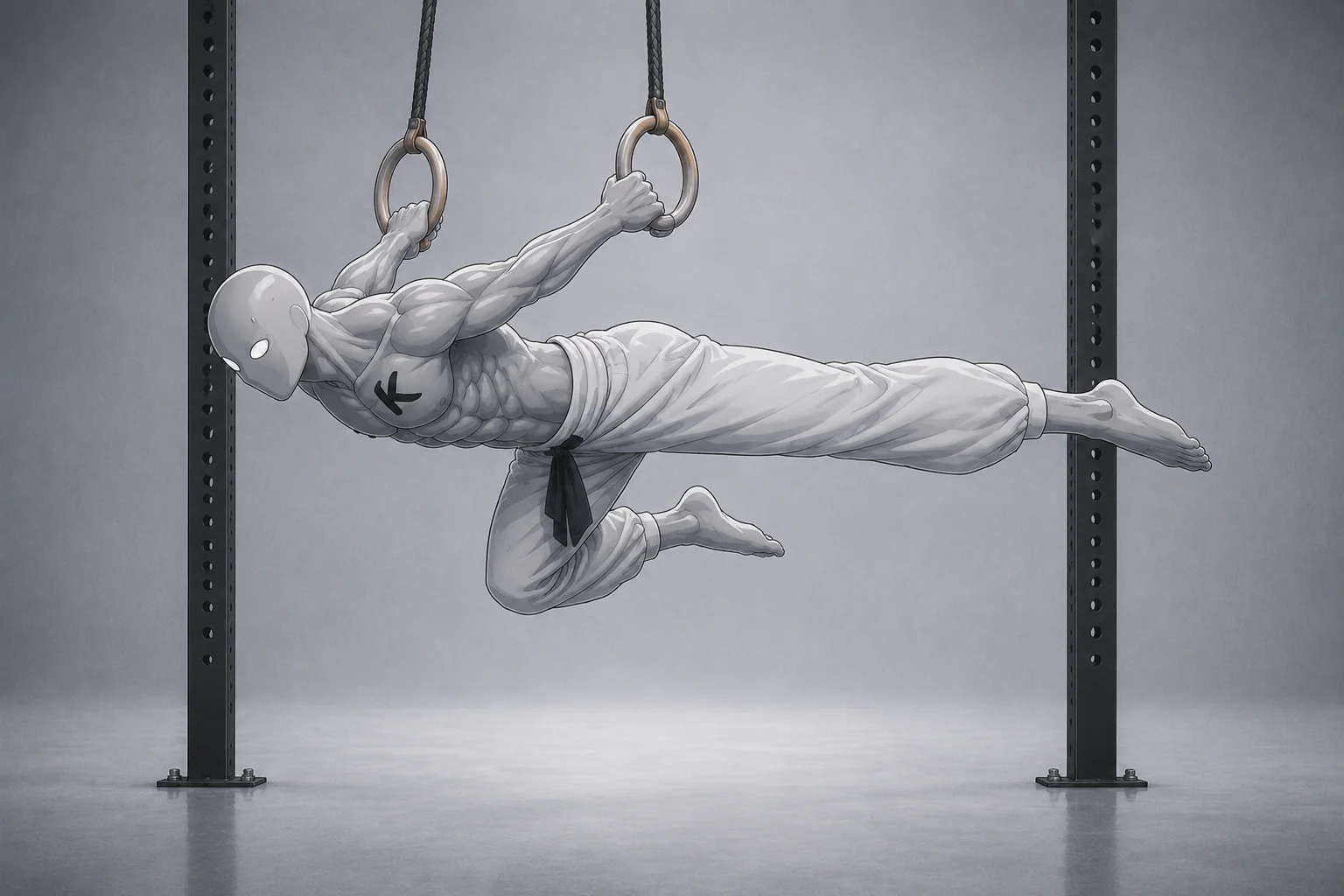
Preview · 0:06
A short look at the whole element in motion.
This is an overview clip, not a technique reference — the form in it may be imperfect. Follow the steps in Technique.
The one-leg back lever (the "one-leg-out" position) sits between the tuck/straddle back lever and the full back lever: one leg extends fully straight while the other stays tucked in tight, pushing your center of mass further from your shoulders than the straddle without the full torque demand of two straight legs together. It is one of the two standard ways to bridge toward the full back lever — the alternative, the half-layout (both knees bent to 90°, aligned with the hips), approximates a similar center of mass but is harder to control, so most lifters use the one-leg-out version first.
Technique
- Start from an inverted hang (or lower from a tuck position) on a pull-up bar or rings, using a supinated (palms-toward-you) grip.
- Extend one leg fully straight from hip to toe. Keep the other knee tucked in tightly, with the toes of the bent leg near the knee of the straight leg.
- Slowly lower backward, actively tensing the pectorals, latissimus dorsi, and front of the shoulders to control the descent rather than dropping into position.
- Bring the shoulders, hips, and straight leg into one line, matching the alignment you built in the tuck and straddle stages.
- Keep the scapulae depressed and neutral — avoid letting the chest round forward (protraction) or the back arch (retraction).
- Hold with a neutral head position and steady breathing, then reverse the same controlled path back to the inverted hang. Alternate which leg is extended between sets so both sides receive equal work.
Preparation
Before working this position, you should already hold the tuck and straddle back lever cleanly, with the scapulae depressed and neutral and no rounding through the chest or arching through the back — those faults only get harder to correct as the lever extends further. Keep building tolerance for the supinated grip through German hang and skin-the-cat drills; that grip recruits more of the biceps and improves the elbow's connective-tissue tolerance for the fuller extension coming in the full back lever.
Risks
As in the full back lever, the supinated grip combined with a nearly extended elbow places ongoing stress on the elbow's connective tissue and biceps tendon. Build tolerance gradually through German hang and skin-the-cat work, keep the biceps actively tensed during the hold, and back off if you feel sharp or persistent elbow pain.
The most common technique faults are letting the chest round forward or the shoulders hunch, and letting the hips rotate or dip toward the tucked-leg side since the load is no longer symmetric. Check your alignment with a mirror, camera, or partner, and keep the hips square. If the straight leg's hamstring or hip flexibility is limited, do not force full extension — hold a slightly bent knee and build range over time rather than compromising the torso line.
Muscles


- Latissimus Dorsi0%— show exercises
- Chest0%— show exercises
- Core0%— show exercises
- Shoulders0%— show exercises
- Biceps0%— show exercises
- Forearms0%— show exercises
- Glutes0%— show exercises
- Hamstrings0%— show exercises
- Trapezius0%— show exercises
- Quadriceps0%— show exercises
- Lower Back0%— show exercises
- Hands0%— show exercises
Extending one leg while keeping the other tucked shifts more of the isometric demand onto the latissimus dorsi and chest, which pull the shoulders into extension against a longer lever arm than the tuck or straddle stage. The core works asymmetrically to keep the hips square despite only one leg loading the hip extensors, and the biceps and anterior shoulders continue to stabilize the elbow under the supinated grip. The extended leg's quadriceps and hamstrings keep the knee locked and the hip in line, while the tucked leg relies more on hip flexors and abdominals. Forearms, hands, and trapezius handle grip and scapular control as in the other back lever stages.
Stats
- Strength
- 0.00
- Control
- 0.00
- Endurance
- 0.00
- Balance
- 0.00
- Mobility
- 0.00
- Power
- 0.00
This is still primarily an isometric strength hold, so strength dominates, though somewhat less than the full back lever since the lever arm is shorter. Control is the clear secondary stat — the asymmetric leg position makes it easy for the hips to twist or drop toward the tucked side without deliberate correction. Endurance covers sustaining the hold, while balance is slightly more relevant here than in the tuck or straddle stages because of the side-to-side asymmetry. Mobility and power remain minor factors.
Completion criteria
Hold the one-leg-out back lever — shoulders, hips, and the fully extended leg in one straight line, the other knee tucked tightly with its toes near the straight knee, scapulae depressed and neutral — for the target time below, without the chest rounding, the back arching, or the hips rotating toward the bent-leg side. Repeat with the legs switched.
Progression thresholds
- Lower threshold
- 8 s
- Upper threshold
- 20 s
Once you can hold the one-leg-out back lever cleanly (both legs alternated) for the target time above, start working the straddle-to-full transition and full back lever attempts. If you cannot yet hold the position for the lower threshold, drop back to the straddle or tuck back lever and rebuild time and scapular control there before retrying.