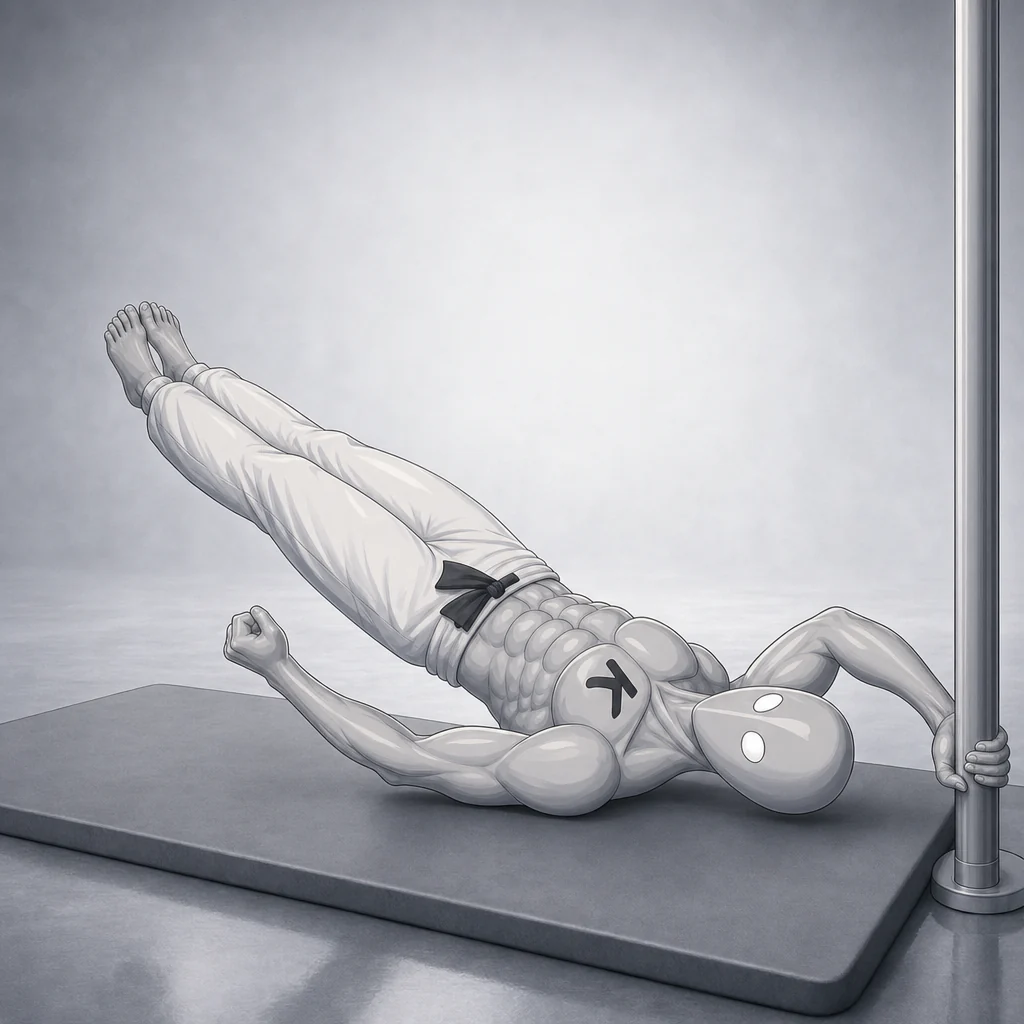
This article extends the operator-defined dragon press to a one-arm hold: the same supine, upper-back-supported straight-body position, but pressed and stabilized through a single hand instead of two. Removing one point of support does not just double the pressing demand on the working arm — it turns the hold into an anti-rotation task, since nothing on the free side resists the hips twisting toward the supported arm. The lift into position and the lowering out of it remain entries and exits within this product definition; the hold itself is scored here in seconds, not repetitions.
Technique
- Set up as for the two-hand dragon press: lie supine on a firm, padded surface with the upper back as the only torso contact point. This variant removes one hand from the floor, so the single support hand goes beside the hip roughly under the torso's midline rather than out to the side, giving the best angle to resist twisting.
- Brace the trunk hard before pressing — the free arm cannot help share the load, so the core and the working-side shoulder must already be tight when the hips lift.
- Press through the single hand to raise the hips and lower body until only the upper back remains on the floor, keeping the legs together and fully extended for the full variation (a knee bend or hip fold is a valid shorter-lever regression, not the final position).
- Hold one straight line from shoulders through hips to feet. The free arm can rest lightly on the torso or extend for a small counterbalance, but it must not touch the floor or bear meaningful weight — if it does, the hold reverts to the two-hand version.
- Actively resist the hold's tendency to rotate the hips and pelvis toward the working-arm side; this anti-rotation task, not the raw pressing strength, is usually the limiting factor.
- Lower with control back to the two-hand or floor position, then reset. End the attempt as soon as the body line breaks, the hips rotate off the sagittal plane, or the support hand shifts.
Preparation
The direct prerequisite is the two-hand dragon press; this article assumes that hold is already comfortable and controlled before removing a hand. Within this operator-defined product line, working the hold with a bent-leg or shortened lever first — the same regression used for the two-hand version — is a reasonable way to feel the single-arm pressing and anti-rotation demand at a lower body-lever length before extending the legs.
Risks
A single hand now carries the entire bodyweight through the wrist, elbow, and shoulder in a fixed, straight-arm position — do not attempt this hold with any unresolved wrist, elbow, or shoulder pain, and build the two-hand dragon press to a comfortable, controlled level first. The asymmetric load also creates a strong rotational demand on the spine and pelvis; stop the attempt at the first sign of the hips twisting rather than fighting to hold a position that is already collapsing, since forcing a rotated hold is a plausible route to lower-back strain. As with the two-hand version, build into the position gradually rather than dropping into it, and keep a shorter-lever (bent-leg) regression available on days when the full straight-body line is not achievable.
Muscles
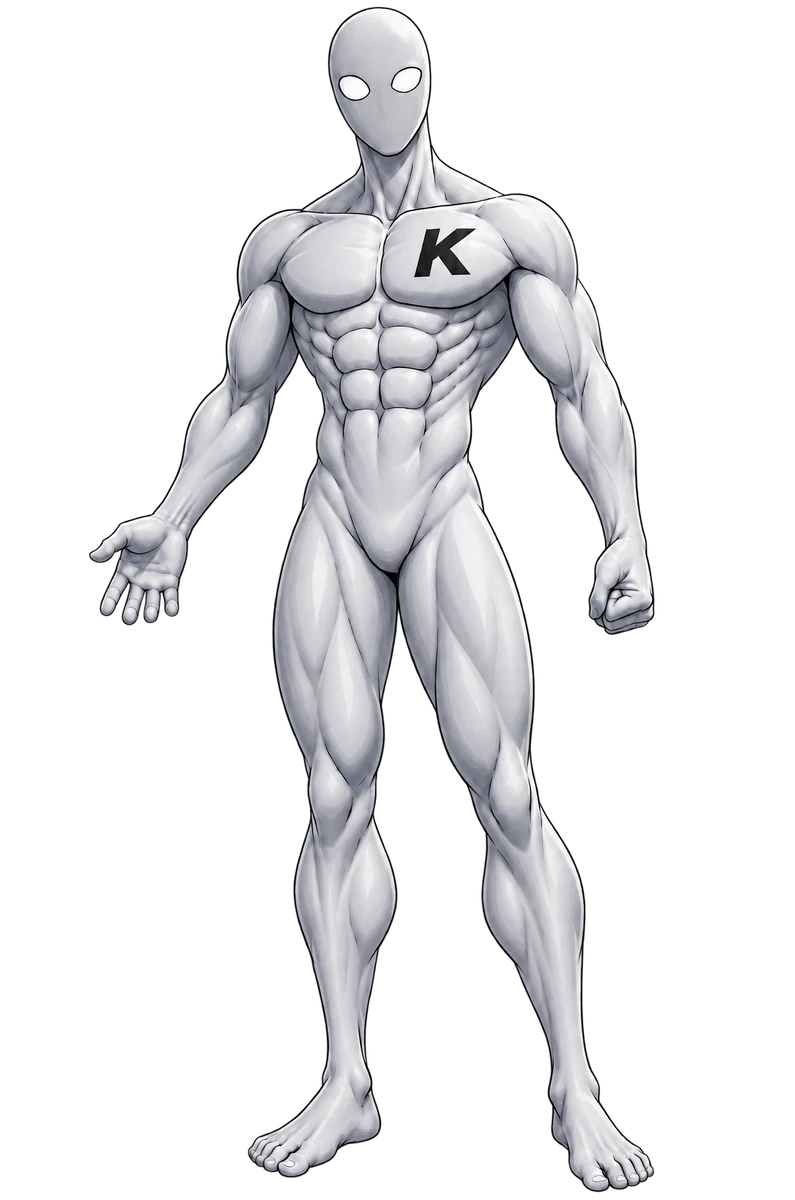
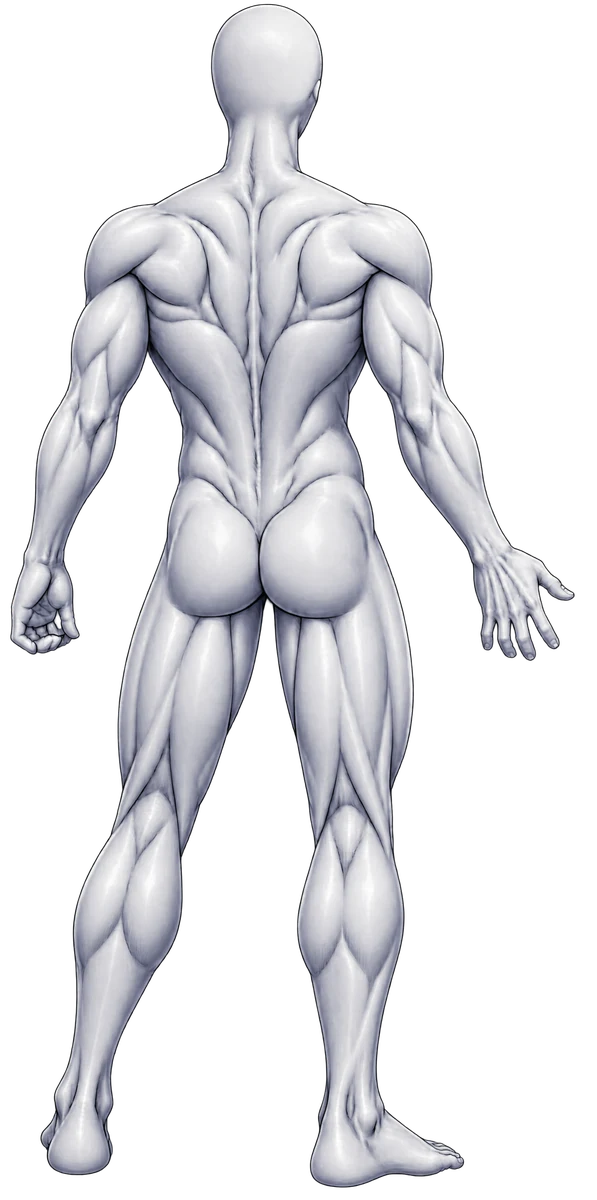
Moving from two hands to one concentrates load rather than changing the movement pattern: the working-side shoulder, triceps, forearm, and hand all take a larger, largely isometric share of the press and support than in the two-hand version, so their intensities are estimated higher here. The core's role grows as well, since it now resists an active twisting force toward the support side in addition to maintaining the straight body line — it is treated as effectively maximal for this variant. Latissimus and lower-back involvement is also raised relative to the two-hand hold, reflecting the extra trunk bracing needed to keep the pelvis level, while glutes and quadriceps keep the long leg lever rigid much as they do in the parent movement. All figures are conservative biomechanical estimates calibrated against the two-hand dragon press, not one-arm-specific measurements.
Stats
- Strength
- 0.00
- Control
- 0.00
- Balance
- 0.00
- Endurance
- 0.00
- Mobility
- 0.00
- Power
- 0.00
Strength remains dominant and is rated slightly above the two-hand version to reflect the full bodyweight now routed through one arm. Balance and control are both raised substantially relative to the two-hand hold: control captures resisting the hip-rotation the single support point invites, and balance captures finding and holding the narrow, asymmetric position at all. Endurance, power, and mobility play smaller supporting roles, similar in kind to the two-hand dragon press. These weights are product calibration estimates, benchmarked against the parent movement, not laboratory measurements.
Completion criteria
Demonstrate the full one-arm static position with a single hand beside the hip, the upper back as the floor contact, a continuous straight body line, and no visible hip rotation toward the support side. For this product, a 5-second hold with the working arm fully extended, on each side, is the working mastery estimate rather than a universal sport standard.
Progression thresholds
- Lower threshold
- 2 s
- Upper threshold
- 5 s
The 5-second upward and 2-second downward checkpoints are product-calibration estimates set below the two-hand dragon press's 10/3-second checkpoints, reflecting the much higher single-arm and anti-rotation demand rather than any universal standard. Below 2 clean seconds, or if hip rotation cannot be controlled at all, return to the two-hand dragon press or a shortened-lever one-arm regression before pushing the hold further.