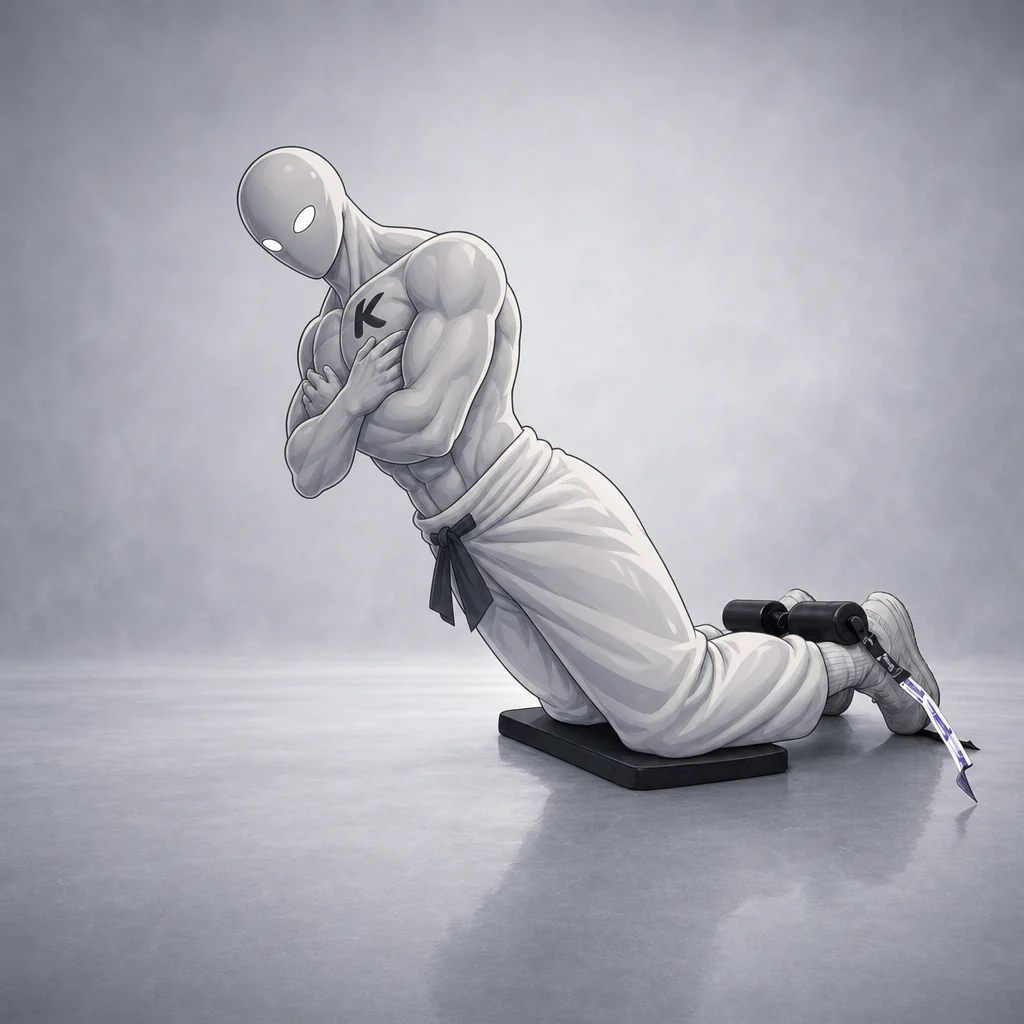
The Nordic curl (Nordic hamstring exercise) is a kneeling, partner- or anchor-assisted movement in which the hamstrings work eccentrically to resist the body falling forward as the knees extend. Unlike squat-pattern leg work, it isolates the hamstrings as knee flexors under a slow, heavy lengthening contraction, which is why it is widely used in sport settings specifically to build eccentric hamstring strength and resilience.
Technique
- Kneel on a padded surface and have a partner pin your ankles down, or lock your feet under a Nordic bench/anchored bar. Your hips, knees, and shoulders should form a straight line at the start, with hips fully extended (not sitting back onto your heels).
- Brace your core and squeeze your glutes to keep the hips extended throughout — the hips should not flex or "hinge" as you move; only the knees bend.
- Slowly lean forward as one rigid unit from the knees, resisting the fall with your hamstrings for as long as possible. Aim for a slow, controlled descent (several seconds) rather than a free fall.
- Keep your arms loosely tracking the floor in front of you; use them only to catch yourself and cushion the final part of the descent once the hamstrings can no longer control the speed.
- Push back up off the floor with your hands as needed and use hip/hamstring drive to help return to the starting kneeling position, or reset by hand to repeat the eccentric-only version.
Preparation
Equipment and conditions
- A padded surface for kneeling (mat or cushioned floor).
- A way to lock the ankles down: a Nordic-curl bench/attachment, a lifting partner holding the ankles firmly, or the feet hooked under a secured heavy object (e.g. a loaded barbell or bar anchored low).
- Enough clear floor space in front to lower toward and, if needed, catch yourself with your hands.
The two things that make or break this exercise are keeping the hips locked in extension (so the knees, not the hips, are doing the work) and controlling the descent speed rather than letting gravity take over. A secure ankle anchor is a prerequisite, not an afterthought — without one, the exercise cannot be performed safely.
Risks
This is a high-force eccentric exercise for the hamstrings, and hamstring strains most often occur during forceful eccentric contraction near end-range knee extension — the same tissue state the Nordic curl trains. Start with a small, well-controlled range of motion and only progress range and speed as strength allows; avoid free-falling into the bottom position. Keep the hips extended throughout — letting the hips flex turns the exercise into a hip-hinge and shifts load away from the target hamstring action while adding lower-back strain. Secure ankle anchoring is essential: a slipping anchor point creates a fall risk. Expect significant delayed-onset muscle soreness after early sessions and progress volume conservatively, since intense eccentric loading of the hamstrings, done too aggressively too soon, can itself provoke a strain rather than prevent one.
Muscles


The hamstrings (biceps femoris, semitendinosus, semimembranosus) are the clear prime movers, working eccentrically to control knee extension as the torso falls forward; published EMG work on this exercise records hamstring activation above 70% of maximal voluntary contraction through the middle of the range, dropping off only near the very end of the movement. The glutes and lower-back musculature work isometrically to keep the hips extended and the torso rigid, the core braces against the forward lean, and the calves contribute a small stabilizing role through the locked-down ankle position.
Stats
- Strength
- 0.00
- Control
- 0.00
- Endurance
- 0.00
- Mobility
- 0.00
- Balance
- 0.00
- Power
- 0.00
This is a strength-dominant movement built around resisting a heavy eccentric load, so control is weighted heavily alongside strength — the entire training effect depends on decelerating the fall smoothly rather than dropping and catching yourself. Endurance plays a secondary role across a working set of reps, while power, mobility, and balance are only lightly involved since the base is fixed and the movement is deliberately slow.
Completion criteria
Able to perform 6-8 slow, fully controlled reps (several seconds of resisted descent each) through as close to full range as mobility allows, keeping the hips extended and using minimal early hand support.
Progression thresholds
- Lower threshold
- 3 reps
- Upper threshold
- 8 reps
Because this is an intense eccentric-strength drill, progression is driven by control and range as much as by rep count: increase reps or slow the descent further before considering harder variants such as removing hand support or moving toward a single-leg version. Regress by shortening the controlled range and allowing an earlier catch with the hands if reps or control drop below a comfortable working range.