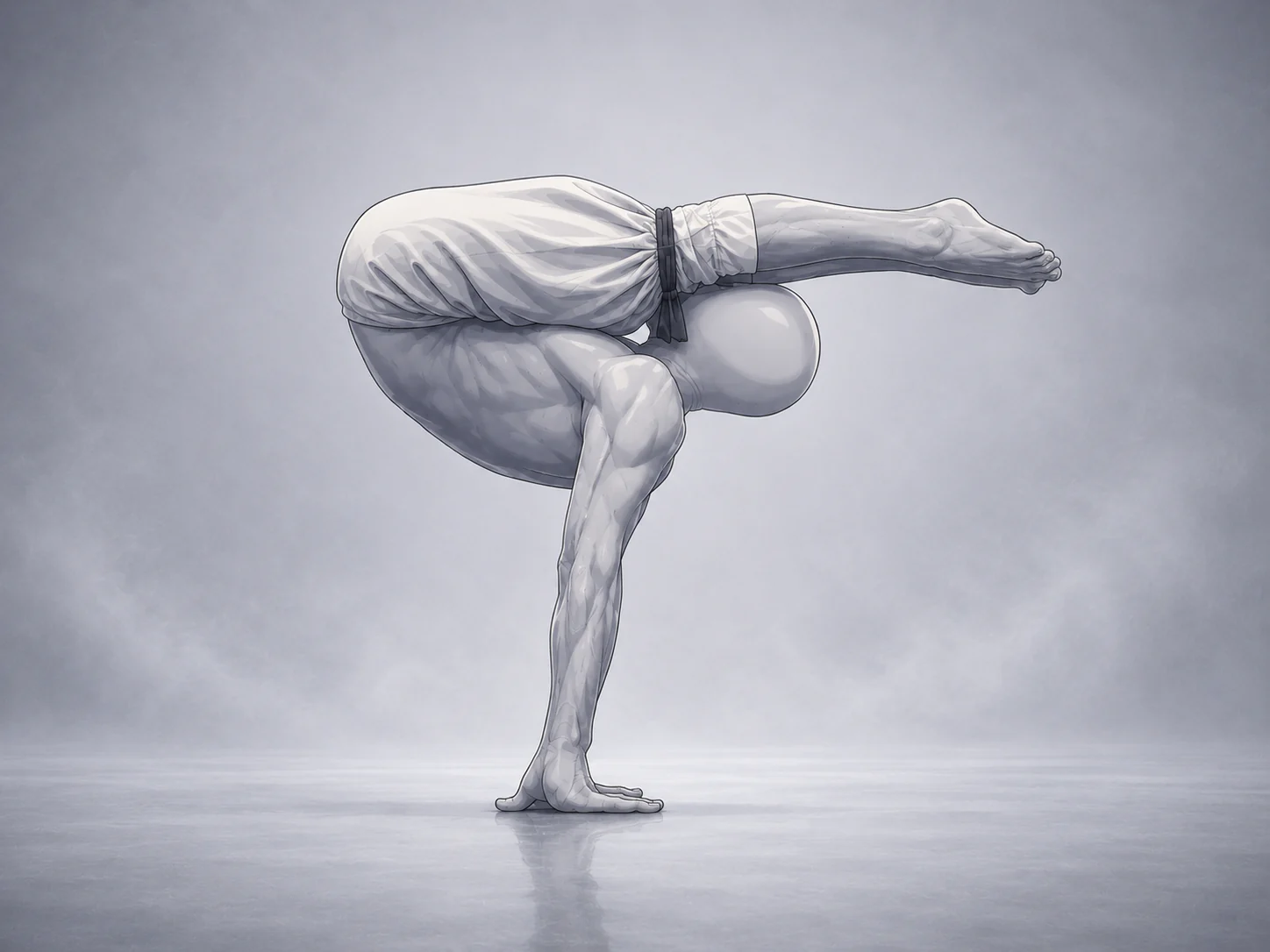
The manna is one of the hardest static holds in bodyweight training: a straddled, hands-turned-backward support in which the hips are driven above shoulder height while the arms stay locked straight. It sits at the top of the L-sit → V-sit → manna pathway and asks for an unusual combination of maximal core compression, extreme posterior-shoulder mobility, and straight-arm pressing strength at the same time.
Technique
- Build the position from the highest straddle V-sit you can control on this tree (the 140* V-sit), seated with straight arms and the hands turned backward, fingers pointing away from the body and placed behind the hips.
- Load the hands fully, depress and retract the shoulder girdle, and curl the pelvis as if trying to touch the toes to the shoulders, so the hips and groin point upward rather than the chest.
- Press the hands back into the floor while spreading the straddled legs as wide as you can control, driving the straight legs up toward vertical.
- As the legs approach vertical, aggressively drive the hips forward — think "create space between the forearms and the hips" rather than "push the hips up" — while continuing to root the fingers into the floor.
- Compress hard: pull the knees toward the face and drive the hips above shoulder height while keeping the arms locked straight and the straddled legs elevated near their maximal controllable angle.
- Hold the top position with active shoulder depression and continuous finger pressure; lower back down through the V-sit progression under control rather than dropping or collapsing out of the shape.
Preparation
Do not approach the manna until the full straddle V-sit series on this tree is controlled with straight arms, straight knees, and a clean, unhurried exit. Supplement the hold itself with posterior-shoulder mobility work (German hang / skin-the-cat holds) before attempts, since the position needs shoulder hyperextension range that ordinary pressing work does not build on its own, and with hamstring/straddle flexibility work, since a looser posterior chain lets the knees compress closer to the face with less resistance and makes the last degrees of hip height achievable.
Risks
The shoulders are taken into an extreme hyperextended, externally rotated range while bearing full bodyweight through locked arms. Do not force the final degrees of hip height before the posterior shoulder and thoracic mobility to reach that range has been built (for example with German hang / skin-the-cat style stretching); forcing range without that preparation is the main way this skill produces shoulder strain. Digging the fingers into the floor with the hands rotated backward loads the wrists and finger flexors heavily. Train on a firm, non-slip surface and back off if wrist or finger pain appears, rather than pushing through it. The deep straddle-compression position commonly produces cramping in the hip flexors, quadriceps, and hamstrings, especially before hamstring and straddle flexibility are established. Treat cramping by easing off, shaking out the muscle, and resuming — it is not a sign to abandon the progression, but forcing through sharp joint pain is. Because the position is only reachable near the very top of a long strength curve, falling backward out of the hold is common when pressing or using speed pushes into it; practice over a soft surface or with a spotter while still building the position.
Muscles
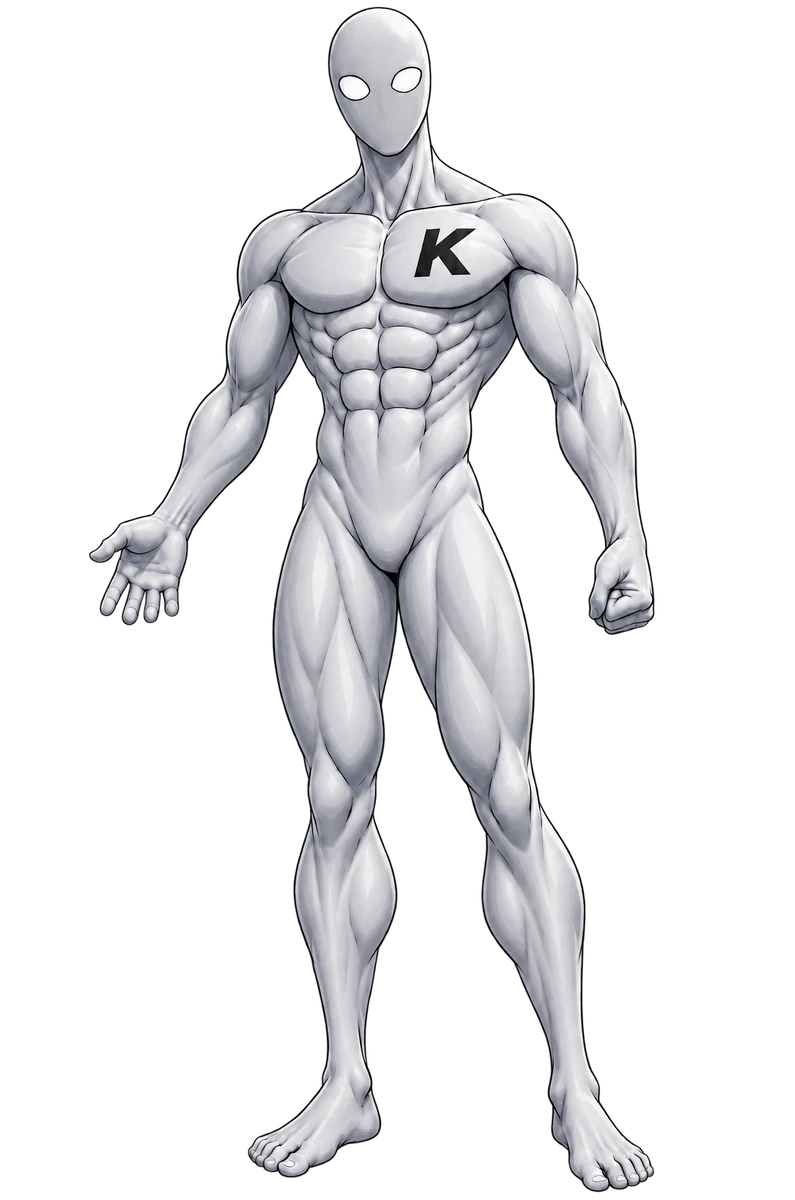
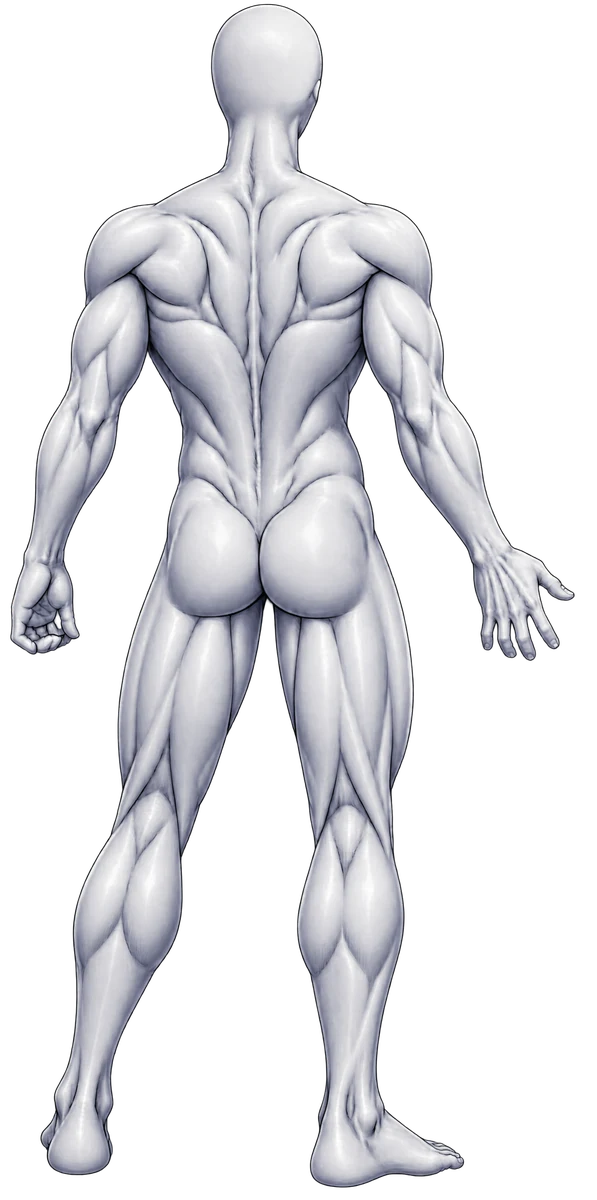
Core compression is the single limiting quality of the manna: the abdominals, hip flexors, and quadriceps work together to pull the straddled knees toward the face and keep the hips driven upward, which is why core sits at maximal load. The posterior shoulder girdle — rear deltoids, scapular retractors, and external rotators — and the triceps carry the straight-arm support through an extreme range, so both are rated above their level in the 140° V-sit. Forearms and hands take on more load than in the V-sit because the fingers must dig into the floor to drive the hands-turned-backward position. Trapezius stabilizes the depressed, retracted scapula; hamstrings work isometrically under lengthened tension in the deep straddle; the lower back organizes the aggressive pelvic curl; and the chest acts mainly as a stabilizer while it is stretched into the hands-back position.
Stats
- Strength
- 0.00
- Mobility
- 0.00
- Control
- 0.00
- Balance
- 0.00
- Endurance
- 0.00
- Power
- 0.00
Strength stays the dominant demand, matched to the same straight-arm, whole-bodyweight support as the V-sit family. Mobility is an equally large secondary demand here, driven by the need for extreme posterior-shoulder range and straddle/hamstring flexibility that the V-sit alone does not require. Balance and control both rise compared to the V-sit because the manna's center of mass sits higher and further from a stable base, making the top of the hold genuinely precarious rather than just heavy. Endurance covers holding the shape once reached; power is a minor factor limited to supplementary speed-push training rather than the hold itself. These weights are product-calibration estimates, held at or above the values used for the 140° V-sit prerequisite on this tree.
Completion criteria
Product completion estimate: hold the full manna shape — hips above shoulder height, straddled legs elevated near your maximal controllable angle, arms locked straight, hands turned backward — for 3 seconds with a controlled entry from and exit back to the V-sit progression. This is listed as a C-level static strength skill in the Gymnastics Code of Points and is one of the rarest static bodyweight-strength positions to achieve.
Progression thresholds
- Lower threshold
- 2 s
- Upper threshold
- 5 s
The 5-second and 2-second checkpoints are product-calibration estimates rather than a documented standard, set conservatively because the manna is already an end-of-tree static skill. Once a clean 5-second hold is repeatable with straight arms and controlled entry/exit, further progress typically moves toward loaded variations, one-arm preparation work, or ring/parallette manna rather than a harder floor hold. If you cannot yet hold the shape for about 2 seconds, or the hips will not clear shoulder height without collapsing, return to the 140° V-sit and the supplementary mobility and compression work above before the next attempt.