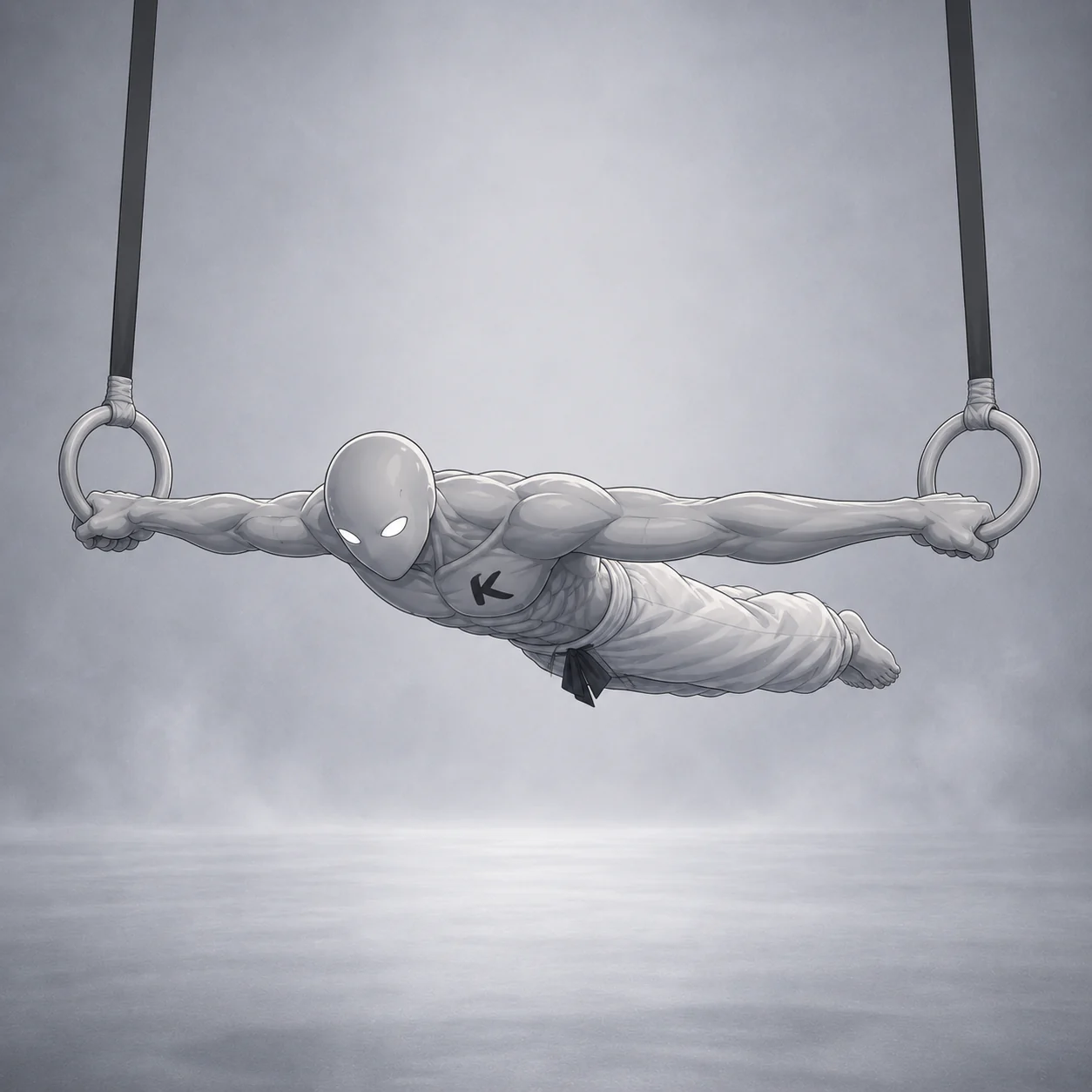
The maltese is a straight-arm ring hold in which the body lies horizontal, parallel to the floor, while the arms are spread out wide to the sides instead of staying narrow underneath the shoulders. Widening the arms this far past a planche's hand position multiplies the shoulder and chest moment arm dramatically, which is why coaching sources consistently treat it as one of the most demanding static skills in ring strength training — meaningfully harder again than the full planche or the ring planche that precedes it in this tree.
Technique
- Start from a straight-arm support hold on the rings, shoulder girdle actively depressed rather than shrugged, and set the hands into a slightly wider-than-shoulder grip you can maintain as the arms move outward.
- Begin leaning forward with the whole body held in a hollow, braced line, letting the rings drift out to the sides as you go — the arms should spread toward a wide "wings out" position rather than staying narrow like a planche.
- Continue lowering under control until the shoulders drop level with or slightly below the rings, keeping the elbows locked straight throughout; do not let them bend to relieve tension, since that shifts the demand away from the target muscles and toward the elbow joint itself.
- Extend the legs fully and bring them together, aiming for the hips sitting level with or a touch higher than the shoulders so the torso, hips, and legs form one continuous horizontal line, parallel to the floor, with the arms angled out to the sides near shoulder height.
- Hold the line by bracing the core, squeezing the glutes and legs, and actively pressing the arms out and down against the rings; breathe in a controlled way rather than holding the breath through the set.
- Reverse the movement slowly back to the support hold rather than dropping or collapsing out of the position, ending the attempt at the first sign the shoulder line or hip line is breaking down.
Preparation
Equipment and conditions
- Gymnastic rings on a rig rated for dynamic bodyweight loading, adjustable to a height that keeps the feet well clear of the floor through the full lean.
- A spotter or a soft landing surface underneath while the hold is still inconsistent.
- An established full planche and iron cross–level base of straight-arm shoulder strength, plus prior comfort with assisted or partial maltese leans, before attempting the free hold.
The locked prerequisite here is the ring planche, but moving from it to the maltese is more than adding hold time: it is a deliberate change in lever geometry, from hands tucked near the hips to arms spread wide near shoulder height. Coaching material on the skill points to the same straight-arm strength base used for the iron cross — a solid back lever, a straddle or full planche, and turned-out ring pressing work — as the realistic entry point, since both skills load the shoulder in an extreme, disadvantaged position. From that base, the maltese itself is built gradually: assisted or partial leans with the feet supported, resistance-band-assisted pullouts, and dedicated wide-arm accessory work such as ring wall maltese push-ups, reducing assistance only as the position becomes controllable.
Risks
The wide-arm position multiplies the lever arm well beyond a floor planche or even an iron cross, so it places extreme, end-range stress on the shoulder and elbow connective tissue; do not attempt free-hanging maltese work without an established straight-arm strength base and gradual, assisted exposure to the position first (partner assistance, band-supported pullouts, or a block/foot-supported lean). The most common technique breakdowns are letting the elbows bend under fatigue — which unloads the target muscles onto the joint itself — and letting the hips sag or the shoulder girdle ride up, both signs the set should end immediately rather than be fought through. Because this hold is trained almost entirely on rings, grip and shoulder fatigue can compound quickly near maximum effort; train it with a spotter or over a soft landing surface, and treat any sharp or lingering shoulder, elbow, or wrist pain as a reason to stop and have it assessed rather than to keep pushing the position.
Muscles


- Chest0%— show exercises
- Shoulders0%— show exercises
- Core0%— show exercises
- Biceps0%— show exercises
- Forearms0%— show exercises
- Glutes0%— show exercises
- Triceps0%— show exercises
- Hands0%— show exercises
- Trapezius0%— show exercises
- Quadriceps0%— show exercises
- Latissimus Dorsi0%— show exercises
- Lower Back0%— show exercises
- Hamstrings0%— show exercises
The chest is the primary limiting muscle: holding the arms wide against the pull of gravity is mechanically similar to an isometric fly at a very disadvantageous angle, and the pectorals carry the largest share of that load. The shoulders (mainly the anterior deltoid) and the core work alongside the chest to keep the arms out and the torso rigid, while the biceps and triceps stabilize the locked elbow against rotational torque through the joint — a straight-arm demand shared with the planche and iron cross. The trapezius and other scapular stabilizers keep the shoulder blades controlled, the forearms and hands manage grip and small pressure adjustments on the rings, and the glutes, quadriceps, lower back, and hamstrings keep the hips and legs forming one unbroken line with the torso.
Stats
- Strength
- 0.00
- Balance
- 0.00
- Control
- 0.00
- Mobility
- 0.00
- Endurance
- 0.00
- Power
- 0.00
Strength is the dominant quality, and it sits at the very top of what a static hold demands, since the wide-arm lever pushes the shoulder and chest moment well past what a floor planche requires. Balance is the clear secondary factor: with the base of support reduced to two ring points spread wide apart, small shifts in hip or shoulder position have an outsized effect on whether the horizontal line can be held at all. Control follows as a meaningful tertiary demand, since the entry, the hold, and the exit all depend on precisely regulating shoulder and hip position rather than muscle strength alone; mobility plays a small supporting role in tolerating the wide shoulder angle, while power and endurance are minor contributors to a brief, static skill.
Completion criteria
Hold a full maltese with the elbows locked, the arms spread out to the sides near shoulder height, and the shoulders, hips, and legs forming one continuous horizontal line, entering and exiting the position under control rather than dropping into or out of it.
Progression thresholds
- Lower threshold
- 2 s
- Upper threshold
- 5 s
These second counts are a conservative, estimated product checkpoint rather than a sourced physiological threshold — at this level of difficulty, even a briefly controlled full hold is a rare achievement, so the bar is set well below the ten-second benchmark used for the floor planche. Use a short, clean hold of a few seconds as a sign the free position is becoming reliable enough to explore longer holds or dynamic entries; if the line cannot be held for at least a couple of seconds, return to assisted leans, partial-range work, or the ring planche and rebuild the wide-arm strength base before trying again.