Element preview
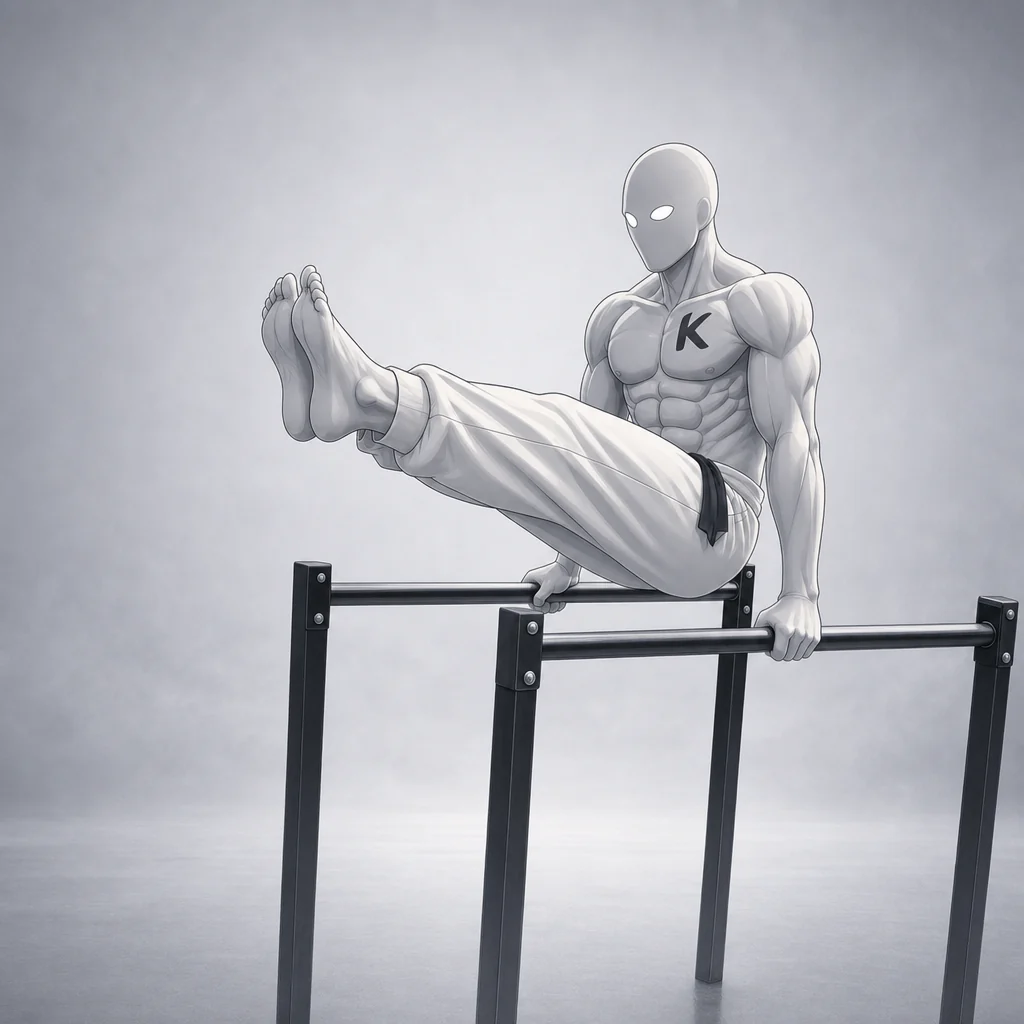
Preview · 0:06
A short look at the whole element in motion.
This is an overview clip, not a technique reference — the form in it may be imperfect. Follow the steps in Technique.
The L-sit muscle-up is the strict, non-kipping counterpart to the L-sit kipping muscle-up: the athlete holds a full L-sit — hips flexed, knees locked, toes pointed — from the start of a motionless hang, through a strict pull with no swing or hip drive, across the bar transition, and into a supported dip lockout, only releasing the L-sit shape after returning to the hang. Removing the kip's momentum means the pull alone has to supply the height needed to clear the bar while the trunk and hip flexors keep the legs rigid for the entire repetition, which is why it sits above both the strict muscle-up and the L-sit kipping muscle-up on the vertical-pull path even though each looks similar in isolation.
Technique
- Set a false grip on the bar if you use one — wrists rolled slightly over the top of the bar — then settle into a straight-arm hang.
- Lift both legs into a full L-sit: hips flexed to roughly 90 degrees, knees locked, toes pointed. Hold this shape motionless before starting the pull.
- Brace the trunk hard and pull with no kip, no arch-and-hollow swing, and no leg drive — drive the elbows down and back exactly as in a strict muscle-up, letting the shoulder blades depress first.
- Continue pulling until the torso is high enough to lean forward and roll the wrists over the bar, keeping the legs level through the turnover rather than letting them drop to help the transition.
- Press to a full lockout in a supported dip above the bar while still holding the L-sit, then lower under control back to a hang and re-establish the L-sit before the next repetition.
Preparation
This skill assumes two things are already solid: a comfortable, dead-hang-to-lockout strict muscle-up performed with no kip, and an L-sit kipping muscle-up that shows the athlete can hold the L shape through a bar transition even with some momentum to help. The remaining step is removing that momentum. Build hanging L-sits and strict L-sit pull-ups to strengthen the isometric leg hold on its own, then practice lifting into the L-sit before the pull begins rather than during it, so the shape is already set before the bar transition starts. Some athletes use a false grip — wrists rolled slightly over the top of the bar during the hang — to smooth the transition, though this is a technique preference rather than a strict requirement.
Risks
Everything that makes a strict bar muscle-up demanding — pulling high enough before turning over, keeping both shoulders moving together instead of turning over one arm at a time, controlling the descent — is still present here, and the fixed L-sit removes the option of a small leg kick or hip drive to rescue a stalled transition. If the pull loses height partway through, let go and reset rather than trying to force the turnover.
Holding the legs extended through the entire hang, pull, transition, and press adds sustained hip-flexor and core tension on top of the shoulder and elbow demand. Some coaches flag this kind of repeated, high-frequency shortened-position loading as a plausible contributor to hip-flexor tightness, though this is a general training caution rather than a measured injury rate specific to this skill.
Attempt this only once a strict bar muscle-up and a strict L-sit pull-up are both comfortable and repeatable. Train over a soft landing surface or with a spotter while learning, and end the set as soon as fatigue starts to break the L-sit shape, since a collapsing L or a rushed transition is the most common way a repetition is missed.
Muscles


The latissimus and biceps drive the pull just as in a strict muscle-up, with the triceps and chest taking over through the transition and lockout — and because there is no kip to contribute momentum, all three groups have to produce more of that height and press through force alone. Holding the L-sit throughout adds a continuous, heavy demand on the core and hip flexors that is greater than in the kipping version, since the legs cannot swing at any point to unweight them. The quadriceps lock the knees and the hamstrings hold light tension to keep the legs straight, the shoulders and trapezius organize the shoulder blades under load through the whole hang-pull-press sequence, and the forearms manage grip through an extended isometric hang. The glutes play only a small stabilizing role here, less than in the kipping version, since there is no hip drive to help initiate the pull.
Stats
- Strength
- 0.00
- Control
- 0.00
- Endurance
- 0.00
- Power
- 0.00
- Mobility
- 0.00
- Balance
- 0.00
Strength is the dominant quality and sits at the top of this vertical-pull family, since the athlete pulls and presses full bodyweight through a fixed-bar transition while also holding a rigid L-sit that removes any assist from a kip or leg drive. Control is a close secondary demand, higher than in the kipping version, because the L-sit has to stay visibly intact through the hang, the strict pull, the turnover, and the descent rather than just through a brief kip. Power is somewhat lower than in the kipping muscle-up, since the L-sit's forward-shifted center of mass and the lack of any leg swing turn the movement into more of a sustained grind than an explosive burst; endurance sits at a similar level, reflecting the extra time under tension from holding the L position across the whole repetition. Mobility and balance make only minor supporting contributions.
Completion criteria
Complete one unassisted repetition from a motionless L-sit hang to a stable support with straight elbows, then return under control to the L-sit hang. The L-sit shape (hips near 90 degrees, knees locked, toes pointed) should stay visibly intact through the pull, the transition, and the descent, with no kip, no leg swing, and no one-arm turnover.