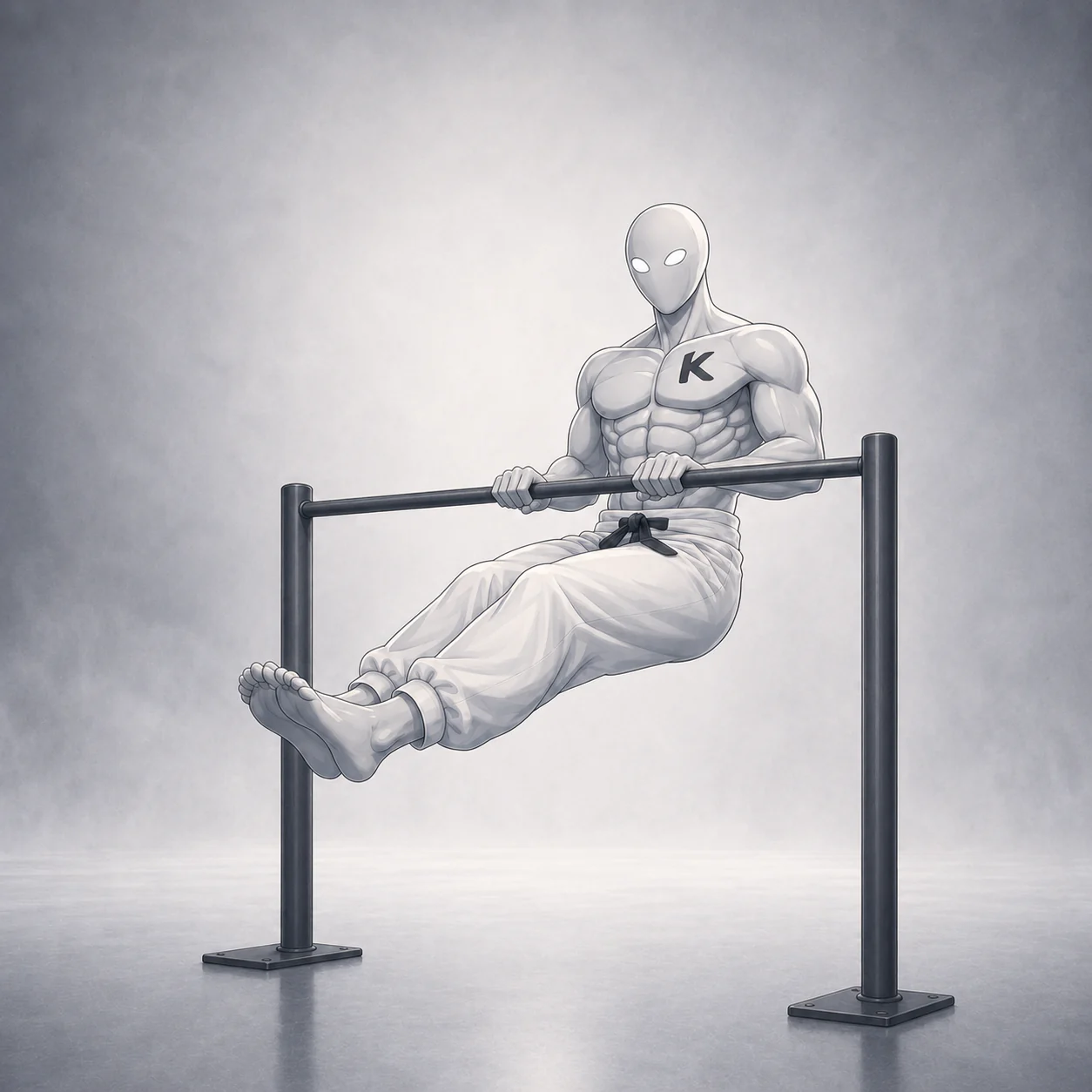
The L-sit kipping muscle-up layers a straight-leg L-sit onto the kipping muscle-up's hang-to-lockout swing. Holding the legs extended through the whole movement removes most of the free leg swing that a standard kip relies on for momentum, so the athlete has to replace some of that momentum with a stricter, more explosive pull while also keeping the trunk and hip flexors braced hard enough to stop the legs from dropping. That combination — bar transition mechanics plus a sustained compression hold under acceleration — is why it sits above both of its prerequisites on the vertical-pull path even though it keeps the same beginner-tier classification as the kipping muscle-up.
Technique
- Hang from the bar with a shoulder-width pronated grip, then lift both legs into an L-sit — hips flexed to roughly 90 degrees, knees locked, toes pointed — before starting the swing.
- Because the legs stay extended and cannot swing freely the way they do in a standard kip, generate the momentum mainly through a small, controlled rock of the shoulders and hips: push slightly into an arch, then reverse into a hollow while keeping the L shape as intact as possible.
- At the top of the hollow-to-arch reversal, pull explosively while driving the chest and hips up and forward toward the bar, letting the legs lower somewhat from the L as they trade position for the vertical pulling force needed to clear the bar.
- As the chest rises past the bar, roll the wrists over it quickly and lean the torso forward through the transition, the same "false" moment found in any kipping muscle-up.
- Press the arms to full lockout above the bar in a supported dip, then lower under control back to a hang and re-establish the L-sit before the next repetition.
Preparation
This skill assumes two things are already solid on their own: a comfortable, pain-free kipping muscle-up, and a strict L-sit pull-up with the legs held level and the knees locked through a full pulling repetition. The new skill is mostly about merging the two rather than adding fresh strength on top of either: practice lifting into the L-sit before the first kip, then drill a smaller, more compact arch-hollow rock than usual while keeping the legs still, so the timing changes without the legs collapsing out of position.
Risks
Because the legs cannot swing to build momentum, the reduced kip amplitude shifts more of the work onto a strict, explosive pull, so the wrist, elbow, and shoulder loads at the bar transition described for the kipping muscle-up apply here as well, and arguably arrive with less rhythm to absorb them. Do not attempt this variation until the plain kipping muscle-up and a strict L-sit pull-up are both comfortable and repeatable. Holding the legs extended through an already fast, whole-body movement adds sustained hip-flexor and core tension on top of the ballistic shoulder demand; if the hips or lower back start to ache rather than simply fatigue, that is a signal to shorten the hold portion or regress to a tucked-leg kip. As with any kipping bar skill, train on a soft landing surface or with a spotter while learning, and stop the set once fatigue starts to break the L-sit shape or the timing of the transition, since a late or rushed transition is the most common way a rep is missed.
Muscles
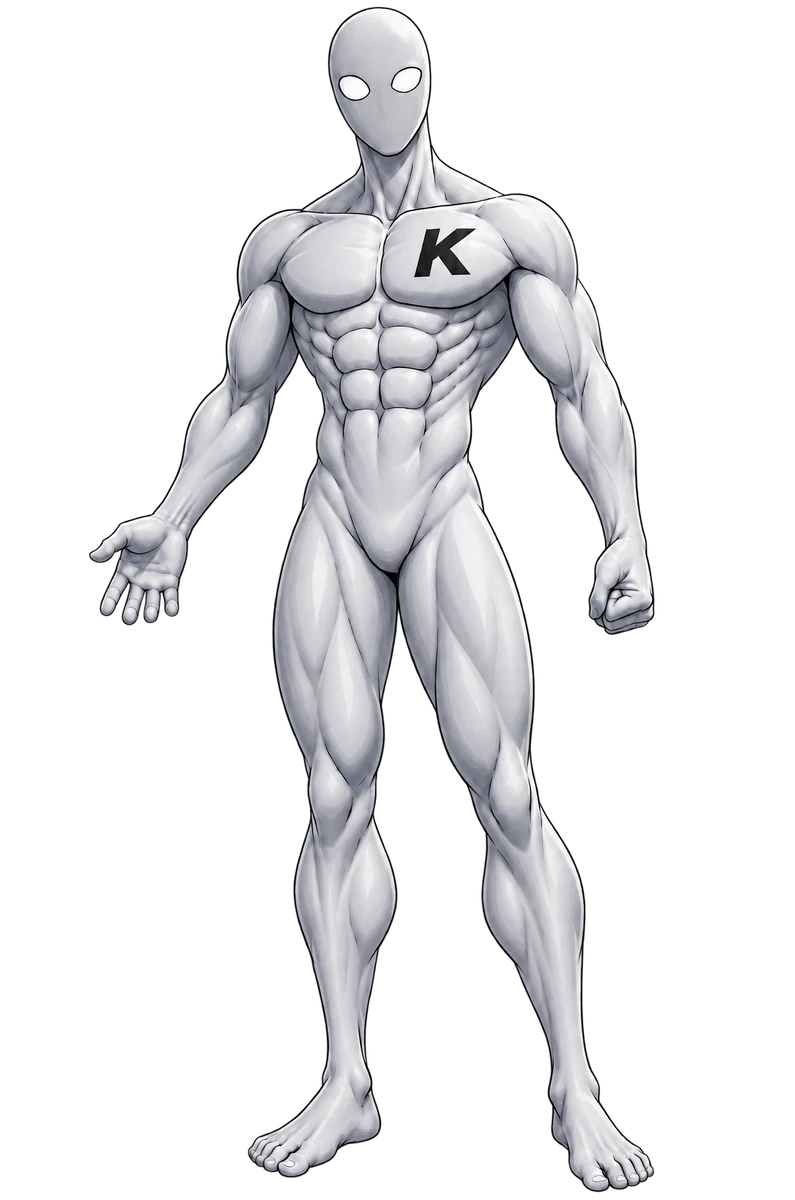
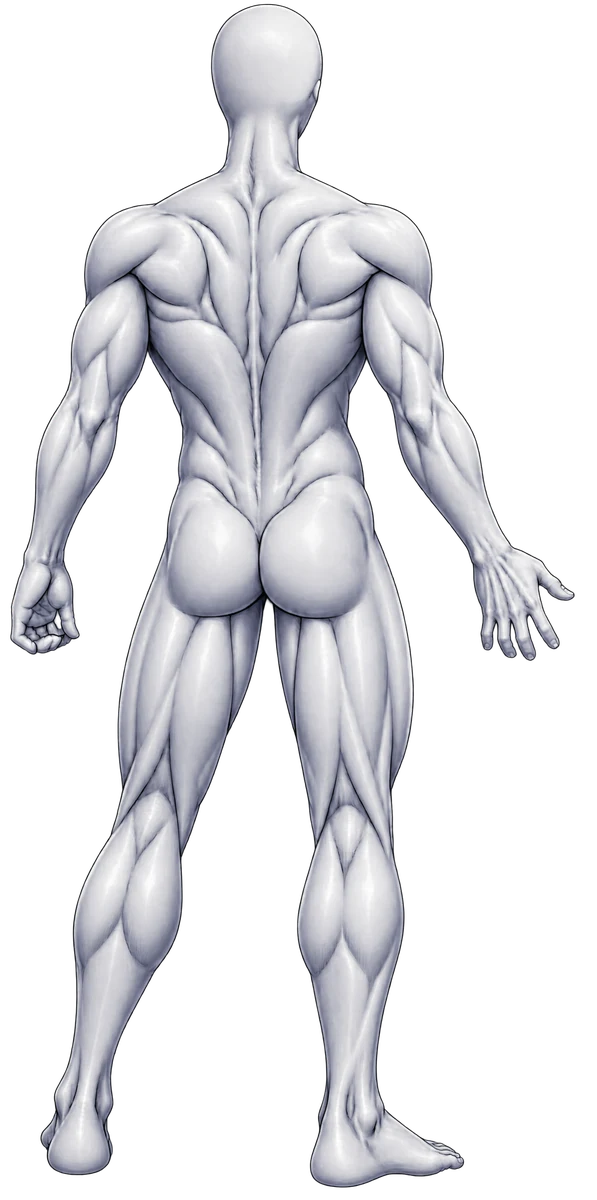
The latissimus and biceps drive the pull just as in any muscle-up, while the shoulders, chest, and triceps take over through the transition and lockout. Holding the L-sit through the kip and pull adds a heavy, continuous demand on the core and hip flexors that a standard kipping muscle-up does not have, since the legs must stay extended and controlled rather than swinging freely. The quadriceps lock the knees and the hamstrings hold light tension to keep the legs straight, while the forearms and trapezius stay under load throughout the hang, kip, and pull, and the glutes contribute a smaller amount of hip drive than in the free-swinging version.
Stats
- Strength
- 0.00
- Control
- 0.00
- Power
- 0.00
- Endurance
- 0.00
- Mobility
- 0.00
- Balance
- 0.00
Strength remains the dominant demand, and it edges higher than a plain kipping muscle-up because the constrained kip leaves less room for momentum to substitute for raw pulling force. Control becomes a much larger secondary factor than in the standard kip, reflecting the sustained trunk and hip-flexor bracing needed to hold the L shape through a fast, accelerating movement; power stays meaningful for the transition itself but contributes somewhat less than in the free-kip version.
Completion criteria
2-3 consecutive repetitions that keep a visibly extended L-sit shape through the kip and into the pull, a controlled bar transition, and a full arm lockout at the top of each repetition.
Progression thresholds
- Lower threshold
- 1 reps
- Upper threshold
- 3 reps
Once 3 consecutive repetitions feel repeatable with the L-sit shape held clearly through the kip and pull, that is a reasonable checkpoint to start working toward the strict L-sit muscle-up, which removes the kip's momentum entirely. If fewer than 1 clean repetition is achievable, spend more time drilling the kipping muscle-up and the L-sit pull-up separately before recombining them.