Element preview
Preview · 0:06
A short look at the whole element in motion.
This is an overview clip, not a technique reference — the form in it may be imperfect. Follow the steps in Technique.
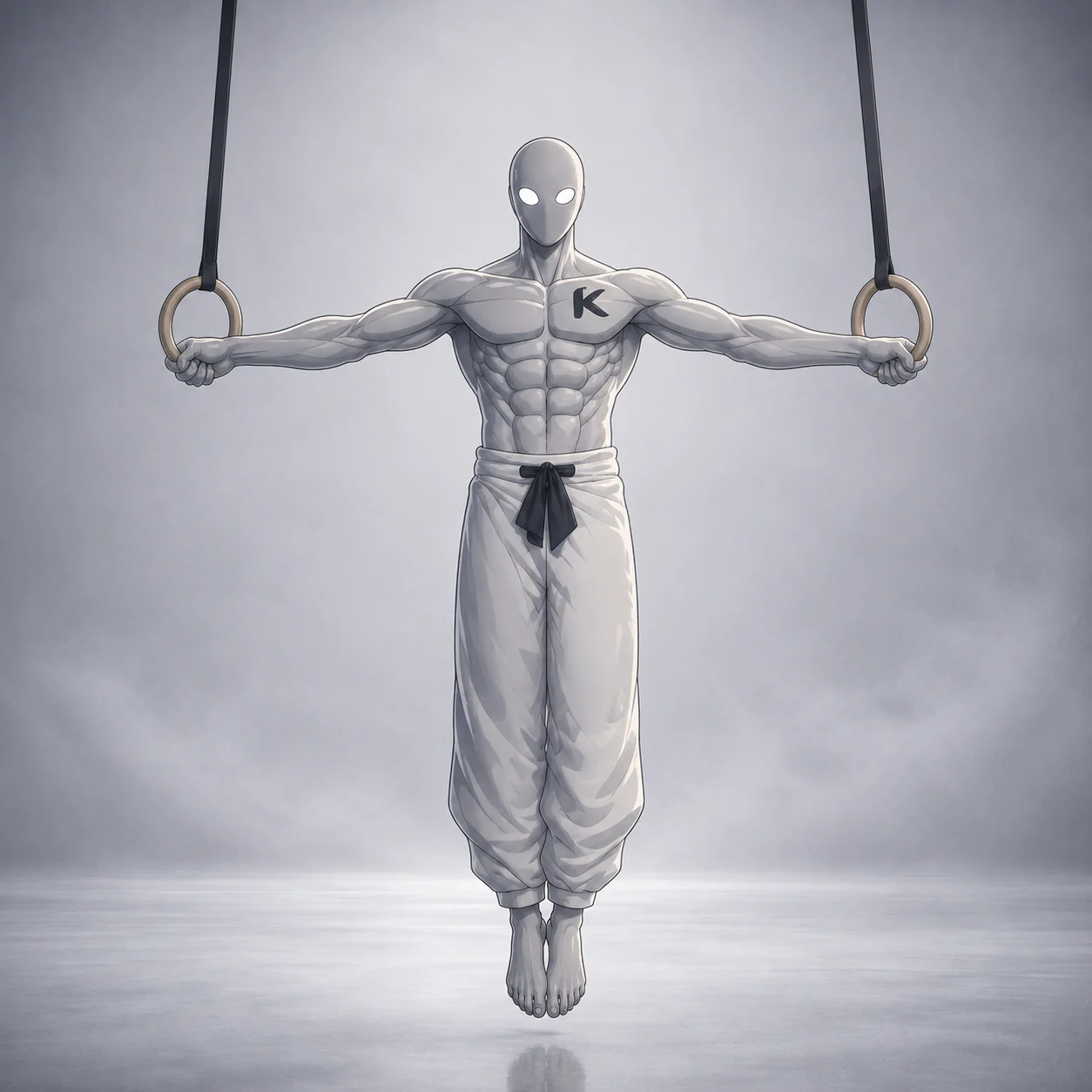
The iron cross is a static ring hold in which the body hangs vertically while the arms are locked straight out to the sides at shoulder height, forming a "T" against gravity. It is one of the classic strength elements of men's artistic gymnastics on rings and is widely regarded as one of the hardest static holds in bodyweight training, since it combines the straight-arm shoulder demands of the planche and back lever with an extremely disadvantaged lever arm that most other skills never approach.
Technique
- Start from a support hold on the rings with the arms straight and the shoulder girdle depressed, then turn the rings out (RTO) so the palms face fully forward.
- Lower with control, rotating the shoulders forward while keeping the elbows locked straight and pointed forward — the rings will naturally rotate as you descend, which is normal.
- As you approach the horizontal position, keep pulling the rings downward and out toward your hips instead of letting your body sink passively into the position.
- Finish with the arms held straight out to the sides in line with the shoulders, torso upright and still, holding for the target time.
- Keep the elbows locked and the shoulder girdle pinned down the entire time; if the shoulders start riding up toward the ears, end the set immediately rather than fighting to hold the line.
Preparation
The iron cross is never trained by simply attempting the free hold — the position places enough stress on the shoulder and elbow connective tissue that most coaching material treats it as requiring its own dedicated preparation phase. A commonly recommended strength base before starting iron cross work includes a full back lever with supinated hands, a front lever worked at least to the half-layout or one-leg-out stage, a rings tuck planche, straight-arm pressing work such as rings handstand pushups, and rings dips turned out toward ninety degrees — together these build the anterior shoulder pressing strength and the elbow/shoulder connective-tissue tolerance the cross position demands.
From that base, the position itself is built with external assistance rather than free-hanging attempts: partner-assisted crosses (most effective, since a partner can hold you at exactly the intensity you can control), resistance-band pullouts with added weight, or supporting part of your bodyweight on a block, gradually reducing the assistance as you get stronger. Straight-arm pulling strength built this way carries over strongly to the back lever, front lever, and one-arm chin-up, since all of these skills share a similar strength profile at the shoulder and elbow.
Risks
The iron cross loads the shoulder in an extremely disadvantaged, end-range position, and shoulder complaints are common in male gymnasts who train ring strength elements — clinical case-series data on surgically treated shoulders in high-level male gymnasts reports shoulder injuries account for roughly 16.8-19% of all reported injuries in this population, with anteroinferior labral tears/capsular laxity and posterosuperior impingement with rotator-cuff or biceps pathology as the two dominant patterns; the same literature notes that ring strength elements can subject the superior labrum to traction on the order of 6-8.5 times bodyweight. This is population-level surgical-case evidence, not a measured injury rate or mechanism specific to the iron cross alone, so treat it as a strong reason for caution rather than a precise risk figure for this skill.
The two most common technique breakdowns, per coaching material on the skill, are: (1) letting the elbows bend, which reduces shoulder torque but shifts load onto the latissimus dorsi at the expense of the pectorals and elbow connective tissue, and (2) letting the shoulder girdle elevate as the prime movers fatigue — a sign the surrounding musculature can no longer safely stabilize the joint, and a cue to stop the set immediately rather than grinding it out. Elbow soreness at the medial side (near the medial epicondyle) is also a known overuse site during iron cross training and should be managed with warm-up, rotator-cuff accessory work, and by not training the skill at the end of a fatigued session.
Do not attempt loaded iron cross work without first building the connective-tissue and pressing base described in the Preparation section below — this skill is trained progressively with partner assistance, resistance-band pullouts, or block-supported pullouts, not by attempting the free hold directly.
Muscles
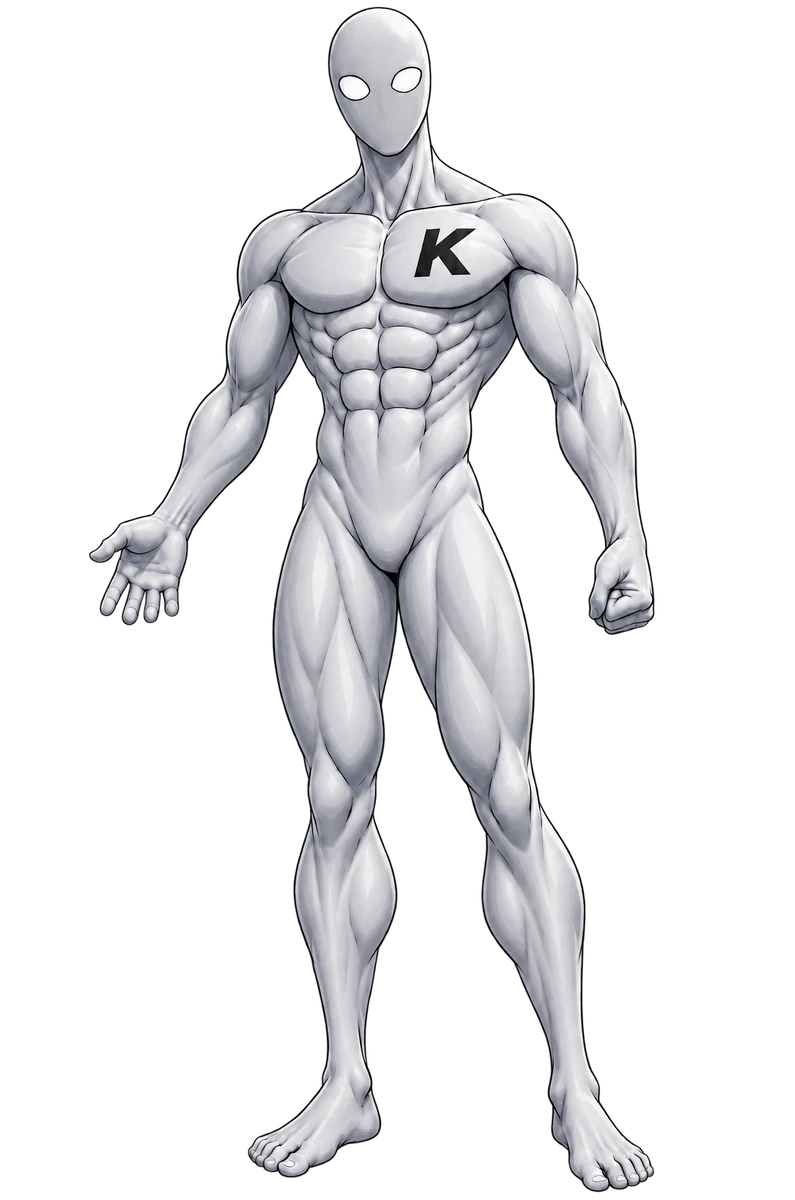
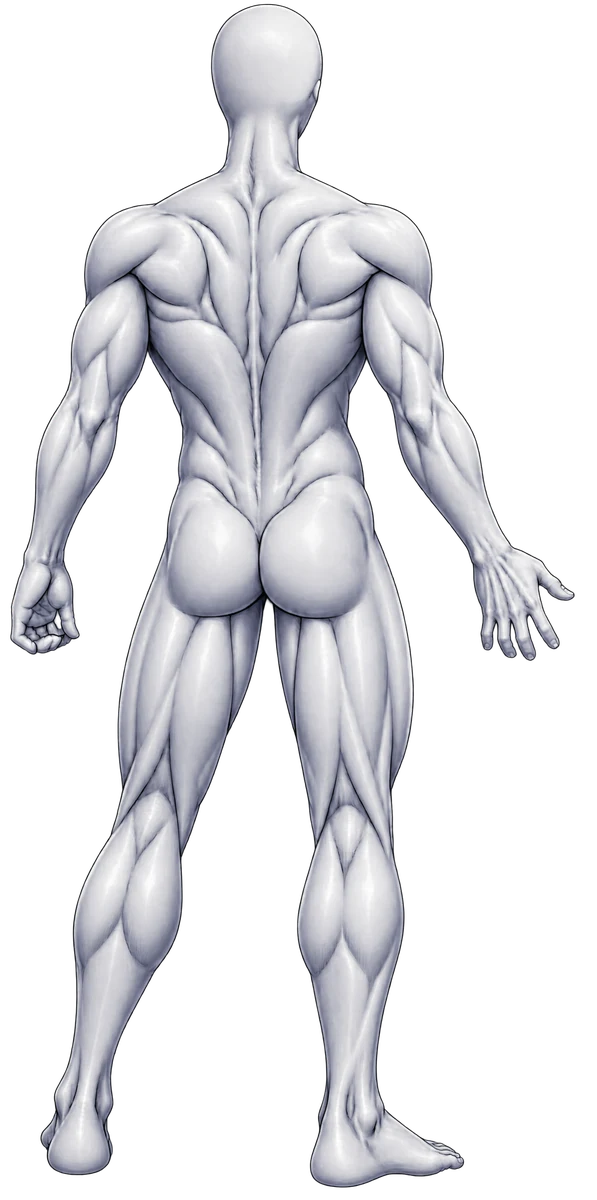
Biomechanically, the hold is resisted mainly by the chest, latissimus dorsi, and shoulders acting as straight-arm adductors — pulling the arms down from the horizontal "T" against gravity — while the biceps and triceps work isometrically to keep the elbow locked straight against rotational torque through the joint. Keeping the elbows fully straight (rather than letting them bend) shifts more of the load onto the chest and shoulders instead of the stronger latissimus dorsi, which is why the pectorals are usually the limiting muscle group once the position is learned. The trapezius, serratus anterior, and other scapular stabilizers work hard isometrically to keep the shoulder blades depressed, the core braces to keep the torso from swinging, and the forearms and hands manage the grip and rotation of the rings.
Stats
- Strength
- 0.00
- Control
- 0.00
- Balance
- 0.00
- Endurance
- 0.00
- Mobility
- 0.00
- Power
- 0.00
This is an extreme total-body isometric strength hold performed from a severely disadvantaged lever, so strength dominates even more than in related straight-arm holds. Control is the clear secondary demand — small errors in scapular or elbow positioning are the difference between a stable hold and a shoulder that gives way, and coaching material repeatedly emphasizes stopping the set at the first sign the shoulder girdle can no longer be controlled rather than pushing through fatigue. Balance plays a real but smaller supporting role in keeping the torso still and centered between the rings, while endurance, mobility, and power are minor contributors since the hold is brief and the working range of motion is fixed.
Completion criteria
A controlled iron cross means locking the arms straight out to the sides, keeping the torso still and the shoulder girdle pinned down (not creeping toward the ears) for the full target time, and lowering out of the position under control rather than dropping or collapsing. As a general practical benchmark, a momentarily stopped, motionless hold of roughly 2 seconds is typically treated as the bare-minimum bar for a position to "count" as achieved at all; the thresholds below describe a comfortably controlled hold for training purposes rather than that bare minimum.
Progression thresholds
- Lower threshold
- 3 s
- Upper threshold
- 10 s
Strength-carryover comparisons from bodyweight strength coaching associate roughly a 3-4 second iron cross hold with the strength of a one-arm chin-up done with about 15lb added, and a longer ~10 second hold with the strength of a one-arm chin-up done with about 25lb added (roughly five reps of that weighted one-arm chin-up). Use the lower threshold as a sign you can safely keep training the free hold with assistance, and the upper threshold as a sign you have the strength base to start exploring dynamic cross work such as pullouts into the position or the iron cross to back lever.