Element preview
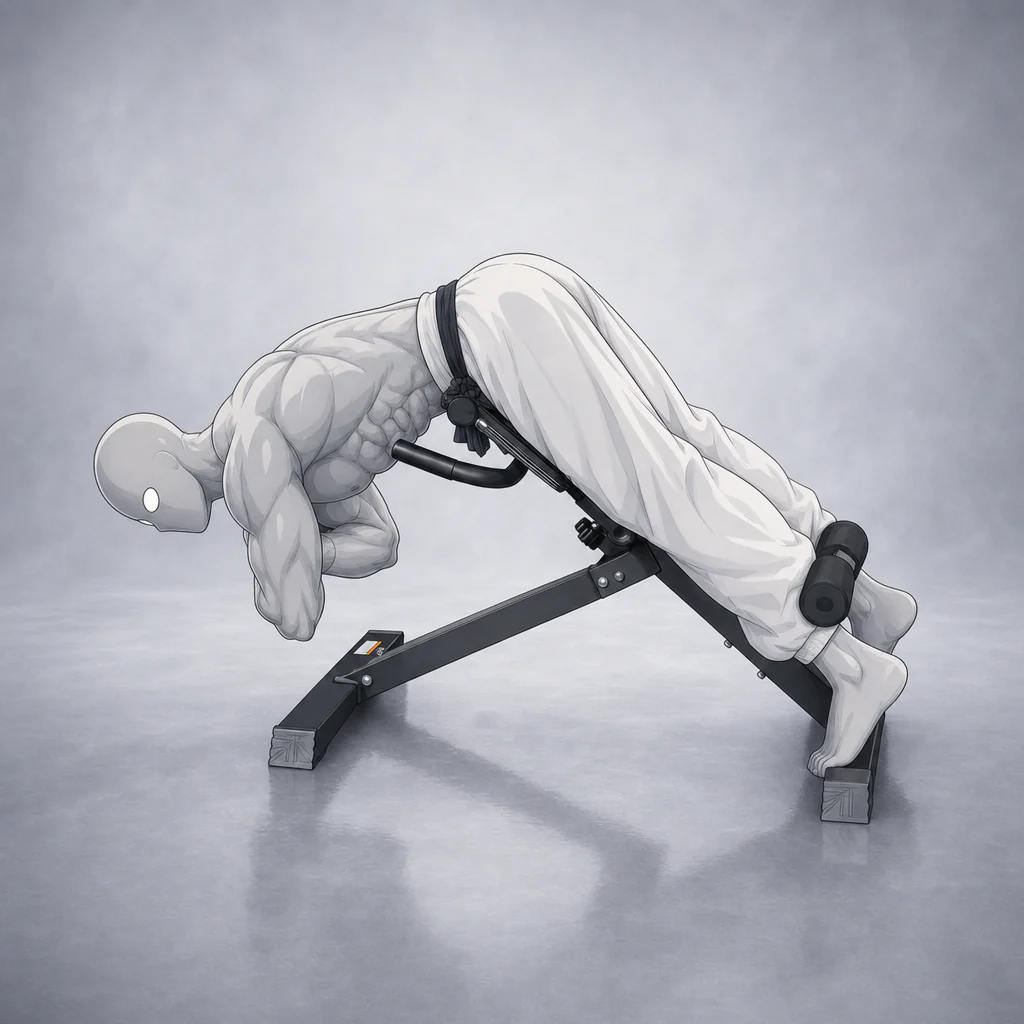
The hyperextension (back extension) is a beginner hip-hinge exercise performed on a Roman chair or GHD-style bench: the hips act as the hinge while the lower back, glutes, and hamstrings work isometrically and concentrically to bring the torso back in line with the legs. It is a common entry point into posterior-chain and core training because the bench supports body weight and lets a beginner learn to control lumbar position under light load before progressing to loaded hip hinges.
Technique
- Set the pad of a Roman chair / GHD bench just below your hip crease, and hook your heels under the footpads or ankle rollers.
- Cross your arms over your chest (or hold light hands-behind-head for an easier lever) and let your torso hinge forward at the hips until it is roughly perpendicular to the floor. Keep the knees soft, not locked.
- Brace the core and drive the hips into the pad, extending at the hips — not the lumbar spine — until your torso is in line with your legs.
- Stop at a straight line from head to heels; do not arch further into extension at the top.
- Lower back down under control over 2–3 seconds until you feel a stretch through the hamstrings and glutes, then repeat.
Preparation
Set up so the hinge happens at the hip crease, not at the waist. Most technique breakdowns in this movement come from letting the exercise turn into a lower-back crunch instead of a hip extension: sagging into spinal flexion at the bottom, or yanking past neutral into a lumbar arch at the top.
Risks
This is a hip-hinge exercise, not a spinal-flexion/extension exercise: repeatedly rounding the lower back at the bottom or arching past a neutral line at the top loads the lumbar discs and posterior spinal structures more than the hips and hamstrings, which are meant to do the work. Move slowly and stop the range of motion at neutral. People with acute low-back pain, a diagnosed disc injury, or other lumbar spine conditions should get individual clearance before loading this pattern.
Muscles


The prime mover is the lower-back musculature (erector spinae), which works isometrically to keep the spine extended and stable while the glutes and hamstrings drive hip extension. The core braces to resist unwanted spinal motion, and the trapezius helps hold the shoulders and head in a neutral line, especially once hands move behind the head or hold added weight.
Stats
- Strength
- 0.00
- Endurance
- 0.00
- Control
- 0.00
- Balance
- 0.00
- Mobility
- 0.00
- Power
- 0.00
Hyperextensions are strength-dominant but built around higher-rep sets, so muscular endurance in the erector spinae and glutes is trained alongside raw strength. Control matters more than in most beginner movements — the whole point of the drill is learning to stop hip extension at a neutral spine rather than letting momentum carry the torso into a lumbar arch.
Completion criteria
3 sets of 15 controlled reps through a full, pain-free hip range of motion, stopping at a straight line (not arching past neutral) at the top.
Progression thresholds
- Lower threshold
- 8 reps
- Upper threshold
- 15 reps
Once full sets of clean, controlled reps become easy, load can be added (a plate held at the chest) instead of increasing reps further, since very high rep counts on this pattern mostly add time under tension without much extra strength stimulus.