Element preview
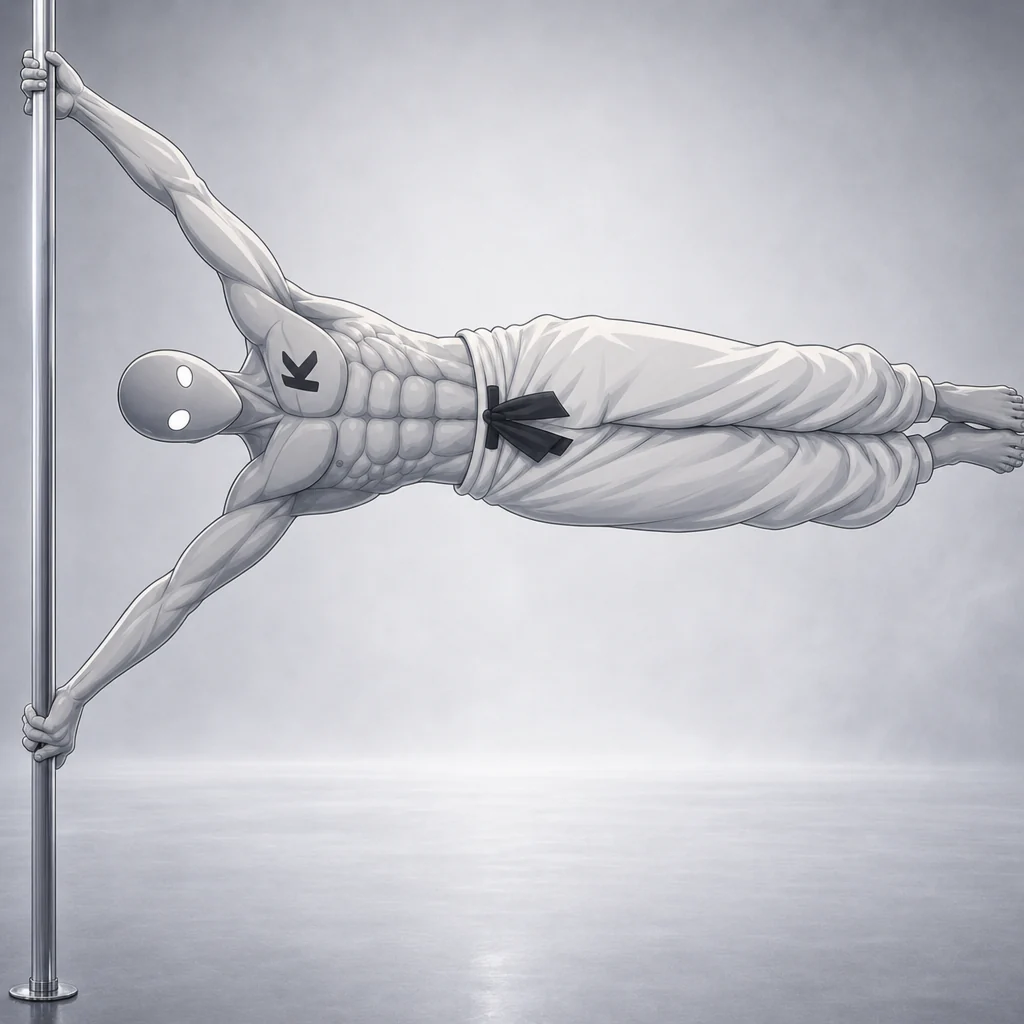
The human flag is a full-body lateral lever: the torso hangs horizontally off a vertical pole, held up entirely by one arm pulling and the other pushing along the same vertical line. Unlike front or back levers, which load the body in the sagittal plane, the flag loads the spine sideways, so it asks for a rare combination of oblique strength, shoulder stability, and grip endurance rather than raw pulling power alone.
Technique
- Grip the vertical pole (or a vertical bar section) with the top hand in a pronated (overhand) grip at roughly shoulder height, and the bottom hand about hip-width lower in a supinated or neutral grip in line with the top hand.
- Drive the top arm into a straight-arm pull toward the pole while the bottom arm pushes straight down and away from it — the two arms work in opposite directions on the same vertical line, which is what suspends the body horizontally.
- Lock both elbows; the shoulders, not the elbow flexors, must carry the static tension so the arms do not have to bend to hold position.
- Brace the whole torso as one rigid unit: posteriorly tilt the pelvis, squeeze the glutes, and press the legs together and straight so the body forms a single horizontal line from shoulders to feet.
- Fight the pole's tendency to rotate the hips downward by driving hard lateral flexion through the obliques on the top side of the torso — this is the main isometric task of the hold, not the arms.
- Keep the head in a neutral line with the spine and the gaze forward; do not let the head sag or rotate to "help" the position, since that leaks tension from the trunk.
Preparation
The direct stepping stone is the tuck human flag, where bending the knees and hips toward the chest shortens the body lever and makes the lateral hold far more manageable. Before attempting the tuck position, most lifters need a solid base of strict pull-ups and dips, comfortable straight-arm support work, and dedicated lateral-core preparation — side-plank variations with hip raises and short holds in a vertical or advanced tuck flag position build the specific oblique and shoulder tolerance the full flag demands. Grip endurance on a vertical grip also needs its own attention, since it differs from the horizontal grip used in most pulling work.
Risks
The straight-arm shoulder position under full bodyweight leverage puts real stress on the shoulder joint, especially the pushing-side deltoid and rotator cuff, and on the wrists and elbows of the pulling arm; do not attempt full-range flag work with an unresolved shoulder or elbow issue. The lateral spine loading is intense and technique failure typically shows up as the hips dropping and the lower back rotating to compensate — stop the set at the first sign of the hip line breaking rather than fighting to hold a collapsing position. Grip failure at height is the other major risk: only attempt full flags over a soft landing surface and with a spotter or a low bar/pole until the hold is consistent, and never bounce or jerk into position from a swing.
Muscles


The core — primarily the obliques working together with the rectus abdominis — is the true prime mover: it contracts isometrically to resist the pole's pull toward hip drop and keeps the trunk rigid through the full lateral lever. The latissimus dorsi and shoulders anchor both straight arms against the pole, with the pulling-side lat and the pushing-side deltoid carrying most of the load; the forearms and hands work hard isometrically just to keep grip on a vertical surface for the duration of the hold. The chest and triceps support the pushing arm's lockout, while the lower back, glutes, and quadriceps keep the hips and legs in one straight, non-sagging line so the whole body acts as a single lever rather than folding at the hips or knees.
Stats
- Strength
- 0.00
- Control
- 0.00
- Balance
- 0.00
- Endurance
- 0.00
- Power
- 0.00
- Mobility
- 0.00
Strength dominates: producing enough force through the shoulders, lats, and core to suspend the entire bodyweight sideways is the core demand. Control is the next-largest factor, since the skill is really about resisting rotation and sag rather than moving fast, and a meaningful slice of balance is needed to find and hold the narrow position where the body stays level. Power, endurance, and mobility play smaller supporting roles — power in driving into the hold, endurance in extending how long it can be maintained, and mobility mainly in shoulder positioning.
Completion criteria
Perform 2–3 controlled reps of pulling into a straight-body full flag (legs together, hips level, no sag) and lowering back down under control, holding each rep briefly at the top before descending — not a single lucky snapshot hold. The reps count per side: repeat the test with the arms swapped.
Progression thresholds
- Lower threshold
- 2 reps
- Upper threshold
- 5 reps
Once controlled reps of pulling into and holding a straight full flag are consistent for 5 or more clean attempts, there is enough of a strength and control margin to start exploring more advanced loading, such as longer holds or one-arm flag work. If a session drops to fewer than 2 clean, level reps, or the hip line cannot be held at all, return to the tuck human flag and rebuild the lateral hold from there before retrying the full position.