Element preview
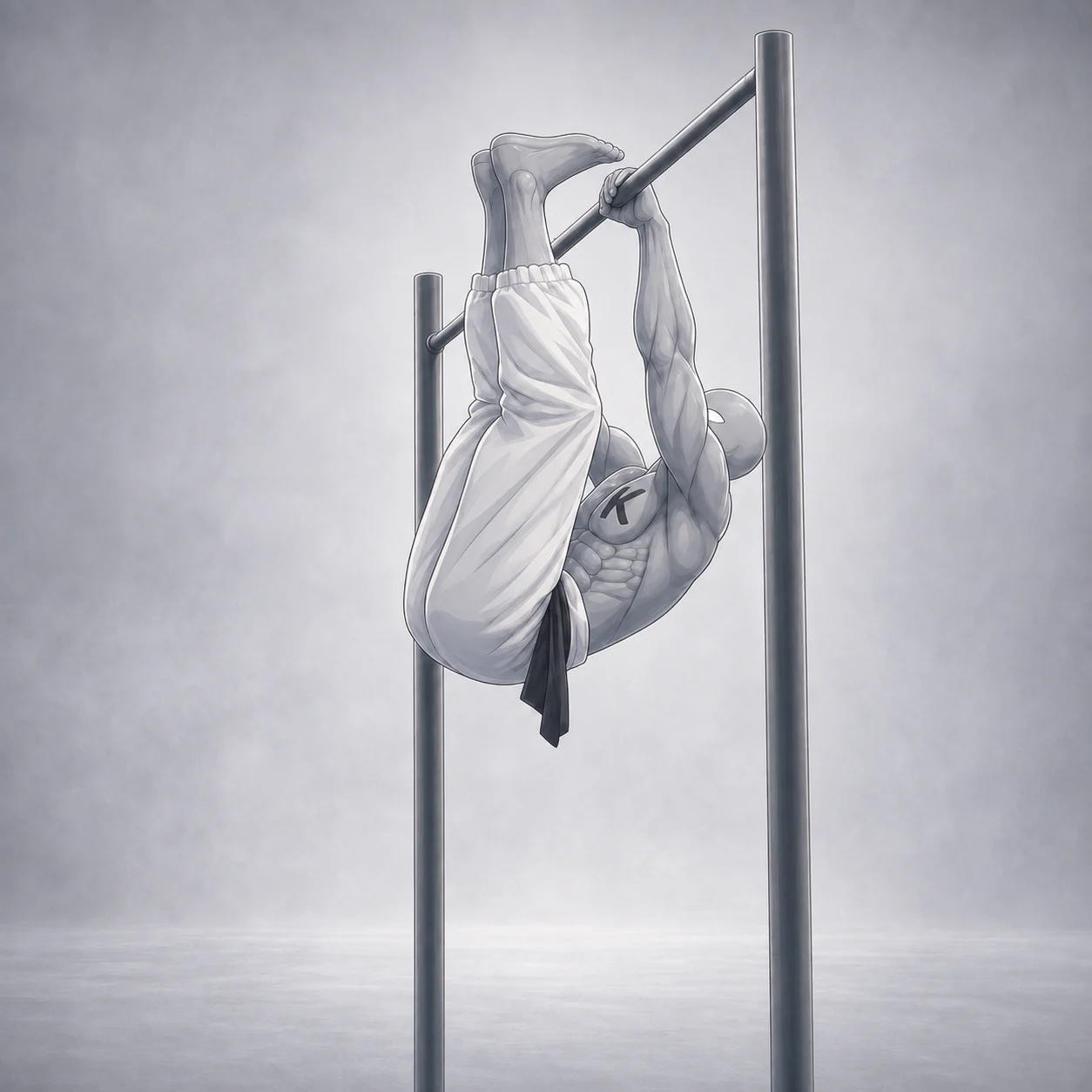
Preview · 0:06
A short look at the whole element in motion.
This is an overview clip, not a technique reference — the form in it may be imperfect. Follow the steps in Technique.
The hanging leg raise to toes-to-bar takes the basic hip-and-spine curling pattern trained by the tuck-up crunch and moves it onto a pull-up bar, adding a grip and shoulder-stability demand on top of the abdominal work. It is a foundational hanging core skill: the same hollow-body control it builds underlies later, harder hanging skills such as the pullover and the vertical flag.
Technique
- Hang from a pull-up bar with a full grip (thumb wrapped around the bar) and arms straight. Set the shoulders down and back and brace the torso into a hollow position before starting the rep.
- Initiate the movement by posteriorly tilting the pelvis and curling the lower abs — do not start by swinging the legs forward from the hips.
- Keep the legs as straight as shoulder and hamstring mobility allow (a slight knee bend is an acceptable regression) and drive both feet up together toward the bar.
- Touch both feet to the bar at the same time, keeping the ribcage drawn down rather than arching the lower back to close the last few centimeters.
- Lower the legs under control back to the hollow starting position instead of dropping them, and reset the hollow brace before the next rep.
Preparation
Before attempting toes to bar, be comfortable with the tuck-up crunch and with simply hanging from a pull-up bar in a hollow position for several seconds without the shoulders shrugging up or the lower back sagging. Learners commonly regress the movement with bent knees (a hanging knee raise) and only straighten the legs once the pelvis-first initiation pattern is consistent, since straightening the legs increases the lever arm on both the abdominals and the hip flexors.
Risks
Treat this as a genuine strength exercise, not a momentum swing: using the hips and lower back to "throw" the legs up largely replaces abdominal work with hip-flexor and lumbar extension effort, and can strain the shoulders if the swing becomes uncontrolled or the grip is lost mid-kip. Straight-leg hanging raises load the lumbar spine and lower abdominal wall heavily, so build the position strictly and controlled before adding speed, and regress to bent knees if the lower back rounds or arches excessively to reach the bar.
Muscles


The rectus abdominis and obliques are the target movers: a controlled trial on the closely related hanging straight-leg raise recorded very high abdominal demand (McGill, Andersen & Cannon, 2014, Journal of Sports Sciences — over 130% MVC in rectus abdominis and 88% MVC in external oblique), which is why core is rated near-maximal here. The hip flexors (iliopsoas, rectus femoris) assist the abdominals in lifting the legs, represented conservatively under quadriceps. Grip endurance loads the forearms, while the shoulders, latissimus, and trapezius work isometrically to keep the shoulder girdle stable and stop the body from swinging, and the lower-back acts as a stabilizer resisting the same spinal loading that the cited study measured.
Stats
- Strength
- 0.00
- Control
- 0.00
- Endurance
- 0.00
- Mobility
- 0.00
- Power
- 0.00
- Balance
- 0.00
This is primarily a strength movement for the abdominal wall and hip flexors, with a large control component because keeping the movement strict — no swinging, synchronized feet, controlled descent — is what separates it from an easier momentum-driven kip. Endurance matters across a working set of reps; power, mobility, and balance play smaller supporting roles.
Completion criteria
Perform a working set of controlled reps (working estimate: around 10) with both feet reaching the bar simultaneously on each rep, hollow body maintained throughout, and no reliance on an uncontrolled kipping swing to generate momentum.
Progression thresholds
- Lower threshold
- 5 reps
- Upper threshold
- 10 reps
These rep thresholds are a product-calibration estimate rather than a measured standard, set relative to the simpler tuck-up crunch that precedes this movement in the tree. Once a set of clean, controlled reps is consistent, the same hollow-hang and pelvis-first pattern is ready to be loaded further in follow-on skills such as the pullover and the vertical flag; if the legs bend excessively or the reps become kip-driven, drop back to a hanging knee raise until control returns.