Element preview
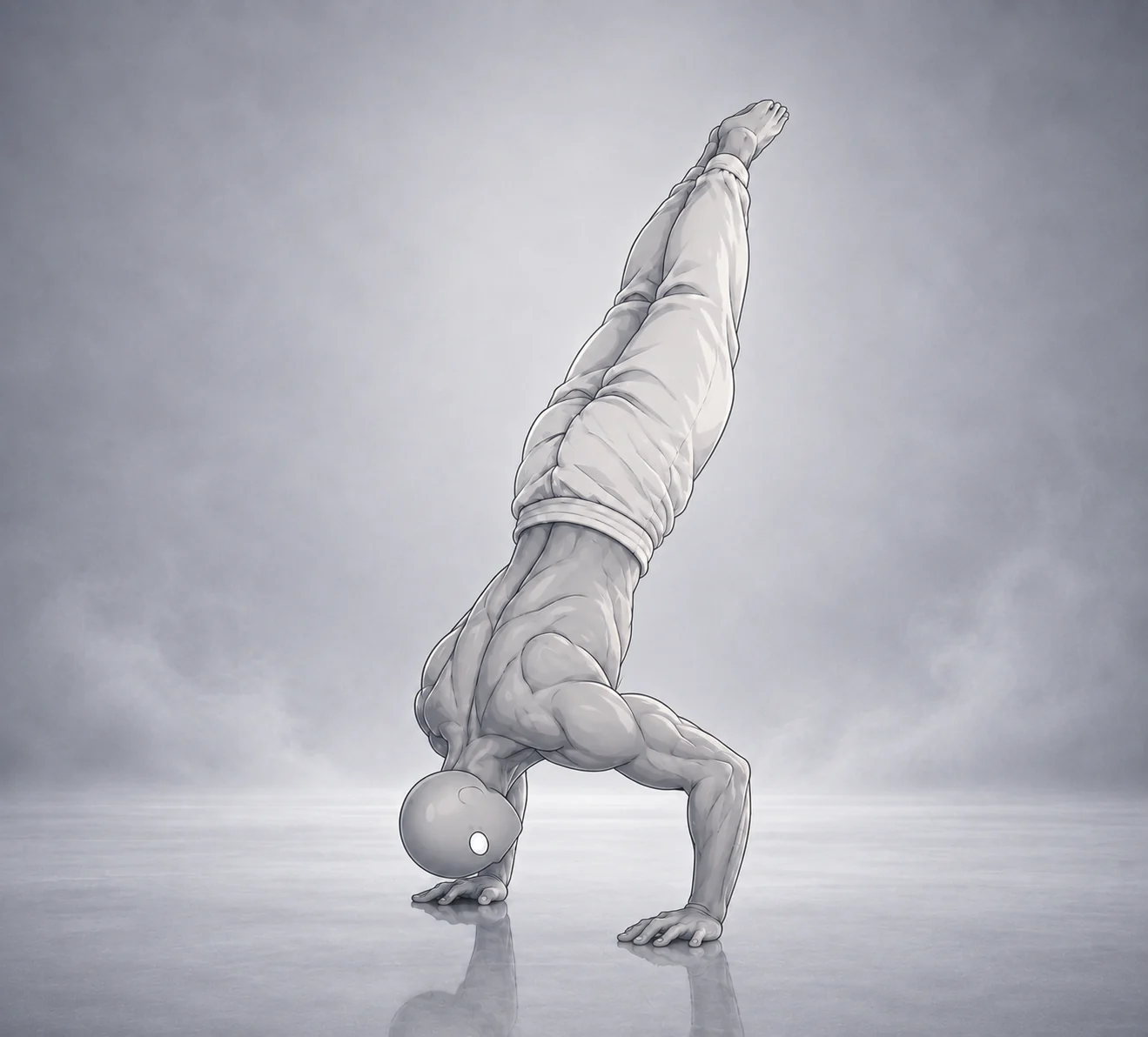
Preview · 0:06
A short look at the whole element in motion.
This is an overview clip, not a technique reference — the form in it may be imperfect. Follow the steps in Technique.
The freestanding handstand push-up takes the overhead press out to its full range of motion while removing the wall as a safety net. Instead of just supporting bodyweight in a handstand, you now have to press the entire body up and down through a full elbow bend while balancing on your hands the whole time — a combination of raw pressing strength and handstand control that few bodyweight movements demand at once.
Technique
- Kick up into a freestanding handstand on parallettes (or another stable raised surface), body fully straight and scapulas elevated.
- Initiate the descent by closing the shoulder angle and bending the elbows, keeping them tracking close to your sides rather than flaring outward.
- Lower under control until your head lightly brushes the floor, keeping the torso and legs in a straight line without arching the lower back.
- Press back up by driving through the shoulders and triceps, re-elevating the scapulas ("earmuffs") to return to the starting handstand position.
Preparation
Risks
Arching the lower back under fatigue is the most common fault — it lets the trapezius and chest take over from the shoulders and triceps, teaches the wrong movement pattern, and loses the core tension needed to stay balanced. Flaring the elbows removes forward-backward control and increases the chance of tipping over. Because the movement is freestanding, a fall is a real risk; only attempt it once you can reliably bail out of a handstand. The wrists absorb the full bodyweight in a pressing position, so build up tolerance gradually and warm up thoroughly.
This movement sits directly on top of the handstand push-up line: it assumes you already own a solid freestanding handstand and have built pressing strength and control through the wall handstand push-up first. Skipping straight to the freestanding version without that base is exactly how the classic faults — back arching and elbow flare — show up under fatigue. Practicing on parallettes (rather than the flat floor) is recommended so your head has room to travel through the full range of motion.
Muscles


The shoulders are the primary mover, driving the press through the full overhead range, with the triceps working hard to extend the elbow from a fully bent position. The core braces isometrically to keep the body in a straight line and resist the back arch that fatigue tends to produce. The chest contributes as the shoulder angle closes near the bottom of the rep. The trapezius helps elevate and depress the scapulas through the movement, while the forearms and hands make the constant fine balance corrections that keep you from tipping. The lower back and glutes work as postural stabilizers to keep the hips from sagging or arching.
Stats
- Strength
- 0.00
- Balance
- 0.00
- Control
- 0.00
- Endurance
- 0.00
- Mobility
- 0.00
- Power
- 0.00
This is primarily a strength movement — pressing full bodyweight through a large range of motion overhead — but it carries a meaningfully higher balance and control demand than a standard press because there is no wall to catch you. Endurance, mobility, and power play smaller supporting roles.
Completion criteria
Perform 5 clean freestanding handstand push-ups on parallettes: full range of motion (head lightly touching the floor each rep), straight body line, no back arch, and no wall assistance.
Progression thresholds
- Lower threshold
- 3 reps
- Upper threshold
- 8 reps
Once you can perform freestanding handstand push-ups for close to 8 clean reps with strict positioning, you're ready to start working toward the rings variation. If you're struggling to complete reps with proper form, drop back to the wall handstand push-up and rebuild strength and control there until you can hit roughly 3 solid reps of the freestanding version consistently.