Element preview
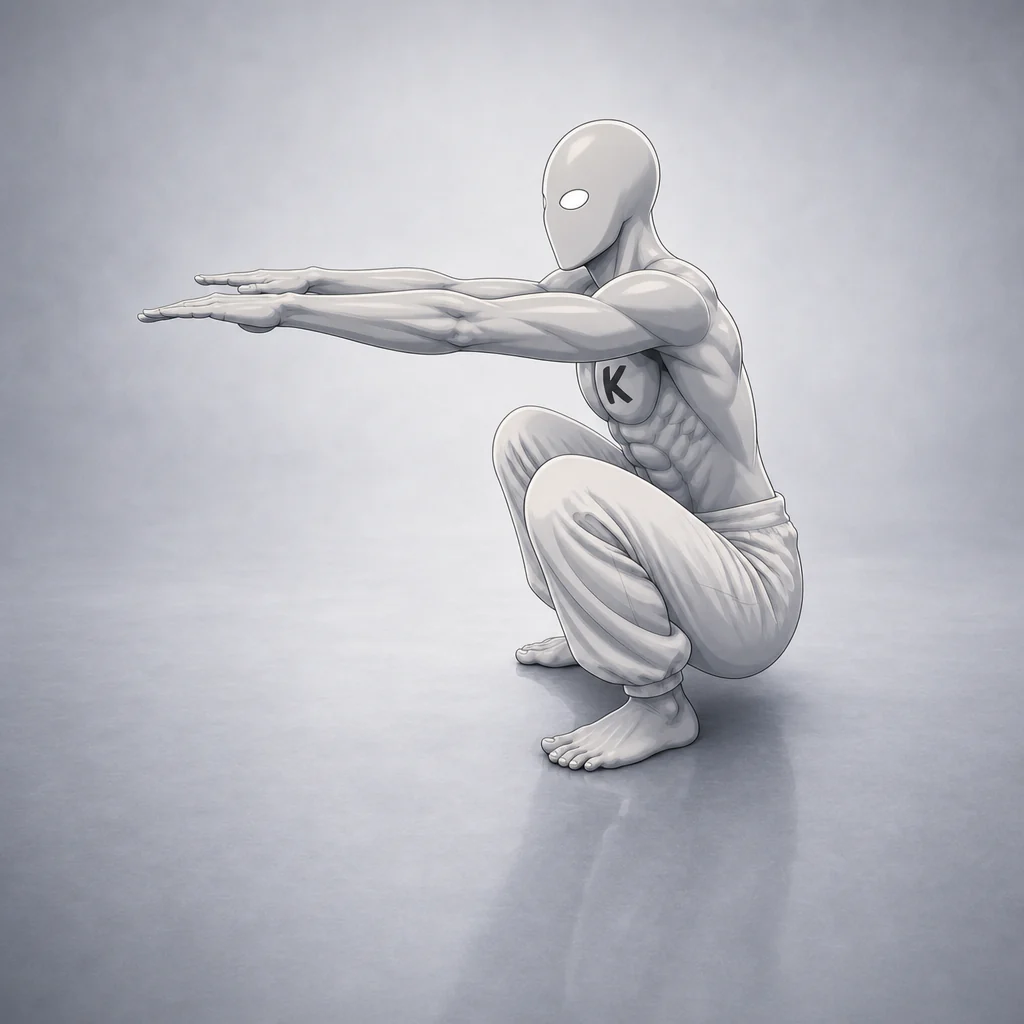
Preview · 0:06
A short look at the whole element in motion.
This is an overview clip, not a technique reference — the form in it may be imperfect. Follow the steps in Technique.
The full squat is the foundational bilateral leg movement of the tree: a deep knee bend that takes the hips below parallel while the spine stays neutral and the heels stay grounded. Some forward torso lean is normal at full depth — the trunk angle naturally mirrors the shin angle to keep the center of mass over the mid-foot — so the goal is a neutral spine, not an upright torso. It builds the base strength, hip and ankle mobility, and motor control that every single-leg and loaded squat variation in this family — split squat, step up, pistol squat — is built on.
Technique
- Stand with feet roughly shoulder-width apart, toes turned out slightly (5-20°).
- Brace the core and set the ribcage over the pelvis before moving — "create tension" before you descend.
- Push the hips back and bend the knees together, letting the knees track in the same direction as the toes.
- Descend until the hip crease drops below the top of the knee (full depth), keeping the heels grounded and the trunk roughly parallel to the shin.
- Keep a neutral, slightly lordotic lower back throughout — avoid rounding at the bottom.
- Drive through the whole foot to stand back up, keeping the knees tracking outward and avoiding inward collapse (valgus).
Preparation
There is no prerequisite movement for the full squat in this tree — it is the entry point for the legs family. The main limiting factor for most beginners is not strength but ankle and hip mobility: if the heels lift or the lower back rounds before reaching full depth, work on ankle dorsiflexion and hip-hinge control at a shallower depth first, then progress the range gradually rather than forcing depth with poor position.
Risks
The main risk factors in a full squat are technique faults, not depth itself: knees collapsing inward (valgus), heels lifting off the floor, and the lower back rounding at the bottom. Some forward trunk lean is normal at full depth, but limited ankle dorsiflexion is a common cause of heel lift and can push that lean to an excess — the chest collapsing forward with the lower back rounding — along with compensatory knee valgus, so build ankle mobility before adding load or range. With controlled technique, squatting to full depth is not inherently harmful to the knee joint.
Muscles


The quadriceps and glutes carry the primary load, extending the knee and hip out of the bottom position. The hamstrings and calves act as secondary stabilizers around the knee and ankle, while the core and lower back work isometrically to keep the trunk braced and the spine neutral throughout the descent and ascent.
Stats
- Strength
- 0.00
- Mobility
- 0.00
- Control
- 0.00
- Endurance
- 0.00
- Power
- 0.00
- Balance
- 0.00
This is primarily a strength movement, with a meaningful mobility demand from the deep range of motion required at the hip and ankle. Balance and control play a smaller supporting role than in single-leg variants, since a bilateral stance is inherently more stable.
Completion criteria
Perform 15-20 controlled bodyweight full squats to full depth (hip crease below the knee) with heels grounded, knees tracking over the toes, and no lower-back rounding.
Progression thresholds
- Lower threshold
- 8 reps
- Upper threshold
- 20 reps
Once bodyweight full squats feel easy and controlled for 20 reps, move on to harder variants such as the split squat or, eventually, single-leg work like the pistol squat. If 8 reps with full depth and good technique is not yet achievable, keep practicing at this level and address any mobility limits before adding difficulty.