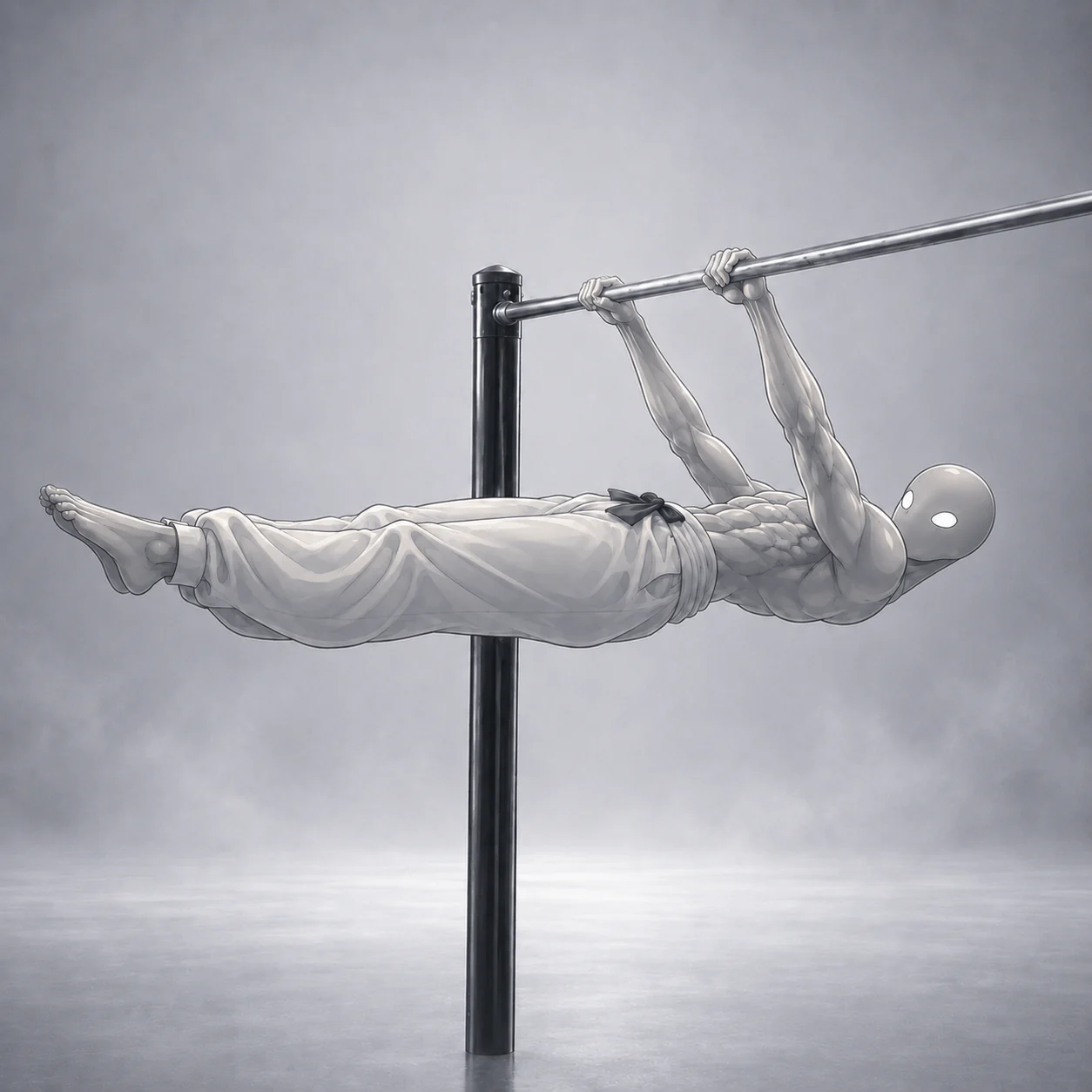
The front lever is a straight-arm, straight-body static hold performed face-down and horizontal: you hang from a bar or rings, then pull your entire body up until it is parallel to the floor, back facing up and chest facing down, arms fully extended overhead. It is trained as a direct continuation of the back lever and is rated among the harder static strength elements in gymnastics scoring, since the lats are held in a lengthened position and the chest in a shortened one — a range where neither muscle group produces its peak force, which is part of why the full hold takes sustained, progressive training to reach.
Technique
- Start from a straight-arm dead hang on a pull-up bar or rings, using a pronated or parallel grip.
- Pull your body up and forward into a horizontal line, keeping your back facing up and your chest facing the floor.
- Actively pull your shoulder blades down and together (depressed, neutral) rather than letting them ride up toward your ears — this "packed shoulder" position is what lets the lats and chest carry the hold instead of the shoulder joint alone.
- Level your hips with your shoulders and keep your legs, hips, and torso in one straight line, toes pointed, with the arms staying straight throughout.
- Brace your entire body — core, glutes, hamstrings, and quads — to resist the hips sagging down and to keep the line rigid under load.
- Gently drive your hands toward your hips to keep tension through the lats and maintain the position, then lower back to a hang with control rather than dropping.
Preparation
The front lever is never attempted directly — it is built through a long progression: tuck front lever, then advanced tuck (knees at ninety degrees, then straightened further), then straddle, then half-lay or one-leg-out, and finally the full layout with the legs together. Grip can be parallel or pronated at the earlier stages; either works, and a pronated grip has the practical advantage of working on almost any bar, ledge, or door frame.
At every stage, the same scapular cue applies: actively pull the shoulder blades down and together until they sit depressed and neutral, rather than letting them stay depressed and protracted (rounded forward). This is the single most common technical breakdown across all front lever progressions, so it is worth grooving from the very first tuck rep. Before attempting the full layout, you should be comfortable holding the straddle or half-lay variation for time with a flat torso and no hip sag — these faults only get harder to correct the longer they are practiced.
Risks
The most common technique fault at every stage of the front lever — from tuck through full layout — is letting the chest round and the shoulders creep forward instead of staying depressed and neutral. This "cheats" the hold into an easier but structurally unstable position and can reinforce poor scapular habits that carry into later straight-arm skills. Build the position with a mirror, camera, or a partner check rather than trusting how the hold feels.
Rings and other still-rings-style strength holds place sustained load through the shoulder, and shoulder complaints are a commonly reported issue in ring-based strength training, typically linked to fatigue or breakdowns in technique rather than the hold itself; this pattern comes from ring elements more broadly rather than a front-lever-specific study, so treat it as a general caution rather than a precise injury rate for this skill. Progress through the tuck, advanced tuck, straddle, and half-lay/one-leg-out stages before attempting the full layout, keep sessions short enough that form does not break down from fatigue, and back off if you feel joint pain rather than only muscle fatigue.
A straddle or wide-leg position under load can also trigger hip-region cramping in beginners who have not yet trained a straddle hold under tension; this is uncomfortable but not dangerous, and settling back into position after a cramp is the expected response rather than a sign to stop training the skill.
Muscles
- Latissimus Dorsi0%— show exercises
- Shoulders0%— show exercises
- Chest0%— show exercises
- Core0%— show exercises
- Biceps0%— show exercises
- Trapezius0%— show exercises
- Glutes0%— show exercises
- Forearms0%— show exercises
- Hamstrings0%— show exercises
- Quadriceps0%— show exercises
- Lower Back0%— show exercises
- Hands0%— show exercises
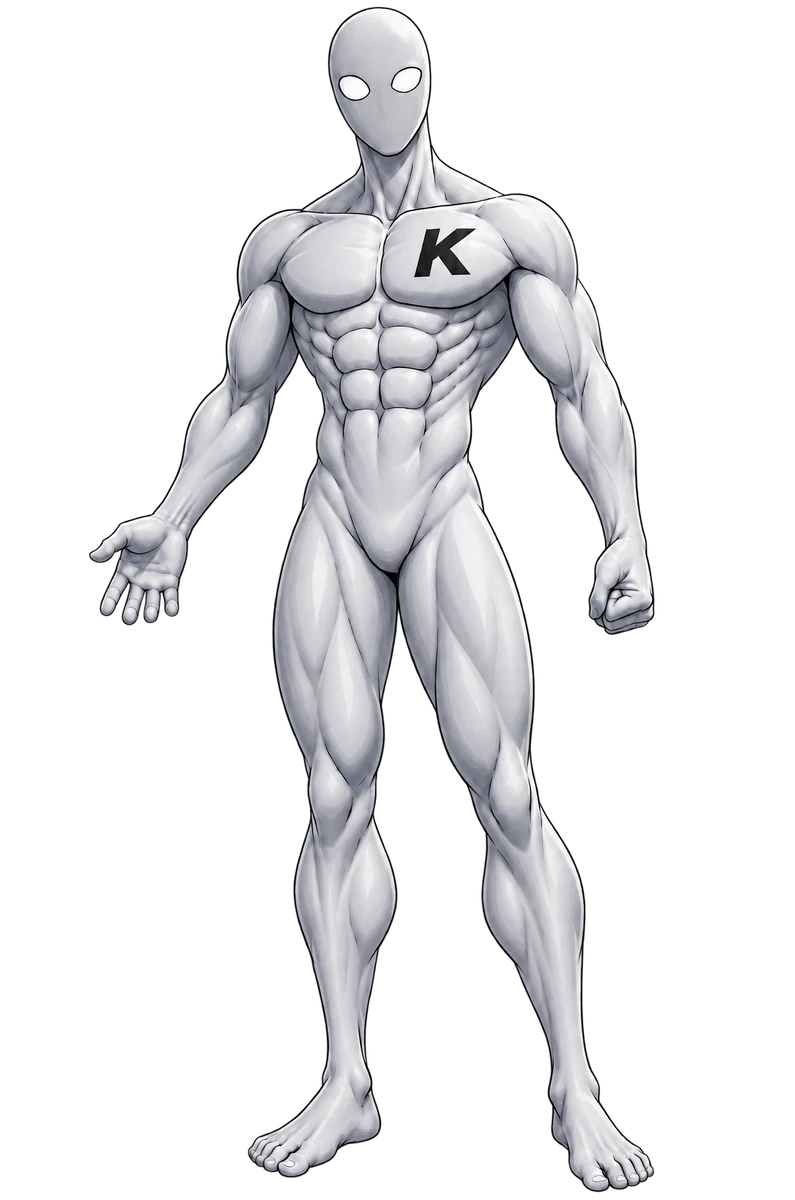
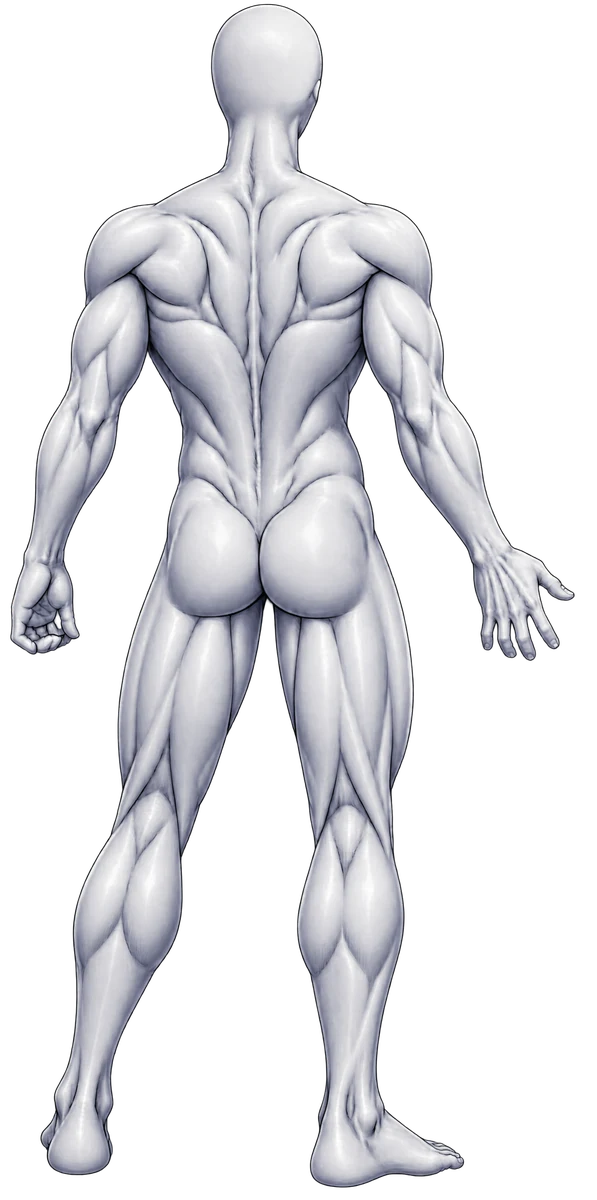
Pulling the shoulders into extension and holding the body horizontal against gravity is driven mainly by the latissimus dorsi, with the chest (lower pectoral fibers) assisting. The shoulders and trapezius work hard to keep the scapulae depressed and retracted under constant isometric load, which is why shoulder fatigue and technique breakdown — not raw lat strength — is usually the limiting factor once the straddle stage is passed. The biceps help keep the elbows locked straight under a pronated or parallel grip, though the load here is lighter than in a supinated hold like the back lever. The core works hardest of all the stabilizers, bracing to stop the hips from sagging, while the glutes, hamstrings, quads, and lower back keep the legs and hips locked into the same straight line, and the forearms and hands manage grip.
Stats
- Strength
- 0.00
- Control
- 0.00
- Endurance
- 0.00
- Mobility
- 0.00
- Balance
- 0.00
- Power
- 0.00
This is a total-body isometric strength hold, so strength dominates. Control is the clear secondary demand, since the whole skill lives or dies on precise scapular positioning and resisting hip sag rather than on raw pulling force alone. Endurance matters for sustaining the hold once the position is found, with mobility playing a supporting role because the lats must tolerate working from a lengthened position. Balance and power are only minor contributors.
Completion criteria
Hold a straight-body, legs-together front lever — shoulders, hips, knees, and ankles in one line, chest down, scapulae depressed and neutral, toes pointed — for the target time below without the chest rounding, the hips sagging, or the knees bending.
Progression thresholds
- Lower threshold
- 6 s
- Upper threshold
- 15 s
Once you can hold a clean full front lever for the target time above, you have the strength base to move on to dynamic straight-arm pulling work such as front lever pull-to-inverted-hang, front lever rows, or combination holds like the 360° pull. If you cannot yet hold the full position cleanly for the lower threshold, drop back to the half-lay or straddle front lever and rebuild time there — along with supplementary work like dragon flags for the core and straight-arm strength — before retrying the full position.