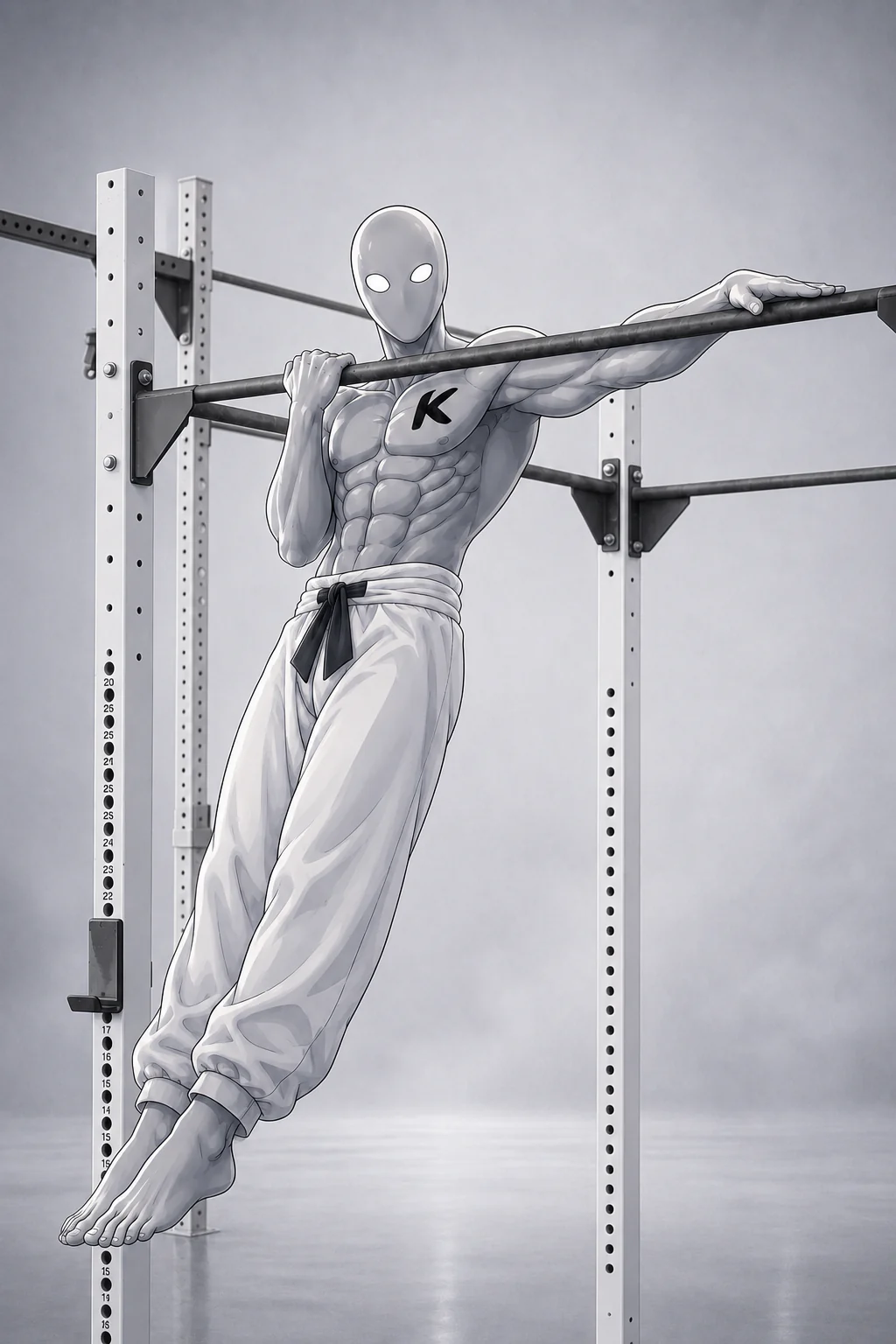
The archer pull-up is an asymmetric ring pull-up: one arm bends to lift most of the body while the other stays straight and travels outward. The straight arm still contributes, but the shape shifts much more of the demand to the pulling side, making the movement a practical bridge between two-arm pull-ups and one-arm pulling work. This article describes the ring version, whose freely rotating handles let each shoulder and wrist find a workable path.
Technique
- Set two rings at equal height and take a pronated or neutral grip. Begin in a controlled dead hang with both elbows straight.
- Initiate the repetition by drawing the shoulder blades down, then choose the side you will pull toward.
- Bend the pulling arm as in a strict pull-up while keeping the other elbow straight. Guide the straight arm outward until it approaches a cross-like position.
- Continue without kipping until the pulling-side ring reaches the upper chest or shoulder area. Keep the trunk braced and let the rings rotate naturally rather than forcing a fixed wrist angle.
- Reverse the path under control to a two-arm hang. Repeat toward the other side with the same range of motion and tempo.
Preparation
Equipment and conditions
Use a securely anchored pair of height-matched rings with enough overhead and lateral clearance to reach a dead hang and extend one arm to the side. A box may be used only to enter or leave the start position safely.
Build a strict pull-up through a full, repeatable range before adding the archer shape. On rings, first become comfortable initiating from the shoulder blades, pulling without leg drive, and lowering to a controlled hang. Wide ring pull-ups or partially assisted archer repetitions can introduce the lateral arm path without forcing the full load shift. Train both directions even when one side is stronger.
Risks
The wide, asymmetric position can provoke shoulder discomfort, particularly as the rotator-cuff and scapular muscles fatigue. Practice the movement while fresh, keep the straight arm active rather than hanging passively from the joint, and stop if the position causes pain. Regress to strict ring pull-ups or a less-wide assisted archer pull if you cannot control the descent.
Muscles


The bent side supplies most of the vertical pull through the latissimus and elbow flexors. The straight side remains active as the arm moves outward, increasing the demand on the shoulder girdle. Forearm and hand tension secure the rings, while the trapezius and other scapular muscles organize the shoulder blades. The core limits swinging and unwanted trunk rotation; the chest and triceps assist the straight-arm position.
Stats
- Strength
- 0.00
- Control
- 0.00
- Endurance
- 0.00
- Balance
- 0.00
- Mobility
- 0.00
- Power
- 0.00
Strength dominates because the exercise deliberately concentrates bodyweight onto one bent arm. Control is the main secondary quality: the athlete must coordinate two different arm actions, manage the moving rings, and keep the torso quiet. Endurance and balance matter, but speed is not the objective of a strict repetition.
Building toward one-arm pulling
Make the movement harder by reducing how much the straight arm contributes while preserving the same controlled path. If the straight elbow bends, the torso swings, or the descent collapses, restore assistance or return to strict ring pull-ups rather than shortening the range.
Completion criteria
Perform one controlled repetition to each side from a dead hang, keeping the assisting elbow straight, avoiding a kip, and returning to the same stable bottom position. Both sides should show comparable range and control before you progress toward more one-arm-dominant pulling.