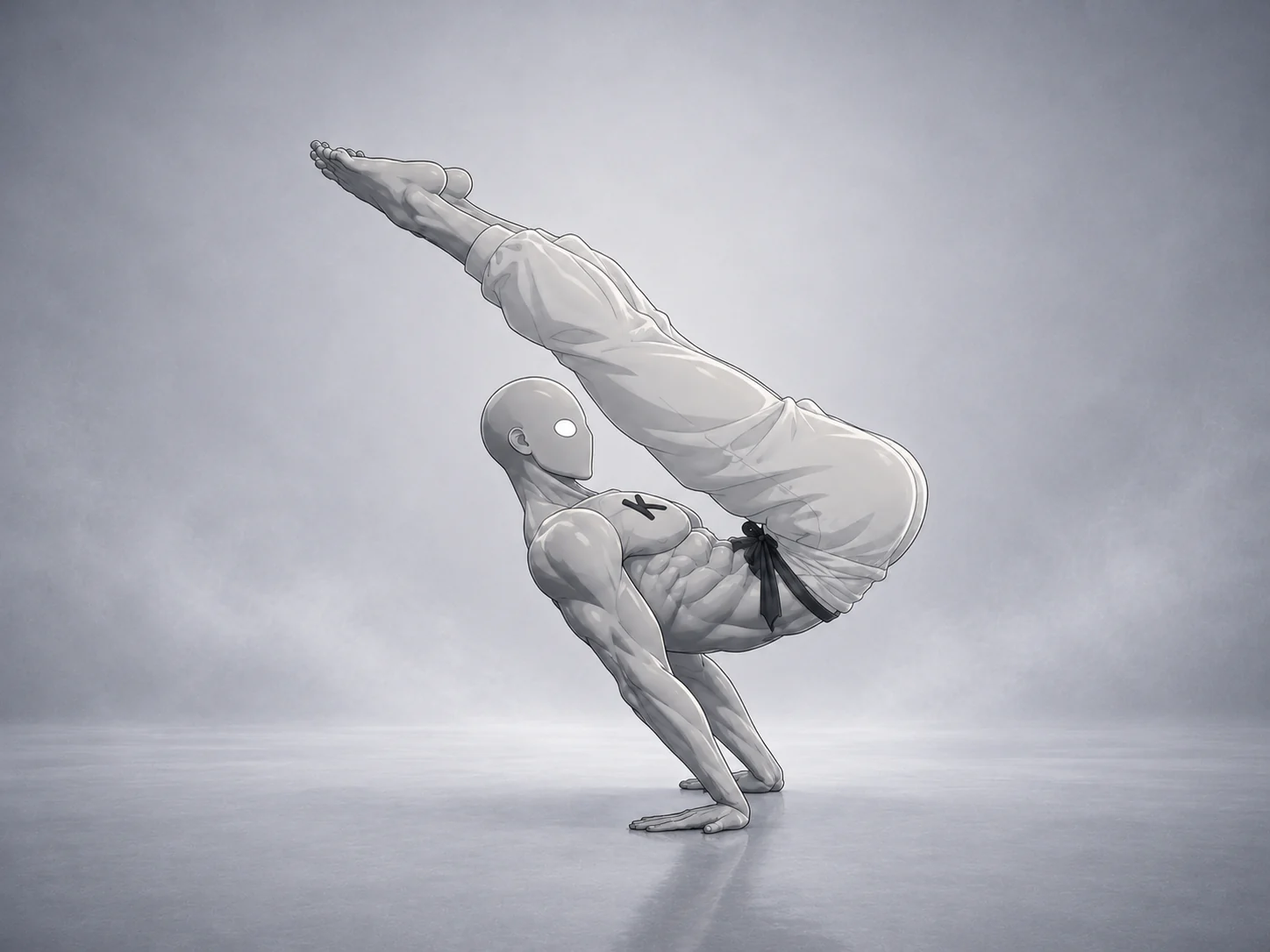
The 140 V-sit is a high straight-arm support in the V-sit-to-manna pathway. From the locked prerequisite 90 V-sit, the athlete raises the straight legs farther and moves the hips forward and upward while supporting body weight through the hands. In this tree, the number names the visual target position; it is a deliberately demanding intermediate shape on the way toward the later high V-sit and manna positions.
Technique
- Use a clear, firm floor or rigid, stable parallel bars. Warm the wrists, shoulders, and active pike-compression range before loading the full position.
- Start from a controlled 90* V-sit: hands beside or slightly behind the hips, elbows locked, legs together and straight, and the hips clear of the support.
- Press continuously down through the hands. Keep the shoulder blades active and the elbows straight while the pelvis travels forward and upward; do not try to gain height by bending the arms.
- Keep the knees locked and toes pointed as you actively compress the thighs toward the torso. Continue only as far as you can match the 140* leg position shown for this skill-tree node without losing hip clearance or control.
- Hold the position with steady breathing. End the attempt when the elbows bend, the hips sink, the knees bend, or the shape falls short of the intended line.
- Return through the 90* V-sit under control before setting the feet down. Do not drop out of the position or force a deeper shoulder range.
Preparation
Equipment and conditions
- A clear, firm, non-slip floor, or rigid parallel bars that do not move under straight-arm support.
- Enough clearance to lower the feet safely and to keep the hips off the support.
- A movement-specific warm-up for the wrists, shoulders, and active pike-compression range.
The prerequisite is the 90* V-sit. First make that position repeatable with locked elbows, hip clearance, straight knees, and quiet breathing. The 140* position should be built by adding range while the same landmarks remain intact, not by throwing the torso backward or bending the arms to lift the legs.
Two qualities usually limit the next range: active compression to keep the thighs close to the torso, and the shoulder range and straight-arm support strength to move the hips forward without sinking. Use lower-angle V-sit holds, controlled tucked versions, and seated compression lifts to keep working those qualities. A camera view from the side is useful for comparing each attempt with the operator-provided visual target.
Risks
This is a high-load straight-arm support for the wrists, shoulders, and elbows. Build the range from the locked 90* V-sit and use a stable surface with clear space to lower the feet. Stop the attempt rather than forcing the angle if the shoulders elevate uncontrollably, the elbows bend, or the wrists, shoulders, or elbows become painful.
Keep the knees straight only while the pelvis remains supported and the hips stay clear. A bent-knee, lower-angle hold is an appropriate regression; forcing a deeper angle after the shape has broken adds load without practicing the target position.
Muscles


The core creates the compression that keeps the straight legs high, while the quadriceps help preserve locked knees and the lower back contributes modestly to trunk organization. The triceps, shoulders, chest, and shoulder-blade muscles maintain the straight-arm support as the hips move forward and upward. Hands and forearms distribute pressure at the base of support. These values are conservative product estimates based on the position's visible joint actions, not V-sit-specific EMG measurements.
Stats
- Strength
- 0.00
- Mobility
- 0.00
- Control
- 0.00
- Endurance
- 0.00
- Balance
- 0.00
- Power
- 0.00
Strength is dominant because the arms and trunk must sustain body weight in a long-lever straight-arm support. Mobility is the main secondary demand: a deeper position requires enough active pike compression and shoulder range to reach the target without substituting a bent-arm or sinking hold. Control and endurance matter for keeping the hip, knee, and shoulder landmarks consistent; balance and power play smaller roles in the strict static version. These stat weights are product-calibration estimates.
Completion criteria
Product completion estimate: hold the 140 V-sit shape for 5 seconds with straight elbows, hips clear of the support, straight knees, and a controlled entry and exit through the 90 V-sit. The 140* label identifies the visual target used by this skill tree.
Progression thresholds
- Lower threshold
- 2 s
- Upper threshold
- 8 s
The 8-second upward and 2-second downward checkpoints are product-calibration estimates, not universal standards. At 8 clean seconds, begin cautiously exploring the next prescribed high-V-sit position while preserving straight elbows and hip clearance. If you cannot establish about 2 clean seconds at the 140 target, return to the 90 V-sit or a tucked, lower-angle version and rebuild compression and support quality before adding range.